Choosing between chucks and collets starts with your workpiece and production requirements. Part shape, gripping diameter, tolerances and batch size help determine how you need to hold and locate each component. This guide explains how to compare gripping range, accuracy, changeovers and machine compatibility so you can prepare a clear workholding specification before requesting a machine quotation.
What Is a Jaw Chuck?
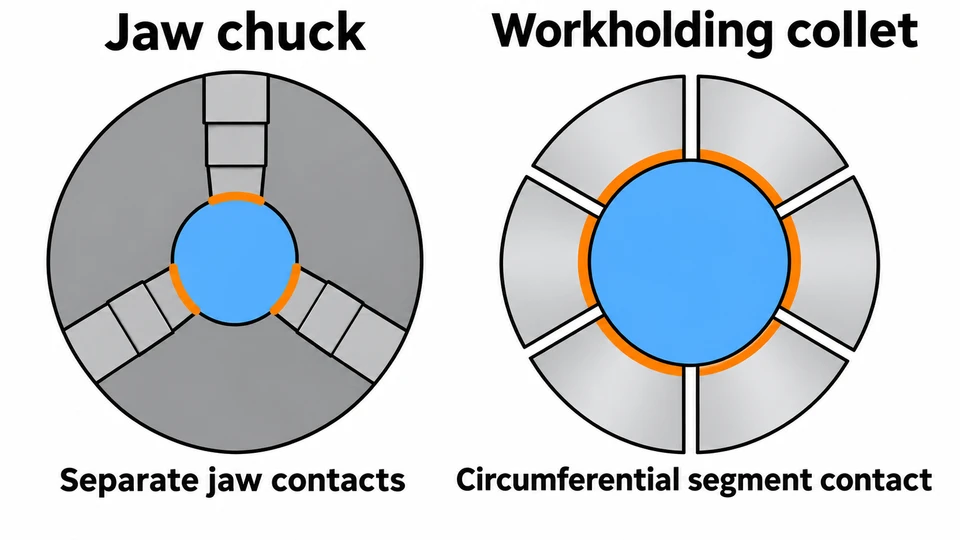
A jaw chuck is a workholding device that uses separate movable jaws to grip a component on a lathe. The jaws secure the workpiece while the spindle rotates it for machining. In this comparison, ‘chuck’ means a jaw chuck; a collet also needs a compatible chuck or closing mechanism to operate.
A common three-jaw self-centering chuck moves its jaws together to center suitable stock. An independent four-jaw chuck lets you adjust each jaw separately, which can help you position irregular workpieces or align a particular feature with the spindle axis. These designs offer different capabilities, so the chuck type matters as much as the number of jaws.
Advantages of Jaw Chucks
- High Holding Power. A suitably sized power chuck can provide a strong grip for demanding turning cuts. The chuck, actuator, jaw setup and operating speed determine the available holding force.
- Versatility. A jaw chuck can handle different gripping diameters and blank shapes with suitable jaws. Repositioning, replacing or machining the jaws lets you adapt the setup as jobs change.
- Accurate Part Location. Properly bored soft jaws can locate a finished diameter and support a shoulder for repeatable second-operation work. Careful jaw preparation and reliable seating help you maintain that accuracy.
What Is a Collet?
A workholding collet is a slotted sleeve or segmented clamping head that closes around a matching section of a workpiece. It operates inside a compatible collet chuck. In many designs, axial movement against a taper makes the gripping segments close radially. Conventional slotted collets and segmented clamping heads have different designs, so select the actual system before deciding what stock it can accept. Round, square, hexagonal and custom profiles are available in suitable systems. The HAINBUCH clamping-head options, for example, include designs for raw material, finished material and special profiles.
Specify workholding collets separately from toolholding collets. A workholding collet grips the part; toolholding collets, such as the REGO-FIX ER system used with drills or milling cutters, grip the cutting tool.
Advantages of Collets
- Precision and Repeatability. A correctly matched precision collet can repeatedly center consistent stock as parts are loaded or bar is advanced. This helps maintain part-to-part consistency when collet fit, stock condition and installation are controlled.
- High-Speed Capability. Suitable CNC collet systems are less affected by centrifugal force than conventional jaw chucks, helping them maintain grip at higher speeds. The permitted speed depends on the selected chuck, collet, workpiece and installation.
- Reduced Risk of Part Distortion. A well-matched collet can spread gripping force around a thin-walled workpiece, reducing concentrated loading and the risk of deformation. The benefit depends on contact fit, gripping force and part stiffness.
- Efficient Repeated Loading. Powered collet systems designed for rapid opening and closing can reduce handling time in repeated loading or bar-fed production. Match the chuck mechanism to the loading cycle and stock dimensions to realize that benefit.
What Are the Key Differences Between Chucks and Collets?
A jaw chuck offers more flexibility across changing workpiece sizes, while a precision collet is usually the better choice for repeatable machining of consistent stock. The table shows typical CNC turning differences, using general-purpose hard jaws as the baseline for chuck centering.
| Comparison | Jaw Chuck | Precision Collet |
|---|---|---|
| Gripping diameter range | Broader coverage through jaw adjustment and repositioning. | Narrower range per collet; change collets when the stock moves outside that range. |
| Centering after reloading | Lower repeatability with general-purpose hard jaws; bored soft jaws improve it. | More consistent centering of repeated parts with correctly sized gripping surfaces. |
| Preparing a precision grip | Bore soft jaws to the required gripping diameter and locating profile. | Fit a matching precision collet; no soft-jaw boring is needed. |
| Grip at high spindle speeds | Jaw centrifugal force reduces the available external gripping force as speed rises. | Less affected by centrifugal force, helping preserve grip during high-speed turning. |
| Thin-walled parts | Localized jaw pressure raises the risk of deformation at the contact areas. | A fitted collet spreads the load around the part, reducing local deformation risk. |
| Tool access | Projecting jaws restrict tool access close to the gripping area. | A compact collet nose leaves more room for machining close to the grip. |
| Best-suited production | Varied gripping diameters, individual blanks and a changing mix of jobs. | Repeated parts with consistent gripping dimensions and bar-fed production. |
Gripping Range and Workpiece Variety
A chuck’s overall gripping range and its jaw stroke describe different things. Covering the full range may require repositioning, changing or machining the jaws. Ask how much variation the setup can accept between consecutive parts without a changeover.
For a collet, identify the permitted gripping range for the specific collet design. Include the actual variation of the supplied stock, its roundness and its surface condition. A nominal bar diameter alone is insufficient information. If you run several diameters, include the required collets and changeover method in the quotation.
Accuracy and Repeatability
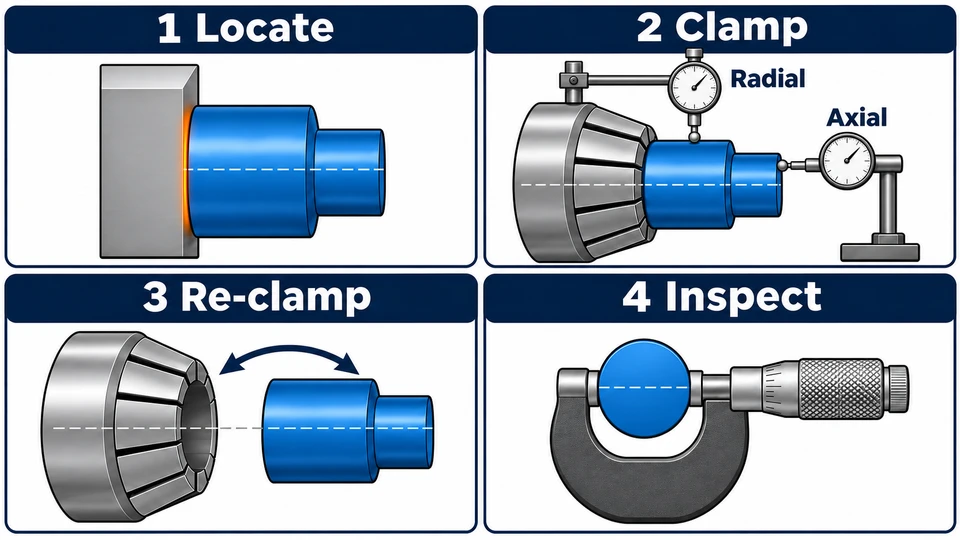
For consistent, correctly sized round stock, a matched precision collet usually provides more repeatable centering than general-purpose hard jaws. A jaw chuck can also provide accurate re-clamping when its soft jaws are bored to locate the finished diameter and seat a shoulder. For a second operation, compare how each setup locates the part from those finished surfaces.
Soft-jaw preparation affects the result; the Kitagawa BR chuck manual gives product-specific forming instructions. For either system, compare runout in machining at the feature that matters on your drawing, using the proposed workpiece and setup.
A pullback collet can draw the workpiece backward as it closes. A dead-length design keeps the collet’s axial position fixed during closure, as shown in Royal’s explanation of collet closing mechanisms. This difference matters when overall length, shoulder location or transfer to a second spindle depends on consistent part position.
With a jaw chuck, a shoulder seat or stop can provide axial location. In either system, reliable seating matters. Compare radial runout and repeatability along the spindle separately when your drawing makes both critical.
Gripping Contact and Part Distortion
Separate jaws apply force through their contact areas; a collet closes around a matching profile through its gripping segments. The useful comparison is the contact and support each proposed setup provides for your part. A long overhang or short gripping length needs attention with either system.
Thin-walled sleeves and finished surfaces require attention to how force reaches the part. A suitable collet or other broad-contact arrangement may distribute the load effectively. Purpose-made jaws can also increase support. Compare the component while clamped and after release to identify distortion that could otherwise be hidden during machining.
Changeovers and Production Efficiency
A jaw chuck may cover a varied job mix through different jaw setups, while a collet system can suit repeated production of parts with consistent gripping dimensions. Changing jobs may require jaw preparation for one option or a different collet for the other. Neither system guarantees the shortest changeover for every part.
For recurring jobs, record setup preparation, changeover, first-piece inspection, loading and unloading, and the expected machining cycle. Include the cost of jaws or collets, stops, connectors and replacement gripping elements. Divide the setup effort across the planned batch. A quick changeover matters most when it removes a real constraint in your schedule.
When Should You Choose a Jaw Chuck?
Choose a jaw chuck when your work varies in size or shape, or when the component needs a grip and locating surface tailored to its geometry. For example, a workshop alternating between individual blanks of different diameters may find suitable jaw setups more practical than maintaining a collet for every gripping size.
A jaw chuck is also worth considering when you must turn a flange or stepped component around for a second operation. Soft jaws can be prepared to grip a finished diameter and support a shoulder, helping you locate the part from features already machined.
For irregular blanks or work that needs individual adjustment to align a particular feature, evaluate an independent four-jaw chuck. Castings and forgings still need reliable gripping surfaces and an appropriate contact design. Confirm that the proposed chuck, jaws and loading method suit the machine and machining operation.
When Should You Choose a Collet?
Choose a collet when you repeatedly machine stock or parts with a suitable, consistent gripping section and the actual size variation stays within the selected system’s permitted range. Recurring batches of round pins, bushes or similar turned components are useful starting points for evaluating this option.
A collet can be attractive for repeated bar-fed work or when the cutting tool needs access close to the gripping area. Check the bar passage and the space around the actual collet nose. For a finished component loaded for another operation, match the gripping profile to the surface you intend to locate from.
Thin-walled parts may also benefit from an appropriate collet contact arrangement, but verify the dimensions after release before choosing it. If raw stock varies substantially, has an unsuitable surface or needs a special profile, ask for a clamping head designed for those conditions. A nominal diameter match alone does not establish suitability.
What Should You Confirm Before Ordering?
Specify the workpiece, the machine connection and the acceptance checks together. When comparing CNC turning centers, ask the supplier to identify the workholding included in the proposed configuration and the options required for your parts.
Use the same drawing, material, stock tolerances and batch sizes for both proposals. Ask the supplier to complete each applicable option and provide the evidence in the last column. Include each spindle and the loading system in the compatibility review.
| Workpiece requirement | Jaw chuck proposal | Collet proposal | Evidence to confirm |
|---|---|---|---|
| Stock shape, diameter variation and available gripping length | Jaw type, contact profile and usable range | Collet series, profile and permitted range | Fit and contact checks using representative stock |
| Drawing datums and accuracy after reclamping | Locating surfaces, jaw preparation and stop arrangement | Locating surfaces, closing motion and stop arrangement | Separate radial and axial measurements after repeated loading |
| Thin walls or finished gripping surfaces | Contact area and proposed part support | Contact length and suitable gripping profile | Clamped and released dimensions; surface inspection |
| Machine interface and working space | Mounting, drawtube connection and jaw clearance | Mounting, drawtube connection and collet-body clearance | Compatibility drawing, actuator force and stroke limits, and interference checks |
| Machining sequence, batch size and changeovers | Jaw changes, loading method and included equipment | Collet changes, loading method and included equipment | Trial-cut results, measured changeover time and itemized quotation |
With bar feeding, check that the feeder, liners, spindle passage, drawtube and workholding accommodate your stock. For robot-loaded blanks, check gripper access, seating and clamping confirmation with representative parts.
Confirm the permitted speed, gripping force, actuator stroke and clearances for the installed assembly. An externally gripping jaw chuck can lose available gripping force as speed increases. The machine’s maximum spindle speed alone does not establish the workholding limit.
Kitagawa’s gripping-force guidance explains that reducing cylinder thrust to limit deformation also reduces holding force. Have the proposed conditions checked against the chuck, actuator and machine instructions, then verified by trial cutting.
Ask for the configuration and verification conditions in writing. During the trial, evaluate the complete machining sequence, including any second setup. Keep the measured outcome tied to the tested workpiece and configuration so that subsequent changes can be reviewed.
Ask for released-part dimensions measured according to the instrument manufacturer’s method, such as the Mitutoyo micrometer instructions.
FAQs
Can the same CNC lathe use both a jaw chuck and a collet chuck?
Yes, when both are compatible with the machine. You can exchange complete chuck assemblies or use a modular system designed for jaw and collet workholding. If you expect to switch frequently, compare the changeover method and required conversion components before choosing the system.
Can you reuse existing collets in a new collet chuck?
You can reuse them when their series, external geometry and closing arrangement are compatible with the new collet chuck. Confirm the permitted gripping range with the supplier as well. A collet’s marked bore size describes only one part of the fit, so provide the exact identification of your existing collets when requesting a compatible system.
Can you hold a part by its bore?
Yes. If external gripping would obstruct the surfaces you need to machine, consider internal-gripping jaws or an expanding mandrel. The bore then becomes the gripping and locating surface, so its condition and contact length, together with the part’s ability to withstand clamping force, become key selection factors.
What if no standard collet fits your part?
Consider a custom collet or a machinable emergency collet as alternatives to custom jaws. Emergency collets are designed to be machined to the required gripping size or profile. Confirm availability for your collet chuck and follow the manufacturer’s machining limits.
Conclusion
Chucks and collets use different gripping designs to achieve the same goal: holding the workpiece securely and consistently during machining. Choosing between chucks and collets is part of specifying a complete CNC turning setup. Make the workholding decision alongside the machine configuration so the quotation reflects the production job you need to run.
If you are planning a CNC turning project, contact ROSNOK with a drawing you can share and your production requirements. We can review the machine and workholding together and discuss a suitable configuration before quotation.