This microscopic texture affects how a component behaves in real operating conditions. It influences friction, wear resistance, sealing performance, fatigue strength, coating adhesion, and overall service life. In manufacturing, the correct surface roughness helps prevent leakage, unstable fitting, excessive wear, and unnecessary machining cost, making it a practical quality factor rather than a simple appearance detail.
To understand surface roughness correctly, one must look beyond the number on a drawing. This guide breaks down what the value means, how it is measured, what changes it during machining, and how better surface control leads to more reliable parts.
What Is Surface Roughness?
In precision manufacturing, surface roughness refers to the fine, microscopic irregularities left on a machined surface after material removal. When a tool or abrasive interacts with a workpiece, it leaves behind a continuous pattern of minute peaks and valleys. This micro-geometric topography is what engineers define as surface roughness.
In machining, surface roughness is one part of overall surface texture. It focuses on the fine, closely spaced surface variations, not larger shape errors or broad waves on the surface. This is why surface roughness should not be judged only by appearance. A bright surface may still have poor roughness, while a dull-looking surface may meet the required roughness value.
Surface roughness is usually expressed by parameters such as Ra, Rz, Rq, and Rt. Among them, Ra is the most commonly used value on engineering drawings because it gives a simple average of surface height variations. However, surface roughness is not just a number. It is a technical way to describe whether a machined surface is suitable for its intended function.
For example, a sealing surface, a sliding surface, and a general structural surface may all require different roughness levels. The correct surface roughness depends on how the part will be used, how it will contact other components, and what performance the final product must achieve.
In simple terms, surface roughness is a measurable surface quality characteristic. It helps manufacturers, engineers, and buyers understand the real condition of a finished surface beyond visual smoothness.
Surface Roughness vs Surface Finish vs Surface Texture
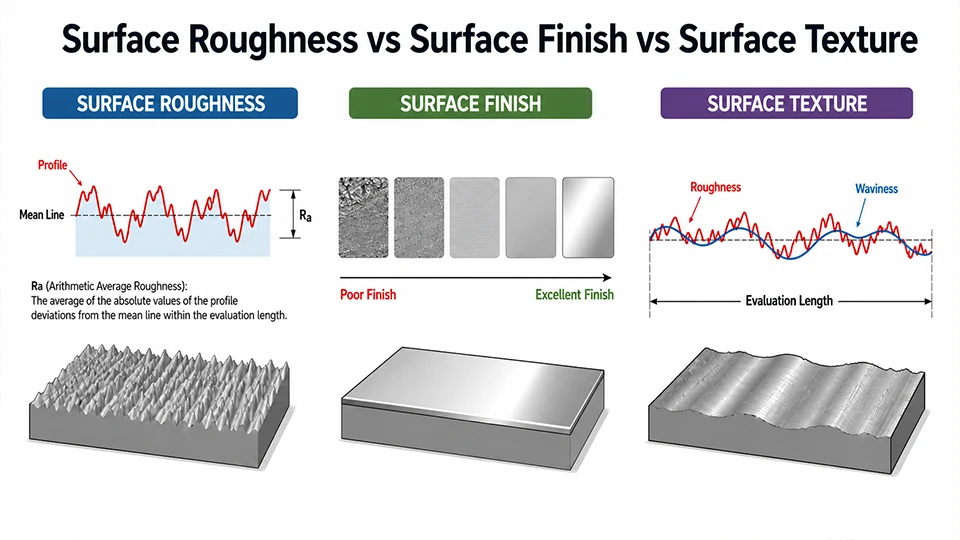
Surface roughness is often confused with surface finish and surface texture, but these terms do not mean exactly the same thing. In machining, using the right term matters because each one describes a different level of surface quality.
Surface roughness focuses on the fine microscopic peaks and valleys on a machined surface. It is usually measured with numerical parameters such as Ra, Rz, Rq, or Rt. When an engineering drawing specifies a roughness value, it is usually referring to this measurable micro-level surface condition.
Surface finish is a broader and more practical term. It describes the general condition of the finished surface, including how smooth it looks, how it feels, and whether it meets the functional requirement of the part. A surface finish may be described visually, functionally, or by using a roughness value.
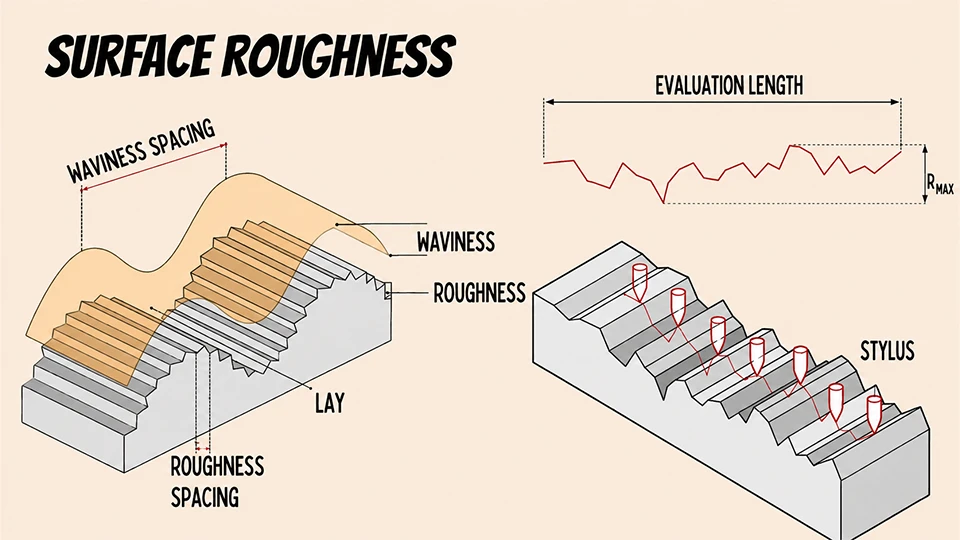
Surface texture is the widest concept. It includes surface roughness, waviness, and lay. Roughness refers to small irregularities. Waviness refers to larger, more widely spaced surface deviations. Lay describes the main direction of the surface pattern, usually created by the tool path or machining movement.
| Term | Meaning | Main Focus |
|---|---|---|
| Surface roughness | Fine microscopic peaks and valleys | Measured roughness value |
| Surface finish | General condition of the finished surface | Appearance and function |
| Surface texture | Overall surface pattern | Roughness, waviness, and lay |
| Waviness | Larger surface undulations | Vibration, deflection, or machine instability |
| Lay | Direction of surface pattern | Tool path or machining direction |
In simple terms, surface roughness is one part of surface texture, while surface finish is the practical result seen or required on the finished part. Understanding this difference helps engineers avoid unclear specifications such as “smooth surface” and use more accurate surface quality requirements instead.
Common Surface Roughness Parameters
Surface roughness is usually described by numerical parameters. These values help engineers define, compare, inspect, and control machined surface quality. Among many roughness parameters, Ra, Rz, Rq, and Rt are the most commonly discussed in machining.
Ra
Ra means arithmetic average roughness. It represents the average height deviation of the surface profile from the mean line within a measured length.
Ra is widely used because it is simple, easy to compare, and common on engineering drawings. When someone says a surface requires “Ra 1.6 μm” or “Ra 0.8 μm,” they are usually referring to the average roughness level of the machined surface.
However, Ra does not show every detail of the surface. Two surfaces may have the same Ra value but different peak shapes, valley depths, or functional behavior.
Rz
Rz focuses more on the height difference between peaks and valleys. It is often used when local high points or deep valleys matter more than the average value.
This makes Rz useful for surfaces related to sealing, sliding, coating, or fatigue resistance. A surface may have an acceptable Ra value but still contain deep grooves or sharp peaks. In that case, Rz can give a more practical warning.
Rq
Rq means root mean square roughness. It is similar to Ra, but it is more sensitive to larger deviations in the surface profile.
Because Rq gives more weight to higher peaks and deeper valleys, it can be useful when engineers need a more detailed understanding of surface variation. It is less common than Ra in general machining drawings, but it has value in precision surface analysis.
Rt
Rt refers to the total height of the roughness profile within the evaluation length. It measures the distance from the highest peak to the deepest valley.
Rt is useful for identifying extreme surface defects. For example, a scratch, burr mark, or abnormal tool mark may not strongly change the average Ra value, but it can increase Rt significantly.
In practical machining, Ra is the most common starting point, but it should not be treated as the only surface quality indicator. For functional surfaces, engineers may also need Rz, Rq, or Rt to better describe how the surface will actually perform.
Why Surface Roughness Matters in Machined Parts
Surface roughness matters because a machined surface is not only a boundary of a part. It is also the contact area where friction, sealing, load transfer, coating, and assembly happen. Even when the dimension is correct, the wrong surface roughness can still cause functional problems.
Friction and Wear
When two surfaces move against each other, their microscopic peaks make contact first. If the surface is too rough, these peaks can increase friction, generate heat, and accelerate wear.
However, the smoothest surface is not always the best choice. In some sliding or lubricated applications, a controlled surface texture helps retain oil and reduce direct metal-to-metal contact. The goal is not simply to make the surface smoother, but to make it suitable for the working condition.
Sealing Performance
Surface roughness has a direct effect on sealing surfaces. If the surface is too rough, fluid or gas may pass through the small valleys between contact points. This can lead to leakage in hydraulic parts, pneumatic parts, valve components, pipe connections, or flange surfaces.
A properly controlled roughness value helps the sealing material contact the surface evenly. It improves sealing reliability without requiring unnecessary extra pressure or excessive finishing.
Fatigue Strength
Surface roughness also affects fatigue performance. Sharp grooves, tool marks, or deep valleys can become stress concentration points. Under repeated load, these small surface defects may become the starting point of cracks.
This is especially important for rotating shafts, automotive parts, aerospace components, and other parts that work under cyclic stress. A better-controlled surface can reduce the risk of premature fatigue failure.
Coating and Plating Adhesion
For coated, painted, plated, or treated parts, surface roughness affects adhesion. If the surface is too smooth, the coating may not grip well. If it is too rough, the coating may become uneven or too thin at high points.
A suitable surface roughness gives the coating enough mechanical bonding area while keeping the surface consistent. This helps improve durability, corrosion resistance, and appearance after finishing.
Assembly and Fit
Surface roughness also influences how parts fit together. Shafts, holes, sleeves, bearing seats, guide surfaces, and sliding components may all meet the correct dimensional tolerance but still perform poorly if the surface condition is wrong.
A rough surface may feel tight, cause unstable movement, or wear mating parts quickly. A properly specified surface roughness supports better assembly, smoother motion, and longer service life.
How Surface Roughness Is Measured
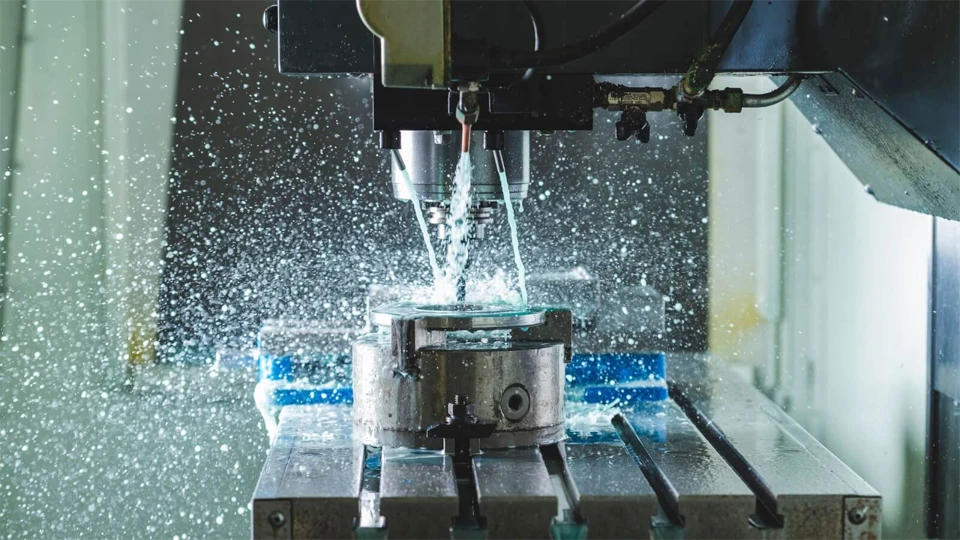
To verify that a machined part meets its engineering specifications, quality control teams use specialized instruments to map the microscopic surface topography. These instruments convert the surface profile into measurable values, allowing engineers to compare the actual surface condition with the roughness requirement shown on the drawing.
Contact Measurement
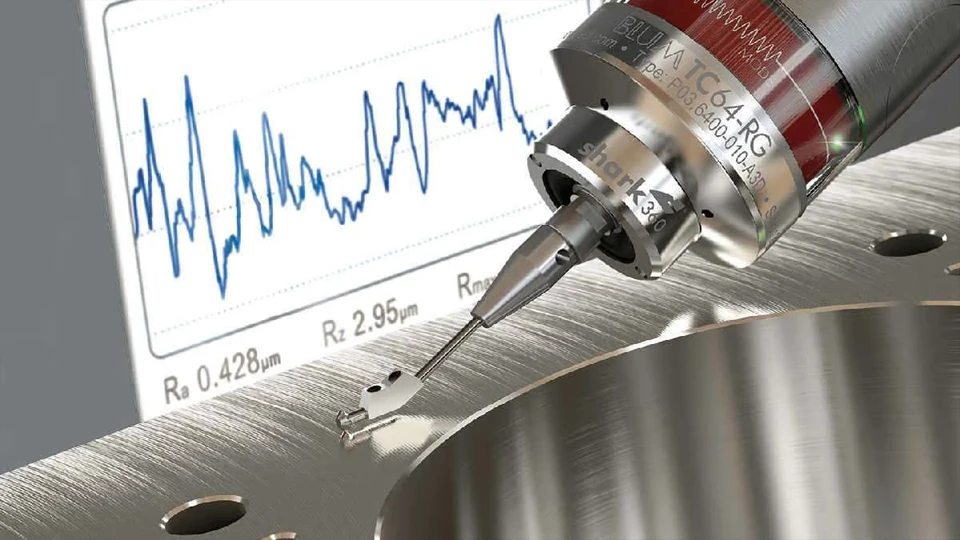
The most common method is contact measurement with a stylus profilometer. A fine stylus moves across the machined surface and follows the peaks and valleys of the profile. The instrument then calculates roughness values such as Ra, Rz, Rq, or Rt.
This method is widely used in machining workshops because it is practical, direct, and suitable for many metal parts. However, the stylus direction, measurement length, probe condition, and surface cleanliness all affect the result.
Non-contact Measurement
Non-contact measurement uses optical or laser-based methods to scan the surface without touching it. Common examples include optical profilometry, laser scanning, and white light interferometry.
These methods are useful for very fine surfaces, soft materials, delicate parts, micro-features, or surfaces that should not be scratched by a contact probe. They can also provide more detailed surface data, but the equipment is usually more expensive and requires proper setup.
Reading a Surface Roughness Symbol
On engineering drawings, surface roughness is usually shown with a standard surface texture symbol. The symbol may include the required roughness value, machining method, lay direction, sampling length, or whether material removal is required.
For example, a drawing may specify Ra 1.6 μm on a sealing surface or Ra 3.2 μm on a general machined surface. This tells the manufacturer what surface condition must be achieved and inspected.
Common Measurement Mistakes
Several mistakes can make roughness inspection unreliable. Measuring in the wrong direction may miss the true tool marks. Using the wrong evaluation length may give a misleading value. Measuring over dirt, burrs, scratches, or damaged areas may not represent the actual machined surface.
Another common mistake is checking only Ra. Ra is useful, but it does not fully describe deep grooves, isolated scratches, lay direction, or peak sharpness. For functional surfaces, the measurement method should match the real requirement of the part.
Main Factors That Affect Surface Roughness
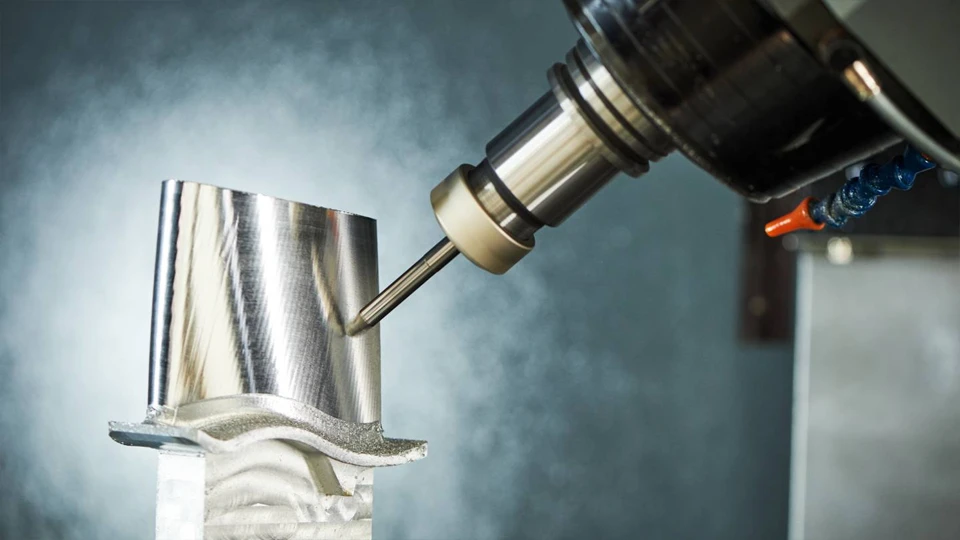
Surface roughness is not controlled by one single factor. It is the combined result of cutting parameters, tool condition, workpiece material, machine stability, workholding, coolant, and chip control. When any of these elements becomes unstable, the finished surface may show roughness variation, tool marks, tearing, vibration marks, or inconsistent texture.
Cutting Parameters
Cutting speed, feed rate, and depth of cut directly affect the surface left by the tool. Among them, feed rate often has a strong influence on visible tool marks. A higher feed rate usually increases the spacing and height of machining marks, especially in turning and milling.
Cutting speed also matters. If the speed is too low, some materials may tear instead of cutting cleanly. If it is too high, heat, tool wear, and vibration may increase. Depth of cut should also remain stable, because sudden changes in cutting load can affect surface consistency.
Tool Condition
The cutting tool must be sharp, stable, and suitable for the material. Tool wear, chipped edges, poor coating condition, or an unsuitable nose radius can quickly reduce surface quality.
A worn tool may rub instead of cut. This can create heat, burrs, built-up edge, and uneven roughness. In finishing operations, even small tool defects can leave visible marks on the surface.
Workpiece Material
Different materials produce different surface results under the same machining conditions. Aluminum alloys, carbon steel, stainless steel, cast iron, and titanium alloys do not cut in the same way.
Ductile materials may form built-up edge or tearing if the cutting condition is not suitable. Hard materials may accelerate tool wear. Materials with inclusions, uneven hardness, or heat-treatment distortion may also create unstable roughness across the same surface.
Machine Tool Rigidity
Machine rigidity affects whether the cutting process stays stable. If the spindle, guideways, bed, tool holder, or feed system lacks rigidity, vibration can occur during machining. This vibration may appear as chatter marks, waviness, or inconsistent surface roughness.
For stable surface quality, the machine tool must resist cutting forces and maintain smooth motion. This is especially important during finishing, where small vibration can still damage the final surface.
Workholding Stability
Even with the right tool and parameters, poor clamping can ruin surface roughness. If the workpiece moves, bends, or vibrates during machining, the tool cannot maintain a stable cutting path.
Long overhangs, thin-walled parts, weak fixtures, and uneven clamping force are common causes of surface problems. Good workholding should support the part firmly without causing deformation.
Coolant and Chip Control
Coolant helps reduce cutting heat, improve lubrication, and remove chips from the cutting area. Proper coolant use can reduce built-up edge, protect the tool, and improve surface consistency.
Chip control is equally important. If chips stay near the cutting zone, they may scratch the finished surface or interfere with the tool. Poor chip evacuation can turn a correct machining process into an unstable one, especially in finishing cuts.
Typical Surface Roughness Problems and Their Causes
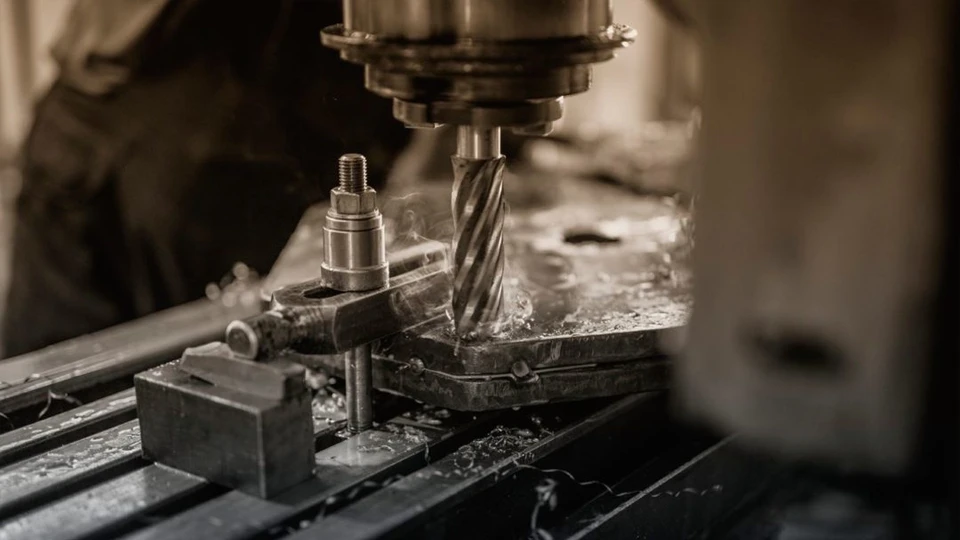
Surface roughness problems usually appear as visible marks, unstable texture, burrs, scratches, or uneven surface patterns. These problems are not random. They often point to specific issues in cutting conditions, tool condition, machine stability, clamping, or chip control.
Visible Tool Marks
Visible tool marks are regular lines or patterns left by the cutting edge. They are common when the feed rate is too high, the tool nose radius is too small, or the finishing pass is not properly controlled.
Tool marks are not always defects. Many machined surfaces naturally show a controlled tool pattern. The problem appears when the marks are deeper, wider, or rougher than the drawing requirement allows.
Chatter Marks
Chatter marks are repeated vibration patterns on the surface. They often look like waves, ripples, or irregular bands. The main causes include poor machine rigidity, unstable workholding, excessive tool overhang, worn spindle components, or unsuitable cutting parameters.
Chatter is especially harmful because it affects both surface roughness and dimensional stability. If the vibration continues, it may also shorten tool life and damage the workpiece surface.
Burrs and Tearing
Burrs are raised edges or unwanted material left after cutting. Tearing happens when the material is pulled or deformed instead of being cut cleanly.
These problems often occur with ductile materials, worn tools, incorrect cutting speed, poor tool geometry, or insufficient coolant. Burrs and tearing make the surface feel rough and may also affect assembly, sealing, or safety.
Scratches
Scratches are often caused by chips, poor cleaning, handling damage, or contact with fixtures and tools after machining. Unlike regular tool marks, scratches are usually random and may appear across the intended surface pattern.
Chip scratches are especially common when chips are not removed from the cutting zone in time. Even a correct finishing pass can be damaged if chips rub against the freshly machined surface.
Uneven Surface Texture
Uneven surface texture means the roughness is not consistent across the same surface. One area may meet the requirement, while another area may appear rougher, wavier, or visually different.
Common causes include spindle runout, tool runout, guideway error, unstable feed motion, uneven coolant supply, thermal deformation, or workpiece deflection. In this case, the issue is usually not one single parameter, but the stability of the whole machining system.
How to Improve Surface Roughness in Machining
Improving surface roughness does not mean making every surface as smooth as possible. The goal is to reach the required roughness value in a stable, repeatable, and cost-effective way. In most cases, improvement starts with controlling the cutting process before adding extra finishing operations.
Optimize Cutting Parameters
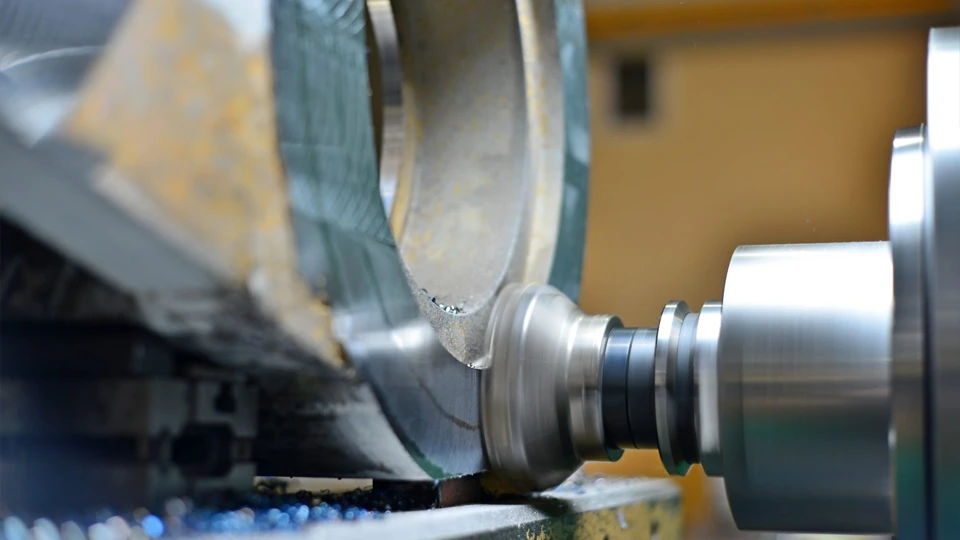
Cutting parameters should match the material, tool, machine, and required surface quality. For finishing, a lower feed rate often helps reduce tool marks and produce a finer surface. Cutting speed should also be selected carefully, because unsuitable speed may cause tearing, built-up edge, vibration, or excessive tool wear.
Depth of cut should remain stable during the finishing pass. A very heavy cut may increase cutting force and vibration, while an extremely light cut may cause rubbing instead of clean cutting. A controlled finishing allowance usually gives more predictable surface roughness.
Use the Right Tool Geometry
Tool geometry has a direct effect on the surface profile. A suitable nose radius, sharp cutting edge, correct rake angle, and proper tool coating can improve cutting stability and surface consistency.
The tool must also match the workpiece material. For example, a tool used for stainless steel may need different edge strength and coating than a tool used for aluminum alloy. Using the wrong tool may cause built-up edge, burrs, heat, or rough surface texture.
Improve Machine Rigidity
A stable machine tool helps reduce vibration during cutting. Spindle condition, guideway accuracy, ball screw performance, tool holder rigidity, and bed structure can all affect the final surface.
For high-quality finishing, the machine must maintain smooth motion under cutting load. If the machine vibrates, deflects, or feeds unevenly, changing the tool alone may not solve the roughness problem.
Improve Workholding
Good workholding keeps the workpiece stable without causing deformation. Long overhangs should be reduced when possible. Thin-walled parts may need extra support. Clamping force should be strong enough to prevent movement, but not so high that it distorts the part.
If the workpiece is not held correctly, the tool path may be accurate in the program but unstable in the actual cut. This often leads to chatter, uneven texture, or local roughness problems.
Control Coolant and Chip Removal
Coolant should reach the cutting zone effectively. It helps control heat, reduce friction, protect the cutting edge, and improve chip evacuation. Poor coolant flow may lead to built-up edge, thermal damage, or unstable surface finish.
Chip removal is equally important. Chips that remain near the cutting area can scratch the newly machined surface. For finishing cuts, clean chip evacuation helps protect the final surface from secondary damage.
Add Finishing Processes When Needed
When cutting alone cannot reach the required roughness, finishing processes may be added. Common options include finish turning, finish milling, grinding, honing, lapping, or polishing.
However, extra finishing should be used with a clear purpose. Not every part needs the lowest possible roughness value. Over-finishing increases processing time, tool cost, inspection cost, and delivery pressure. The best solution is to achieve the required surface quality without unnecessary operations.
Choosing the Right Surface Roughness for a Part
The right surface roughness is not always the lowest possible value. It should match the function of the surface. A non-contact surface, a sliding surface, a sealing surface, and a bearing seat do not need the same roughness requirement.
In real manufacturing, over-specifying surface roughness increases machining time and cost. Under-specifying it may cause leakage, poor fit, unstable movement, or early wear. The best choice is a balance between function, manufacturability, inspection, and cost.
| Application | Roughness Requirement Logic |
|---|---|
| General structural parts | Moderate surface quality is usually enough |
| Sliding surfaces | Need controlled friction and proper lubrication behavior |
| Sealing surfaces | Need stable contact to reduce leakage risk |
| Bearing seats | Need accurate fit and consistent surface contact |
| Coated or plated parts | Need suitable texture for adhesion |
| Medical or aerospace parts | Need strict roughness control and repeatability |
For general structural parts, roughness mainly affects appearance, handling, and basic assembly. These surfaces usually do not need extremely fine roughness unless they contact another precision part.
For sliding surfaces, the surface should not be selected only by smoothness. A proper texture can help retain lubricant and reduce direct surface contact. If the surface is too rough, wear increases. If it is too smooth in the wrong application, lubrication performance may be affected.
For sealing surfaces, the requirement is more sensitive. The surface must allow stable contact between mating parts or sealing materials. Excessive peaks and valleys may create leakage paths, while unsuitable finishing may reduce sealing reliability.
For coated or plated parts, roughness should support adhesion without creating an uneven coating layer. This is why the required surface condition should be confirmed before painting, plating, oxidation, or other surface treatment.
In simple terms, surface roughness is an engineering decision, not a beauty standard. The correct value should be selected according to how the surface works, how it will be measured, and how much machining effort is truly necessary.
Conclusion
Surface roughness may seem like a small surface detail, but it often decides whether a machined part performs reliably in real use. A correct roughness requirement supports better fitting, sealing, wear resistance, coating adhesion, and fatigue performance. By understanding its definition, parameters, measurement methods, influencing factors, and selection logic, manufacturers can control machined surface quality with more confidence and avoid unnecessary processing cost.
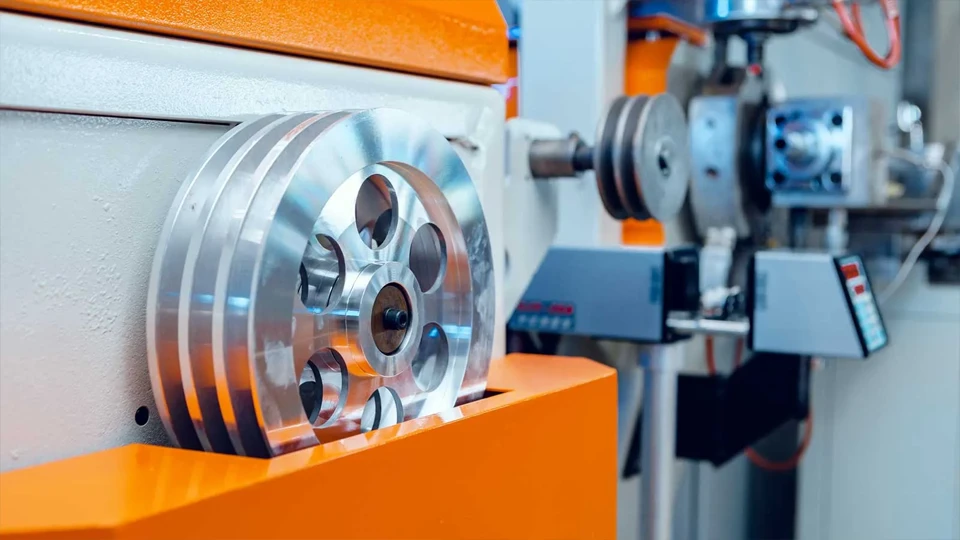
However, mastering these cutting variables ultimately depends on the mechanical foundation of the equipment itself, because consistent surface quality is difficult without strong machine rigidity and stable motion control. This engineering reality is closely aligned with Rosnok’s manufacturing focus. As a dedicated CNC machine tool manufacturer, Rosnok develops high-performance machine tools with the stability, precision, and repeatability needed to help machining facilities meet demanding surface roughness requirements with greater consistency.