In real production, many parts need holes that are more accurate than drilling alone can provide. Engine blocks, hydraulic components, bearing seats, molds, flanges, and heavy machinery parts often depend on precise internal diameters for assembly and performance. This is why boring machining plays an important role in CNC manufacturing, especially when a hole must match another part, support rotation, reduce vibration, or maintain long-term reliability.
In this guide, Rosnok will break down the mechanics of boring machining, explore its common operational types, and highlight its core machining value and applications in modern manufacturing.
What Is Boring Machining?
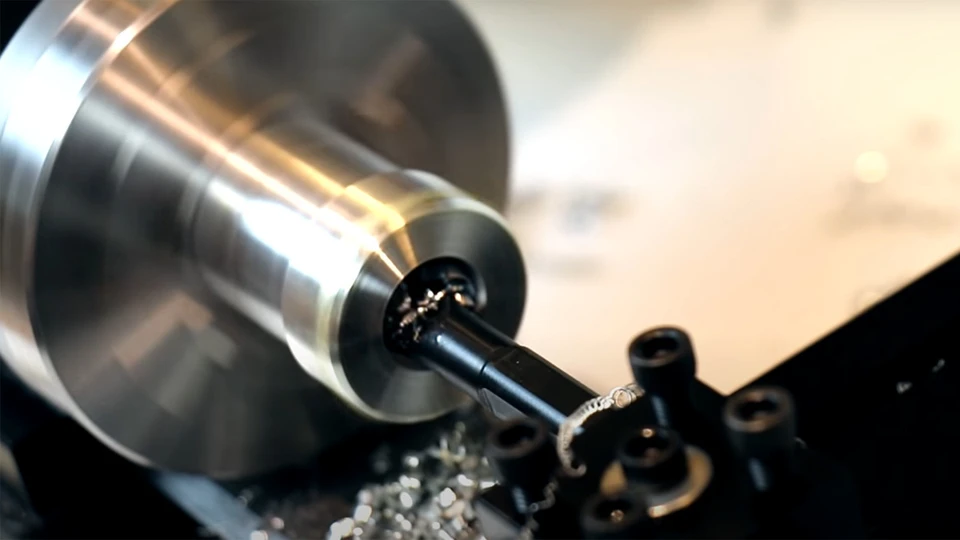
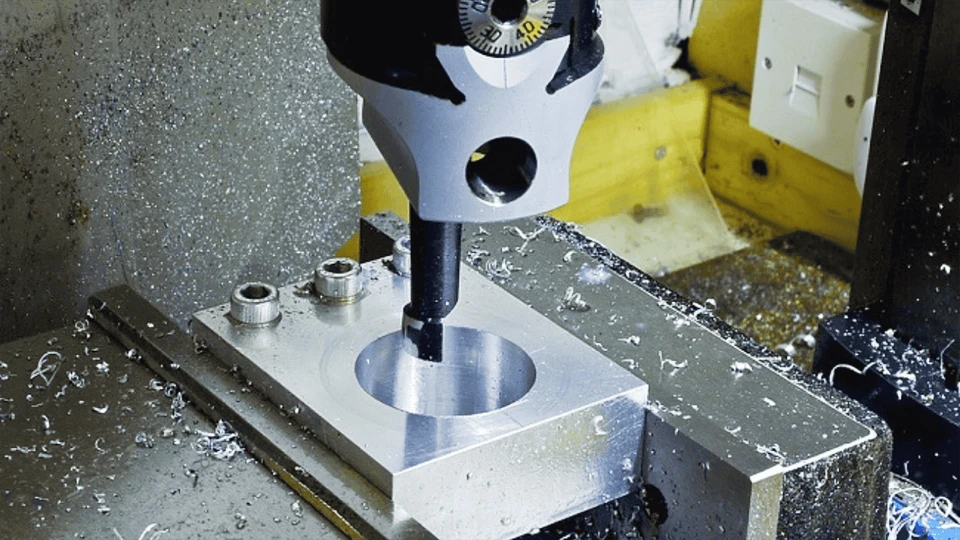
Boring machining is a precision machining process used to enlarge and finish an existing hole in a workpiece. It is not used to create the first hole from solid material. Instead, it works on a hole that has already been drilled, cast, forged, or roughly machined.
The main purpose of boring machining is to improve the internal geometry of a hole. During the process, a boring tool removes material from the inner wall of the hole in a controlled way. This can refine the hole diameter, roundness, straightness, alignment, and surface quality.
Boring machining is often required when the original hole is not accurate enough for final assembly or functional use. A drilled hole may be slightly off-size, rough, tapered, or misaligned. Boring helps turn that rough or semi-finished hole into a more accurate internal feature.
How Does Boring Machining Work?
Boring machining operates on a straightforward principle: using a boring tool to precisely shave material from the inner wall of a hole. However, executing this with high precision requires strict control over the starting conditions and the cutting mechanics.
Starting Hole Condition and Machining Allowance
The boring process does not begin with the cutting motion; it begins with evaluating the existing hole. Whether the initial hole was created by drilling, casting, forging, or rough machining, its initial condition directly dictates the success of the boring operation.
The most critical factor here is the machining allowance (the amount of material left inside the hole to be removed).
- If the allowance is too small: The boring tool may rub against the material rather than cut it, failing to clean up existing errors like taper, ovality, or misalignment.
- If the allowance is too large: The heavy material removal will increase cutting forces. This can cause tool deflection and vibration, leading to poor dimensional stability and a rough surface.
In CNC machining, production engineers carefully calculate the optimal boring allowance based on the final diameter, workpiece material, and accuracy requirements. For highly precise holes, the process is often split into rough boring and finish boring to maintain stability.
The Cutting Tool Movement
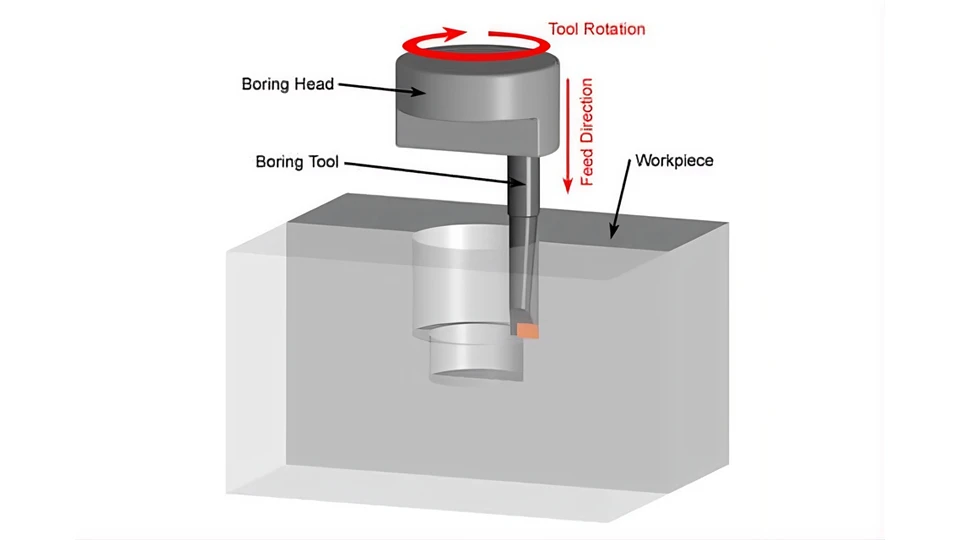
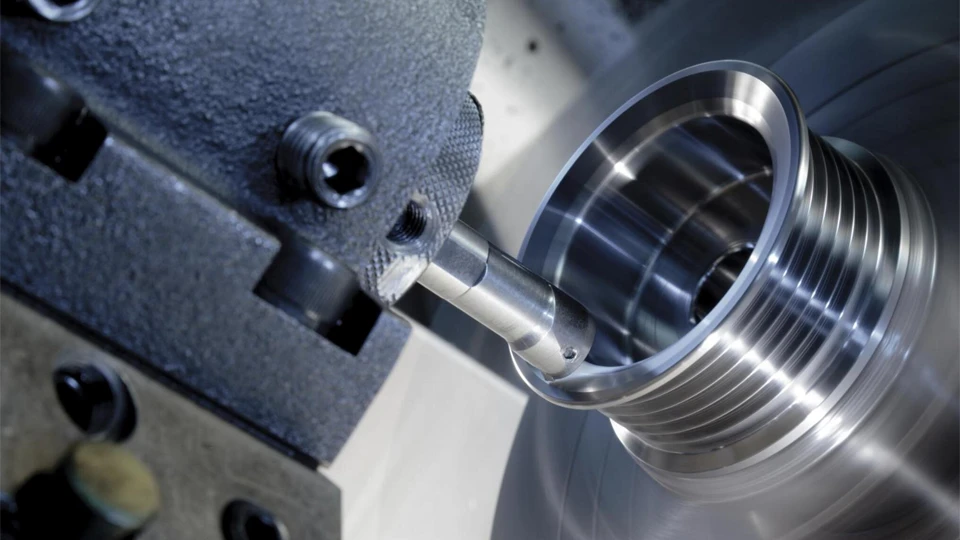
Once the allowance is set, material removal relies on the relative motion between the boring tool, typically mounted on a rigid boring bar, and the workpiece. Depending on the machine tool used, this motion happens in two primary ways:
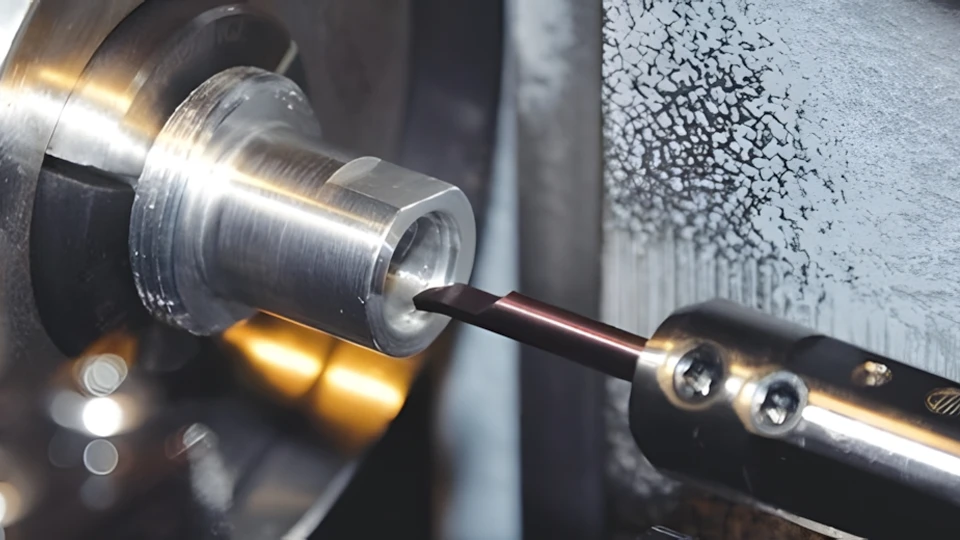
- Workpiece Rotates, Tool Feeds: Common in CNC lathes. The workpiece rotates at a controlled speed while the boring bar remains stationary but feeds axially into the hole.
- Tool Rotates, Workpiece is Fixed: Common in CNC machining centers and horizontal boring mills. The workpiece is clamped tightly to the table, while the spindle rotates the boring tool and advances it into the hole.
In both scenarios, the mechanism is the same: the cutting edge is set to a specific radial depth to control the diameter, and it moves steadily along the hole’s axis as axial feed. This controlled, rigid path helps bring the hole closer to the required axis and geometry.
What Boring Machining Improves
By executing this controlled cutting motion with the correct machining allowance, the boring process mechanically transforms a substandard cavity into a precision feature. Specifically, it improves:
- Hole Diameter: Hitting tight dimensional tolerances consistently.
- Roundness: Eliminating the “out-of-round” geometry often left by standard drills.
- Straightness and Position Accuracy: Helping bring the hole closer to its required axis and correcting any “wandering” that occurred during the initial drilling or casting.
- Surface Finish: Shearing away the rough inner wall to leave a smooth, uniform surface finish.
Why Is Boring Machining Important in CNC Manufacturing?
While drilling is an efficient way to create an initial opening, it may not meet the strict tolerances required for high-precision mechanical assemblies. In real-world production, the precise position and exact diameter of a hole can directly influence how seamlessly components fit together and perform under load.
The internal quality of a machined hole is critical for parts that rely on tight mating surfaces. Components such as bearings, alignment pins, bushings, hydraulic valves, and complex transmission structures all depend on accurate internal dimensions to function as designed.
If a hole is even slightly out of tolerance, the mechanical consequences can be significant. A misaligned, tapered, or poorly finished hole can lead to:
- Assembly Difficulties: Mating parts may bind, fail to fit, or require forced assembly, slowing down production lines.
- Operational Instability: Improper clearances between parts can cause excessive vibration and chatter during operation.
- Fluid Leakage: Imperfect inner walls in hydraulic or pneumatic components may fail to seal properly, leading to pressure drops.
- Premature Wear: Misaligned axes can cause uneven load distribution, accelerating mechanical wear and reducing the service life of the equipment.
This is why boring machining is an important operation in CNC manufacturing. By improving the final hole geometry, boring supports part consistency and high repeatability across batch production. For production engineers and machine shop managers, boring is not just another machining step. It is a practical way to reduce assembly risk and improve the reliability of machined parts.
Boring Machining vs Drilling, Reaming, and Turning
In the world of CNC manufacturing, several processes are used to create or refine internal diameters. While they may seem similar to an outside observer, production engineers must clearly distinguish between them to design a proper machining sequence.
Here is how boring compares to other common hole-processing methods.
Boring Machining vs Drilling
The difference here lies in the starting point and the primary goal:
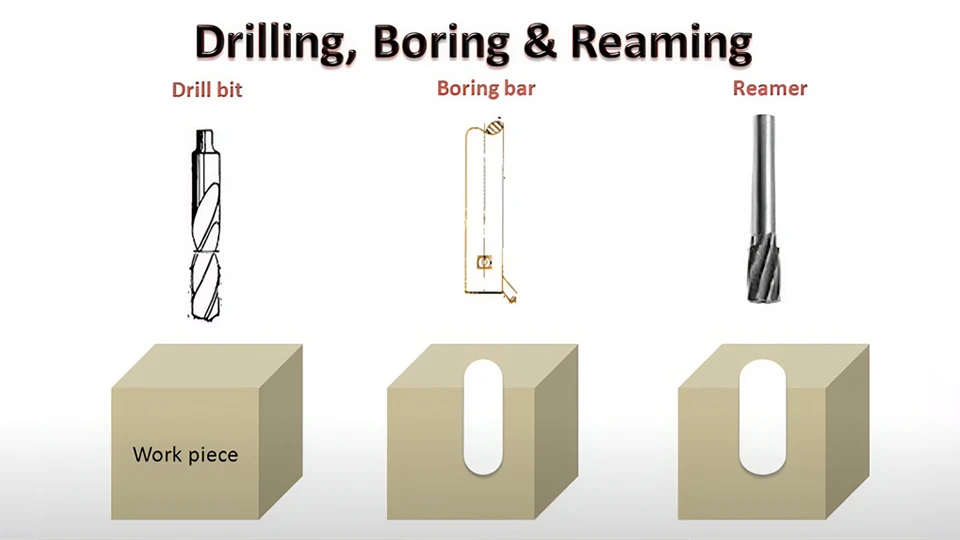
- Drilling is the initial operation. It uses a multi-flute drill bit to plunge into solid material and generate a completely new hole. Its primary focus is rapid material removal and hole creation efficiency.
- Boring is a secondary operation. It works on holes that already exist. Instead of bulk material removal, its primary focus is correcting deviations, enlarging the diameter to a required dimension, and achieving higher hole accuracy and surface quality.
Boring Machining vs Reaming
Both are precision finishing operations, but their mechanics dictate different capabilities:
- Reaming is used to achieve fine surface finishes and tight diameter sizing, but it removes very little material with a small allowance. Most importantly, a reamer tends to follow the path of the existing hole. If the original drilled hole is slightly angled or off-center, reaming usually cannot correct the misalignment.
- Boring, by contrast, uses a controlled tool path to better control the final hole axis. It has greater capability to improve a hole’s geometric position, straightness, and alignment while reducing errors from the initial hole.
Boring Machining vs Internal Turning
These two terms are frequently used interchangeably, which can cause confusion, but the distinction lies in the scope and the machine environment:
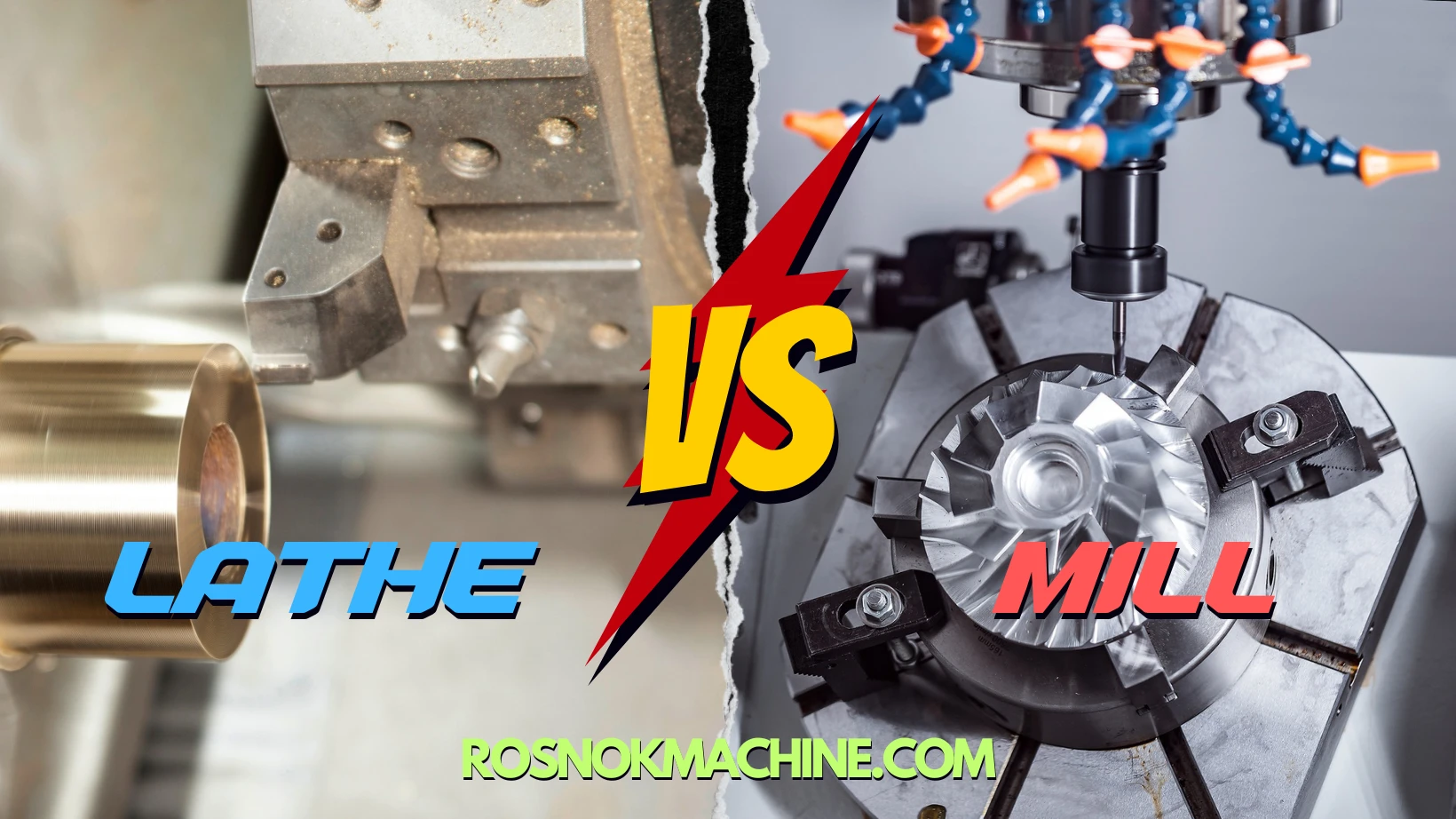
- Internal Turning specifically refers to machining an internal surface on a lathe or turning center. In this setup, the workpiece rotates while a stationary cutting tool feeds into the inner diameter.
- Boring Machining is a much broader concept. While internal turning on a lathe is technically a form of boring, boring also includes operations where the tool rotates and the workpiece is fixed, such as on CNC horizontal machining centers, vertical machining centers, or dedicated horizontal boring mills.
Main Types of Boring Machining
Boring is not a one-size-fits-all operation. Depending on the workpiece size, geometric complexity, and production environment, manufacturers rely on several distinct types of boring methods.
Line Boring
Line boring is essential when multiple holes must share the exact same centerline (coaxiality) across a distance or through several structural partitions. To prevent tool deflection over long spans, a long boring bar is typically supported at multiple points. This method is the standard for machining engine blocks, gearboxes, bearing housings, and heavy machinery frames where perfect shaft alignment is critical.
Horizontal Boring
Executed on horizontal boring mills or horizontal machining centers, this method is designed to tackle deep holes, long bores, and heavy, box-like workpieces. The horizontal spindle orientation allows for excellent chip evacuation. Because it handles massive components, the rigidity and stability of the machine’s structural casting are paramount. It is ideal for the multi-face machining of heavy mechanical parts in a single clamping setup.
Vertical Boring
When a workpiece is too heavy, large, or awkwardly shaped to be mounted horizontally, vertical boring is the solution. Typically performed on vertical lathes or vertical boring mills, the heavy workpiece rotates on a flat horizontal table while the cutting tool feeds vertically. This setup utilizes gravity to safely stabilize and machine large rings, heavy flanges, massive valve bodies, and turbine components.
Precision Boring (Fine Boring)
Precision boring takes geometric control to the microscopic level. It involves very light cuts (minimal machining allowance) and precisely controlled speeds to achieve exceptionally tight dimensional tolerances and fine surface finishes. This high-repeatability process is crucial for automotive, aerospace, mold making, and precision mechanical assemblies that demand strictly accurate diameter control.
Applications of Boring Machining
Boring machining is a cornerstone of modern industrial production. Across various demanding sectors, it is the standard process for manufacturing components that require exact internal geometries for precision assembly, fluid sealing, or heavy load-bearing purposes.
Here is how boring is applied across key industries:
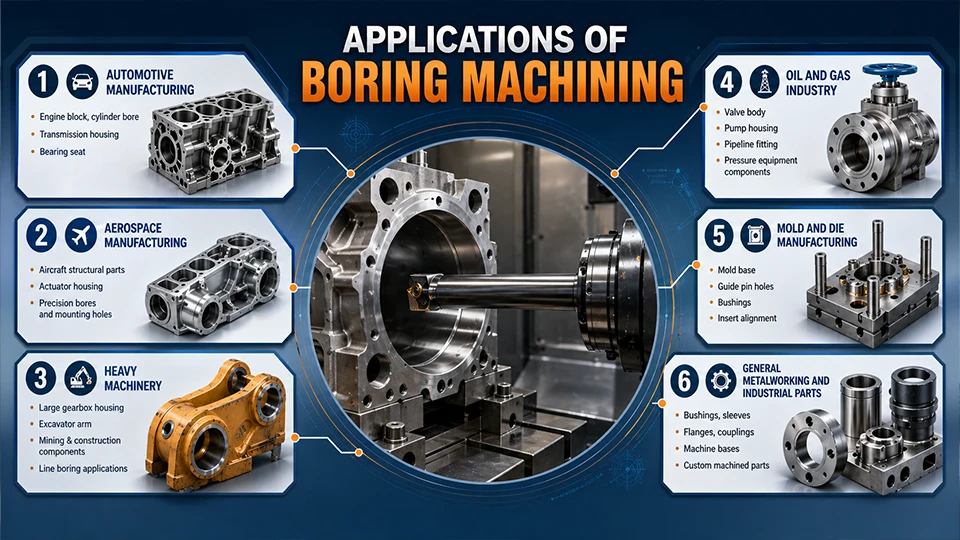
Automotive Manufacturing
In automotive production, boring machining is widely used for engine blocks, cylinder bores, transmission housings, bearing seats, brake parts, and suspension components. These parts often require accurate internal diameters to support rotation, maintain alignment, and reduce vibration.
For example, a cylinder bore must have proper size, roundness, and surface quality to support piston movement. A bearing seat must hold the bearing securely without excessive looseness or stress. In these cases, boring helps the internal hole meet functional requirements before final assembly.
Aerospace Manufacturing
Aerospace parts often require lightweight structures with strict dimensional control. Boring machining is used for actuator housings, landing gear components, structural parts, precision mounting holes, and other high-value metal components.
In this field, a hole is often part of a load-bearing or positioning system. Poor hole geometry can affect assembly accuracy, stress distribution, and component reliability. Boring is therefore used when internal features must meet tight tolerance and repeatability requirements.
Heavy Machinery
Heavy machinery parts usually involve large castings, welded structures, and high-load assemblies. Boring machining is common in gearbox housings, excavator arms, mining machinery frames, large bearing holes, and construction equipment components.
These parts often contain deep or large-diameter holes. The bore must stay accurate even under heavy load. Line boring and horizontal boring are especially important here because many heavy components require aligned holes across long distances.
Oil and Gas Industry
In the oil and gas industry, boring machining is used for valve bodies, pump housings, pipeline components, pressure equipment parts, and large fittings. Many of these components require accurate internal passages and sealing surfaces.
A poorly finished or inaccurate bore can affect sealing, pressure control, and fluid movement. For this reason, boring is often applied after rough machining to improve the internal diameter and prepare the part for reliable service in demanding environments.
Mold and Die Manufacturing
Mold and die components often require precise holes for guide pins, bushings, inserts, alignment systems, and mold base assembly. Boring machining helps ensure that these holes are accurate and consistent.
In mold production, small hole errors can cause misalignment between mold halves or uneven movement of guide components. Boring helps improve the fit and positioning accuracy of these internal features, especially when the mold must operate repeatedly under pressure.
General Metalworking and Industrial Parts
Beyond specialized industries, boring machining is also common in general metalworking. It is used for flanges, sleeves, bushings, couplings, machine bases, custom machined parts, and repair components.
These applications may not always require aerospace-level precision, but they still depend on reliable internal dimensions. When a hole must fit a shaft, locate a part, hold a bearing, or support assembly, boring machining provides a practical way to improve hole quality and machining consistency.
Common Challenges in Boring Machining
Boring machining can produce highly accurate holes, but the process is sensitive to tool rigidity, chip control, heat, and clamping stability. Because the cutting happens inside a hole, many problems are harder to observe than in external machining.
Tool Deflection
Tool deflection is one of the most common problems in boring machining. A boring bar often extends deep into the hole, and the longer the overhang, or the higher the length-to-diameter ratio, the easier it is for the tool to bend under cutting force.
Even slight deflection can change the actual cutting position. This may lead to diameter error, taper, poor roundness, or inconsistent hole size. For deep holes, tool rigidity becomes especially important because the cutting edge is far from the tool holder.
Vibration and Chatter
Vibration, often called chatter, can appear when the boring tool, workpiece, or machine setup lacks enough rigidity. It leaves visible marks on the inner wall and reduces surface quality.
Chatter can also shorten tool life and make hole dimensions unstable. In boring machining, this problem is more difficult because the cutting area is inside the hole, where tool support is limited and cutting conditions can change quickly.
Poor Chip Evacuation
Chip removal is another major challenge. In external turning or milling, chips can leave the cutting zone more easily. In boring, chips are trapped inside the hole and may scratch the finished surface if they are not removed properly.
Poor chip evacuation can also cause heat buildup, tool wear, and even tool breakage. This is why high-pressure coolant, chip shape, cutting direction, and hole depth must be considered during boring operations.
Heat and Tool Wear
Boring generates heat at the cutting edge and along the inner surface of the hole. If heat is not controlled, the workpiece, tool, or boring bar may expand slightly, affecting the final hole size.
Tool wear also changes the cutting edge geometry. As the tool becomes dull, cutting force increases and the hole may become rougher or less accurate. In precision boring, even small wear can affect diameter control and surface finish.
Workpiece Clamping Error
Boring accuracy also depends on how the workpiece is held. If the workpiece is not clamped securely, or if excessive clamping pressure distorts a thin-walled part, the final bore may lose its required position or roundness after unclamping.
This problem is especially important for parts with multiple holes, long bores, or tight assembly relationships. A stable clamping setup helps maintain position accuracy, reduce vibration, and keep the bore consistent throughout the operation.
Conclusion
Boring machining may look like a small step in the machining sequence, but it often determines whether a metal part can truly perform as designed. By refining existing holes, controlling internal geometry, and improving diameter accuracy, roundness, alignment, and surface finish, boring machining turns a rough internal opening into a functional precision feature for CNC manufacturing.
Mastering such tight tolerances, however, requires high machine rigidity to combat vibration and deflection. As a specialized CNC machine tool manufacturer, Rosnok engineers advanced machining centers and lathes with reinforced bed structures and high-stability spindles, providing the mechanical foundation needed to execute stable and accurate boring operations.