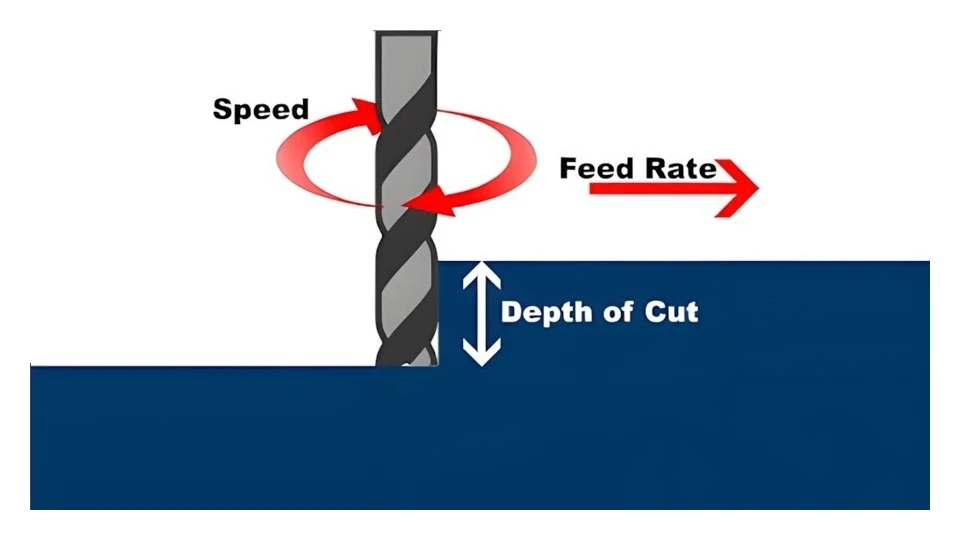
In simple terms, cutting speed refers to how fast the cutting edge moves against the workpiece surface, while feed rate refers to how fast the tool advances into or across the material. These two parameters work together in every machining operation, but they influence machining performance in different ways.
Continue reading this article to learn how feed rate and cutting speed affect cutting action, surface quality, and overall machining performance.
What Is Cutting Speed in CNC Machining?
In CNC machining, cutting speed (usually denoted as $v_c$) is the surface speed of the cutting edge relative to the workpiece. Simply put, it describes how fast the tool’s cutting edge travels across the material surface to shear off a chip.
Beginners often confuse this concept with two others: it is not the rate at which the tool advances through the material (that is feed rate), nor is it strictly the spindle speed (RPM). While spindle RPM describes the machine’s rotational motion, cutting speed describes the actual physical velocity at the point of contact between the tool and the material.
Cutting speed exists in turning, milling, and drilling operations, and is universally expressed in meters per minute (m/min) or surface feet per minute (SFM). When setting up machining data, cutting speed is always the primary starting variable because it is the leading driver of heat generation and thermal load in the cutting zone.
What Factors Determine Cutting Speed?
Cutting speed is never a random guess; it is an engineering balance dictated by the material, the tool, the process, and the physical limits of the machine. The following core factors determine where the optimal cutting speed should be set:
Workpiece Material
The hardness, toughness, and thermal conductivity of the workpiece material directly dictate cutting resistance and heat generation. When machining hard or heat-resistant alloys (like Titanium or Inconel), heat struggles to dissipate, requiring a more conservative cutting speed to prevent insert failure. Conversely, easy-to-cut materials like aluminum allow for significantly higher cutting speeds.
Cutting Tool Material
The tool substrate (e.g., High-Speed Steel, Carbide, or Ceramic) determines how well the cutting edge can maintain its mechanical strength at elevated temperatures (red hardness). Advanced tool materials with higher thermal resistance can survive greater heat loads, allowing for a higher cutting speed limit.
Tool Coating
Tool coatings like TiAlN or Al2O3 do more than reduce friction; they act as thermal barriers, preventing the extreme heat of the cutting zone from penetrating the tool substrate. Tools with the correct coating for the application typically allow for a much wider and higher practical cutting speed window than uncoated tools.
Type of Machining Operation
The physical engagement differs vastly between turning (continuous cutting) and milling (interrupted cutting). The interrupted nature of milling subjects the cutting edge to continuous thermal shocks, which can lead to thermal cracking. As a result, milling generally requires a more conservative cutting speed compared to continuous turning under similar conditions.
Workpiece Diameter or Cutter Diameter
Cutting speed is intrinsically tied to surface motion (Metric formula: $v_c = \frac{\pi \cdot D \cdot n}{1000}$). At a fixed spindle RPM, a larger diameter means the outer circumference is traveling faster. Therefore, to maintain a safe, constant cutting speed, the spindle RPM must be reduced as the tool or workpiece diameter increases.
Cooling and Lubrication Conditions
Flood coolant or High-Pressure Coolant (HPC) systems actively flush chips, extract heat from the cutting zone, and improve lubrication. Efficient thermal evacuation prevents catastrophic heat buildup at the cutting edge, empowering process engineers to push for more aggressive cutting speeds.
Machine Rigidity and Stability
Pushing cutting speed limits tests not only the tool but the dynamic balancing of the spindle and the vibration resistance of the entire machine frame. On less rigid setups prone to chatter, cutting speed must be lowered to avoid destructive harmonics. On highly rigid, heavy-duty CNC machines, the high-speed potential of modern cutting tools can be fully unleashed.
Surface Finish and Productivity Requirements
Parameter selection is ultimately about manufacturing goals. If productivity (maximum Material Removal Rate) is the absolute priority and tool life is secondary, speeds may be pushed to the upper limits. If the goal is dimensional accuracy, a flawless surface finish without Built-Up Edge (BUE), and maximum tool life, the speed will be scaled back to a more conservative, optimal range.
What Is Feed Rate in CNC Machining?
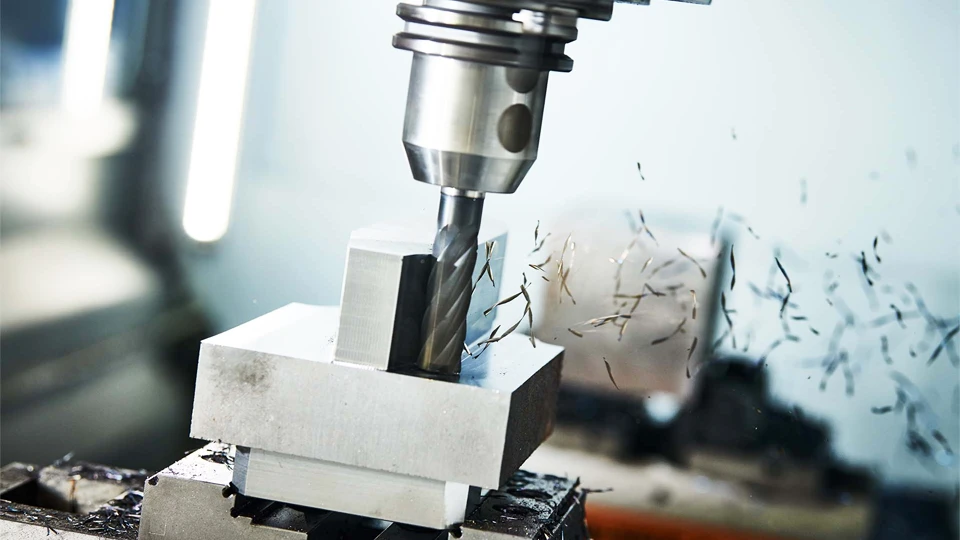
In CNC machining, feed rate (often denoted as $v_f$) is defined as the velocity at which the cutting tool advances into or across the workpiece. Unlike cutting speed, which deals with the rotational surface velocity at the cutting edge, feed rate dictates the linear progression of the tool along the machine’s coordinate axes.
It is best understood as the “tool advance.” Depending on the specific operation, feed rate is typically expressed in millimeters per minute (mm/min), inches per minute (IPM), or millimeters per revolution (mm/rev).
While cutting speed primarily governs heat generation, feed rate is the primary parameter controlling the mechanical aspects of the cut. It directly determines the thickness of the resulting chip (chip load), the mechanical cutting force exerted on the machine, and the physical geometric texture (feed marks) left on the machined surface.
What Factors Determine Feed Rate?
Feed rate cannot be chosen arbitrarily or set in isolation. It must be carefully calculated to maintain a specific chip thickness while keeping mechanical loads within safe limits. The optimal feed rate is determined by the following core factors:
Workpiece Material
The mechanical properties of the material, specifically its shear strength and hardness, determine its physical resistance to tool penetration. Tougher or hardened materials generate higher cutting forces, requiring a reduced feed rate to prevent insert chipping, whereas softer, highly machinable materials allow for a significantly higher feed rate.
Tool Diameter and Tool Design
The physical dimensions and core geometry of the cutting tool dictate how much mechanical bending stress it can withstand. Tools with larger diameters and reinforced core designs can handle heavier chip loads, allowing for a higher feed rate. Conversely, slender or micro-tools require a lower feed to prevent deflection and catastrophic breakage.
Number of Cutting Edges
In multi-edge tools like milling cutters, the total table feed rate is intrinsically linked to the number of flutes (teeth). Because the engineering target is to maintain a specific feed per tooth ($f_z$), increasing the number of active cutting edges allows the overall feed rate of the machine to be increased proportionally.
Type of Machining Operation
Different operations manage mechanical loads and chip evacuation differently. Turning applies a continuous radial load, while drilling creates severe axial thrust and confines chips within a hole. Operations with restricted chip flow or complex tool engagement geometries often demand a more tightly controlled or reduced feed rate compared to simple OD turning or open-face milling.
Depth of Cut and Width of Cut
The axial depth of cut (DOC) and radial width of cut (WOC) define the total volume of material engaged by the tool at any given moment. To keep the maximum cutting force within the safe limits of the tool and machine, an increase in either DOC or WOC must generally be compensated by a decrease in feed rate.
Machine Power and Rigidity
Pushing a tool through solid metal at high feed rates demands immense mechanical thrust from the machine’s servo motors and ball screws. A highly rigid machine with high torque reserves can sustain a maximized feed rate, whereas a lighter-duty machine requires a reduced feed to avoid stalling the axes, overloading the servos, or inducing severe vibration.
Workholding Stability
The feed rate exerts a direct, continuous pushing force against the workpiece. If the part is thin-walled, prone to deflection, or held by a weak clamping fixture, the feed rate must be lowered to prevent part distortion or chatter. Highly secure workholding allows the feed to be increased to the tool’s maximum mechanical limit.
Surface Quality Requirements
Feed rate strictly dictates the geometric spacing of the tool marks left on the machined surface. When a fine surface finish (low $Ra$ value) is the primary objective, the feed rate must be significantly reduced to minimize the residual scallop height. When surface finish is irrelevant (such as in roughing operations), the feed can be maximized.
Chip Load Target
The ultimate engineering goal of setting a feed rate is to achieve the tool manufacturer’s recommended chip load (the thickness of the chip removed per cutting edge). To ensure the tool shears the material cleanly rather than destructively rubbing against it, the feed rate must be maintained at a high enough level to meet this specific target, forming the baseline for all feed calculations.
What Is the Difference Between Feed Rate and Cutting Speed?
The true difference between feed rate and cutting speed goes far beyond their definitions or units of measurement. In a production environment, adjusting one parameter alters the physical state of the machine in a completely different way than adjusting the other. Understanding this distinction is the key to mastering CNC process optimization.
Heat Generation vs. Mechanical Load
The most fundamental engineering difference between the two parameters lies in whether they generate heat or mechanical stress.
Cutting speed is the primary driver of thermal generation. As speed increases, friction and shearing intensity escalate, concentrating extreme heat at the cutting edge. This thermal load directly tests the thermal stability of the tool material and the thermal growth control capabilities of the machine’s spindle system. Furthermore, adjusting cutting speed means shifting the spindle’s RPM along its specific torque/power curve. At lower speeds, the machine relies heavily on peak torque to shear material; at higher speeds, the cut becomes a power-dominated dynamic.
Feed rate, conversely, is the primary driver of mechanical load. Pushing a tool faster into the material does not proportionally increase heat; instead, it aggressively increases cutting resistance and mechanical thrust. This places direct, heavy stress on the machine’s linear axes—specifically testing the load capacity of the ball screws, the dampening capability of the guideways, and the rigidity of the machine frame.
Impact on Tool Wear and Tool Life
When attempting to reduce cycle times, engineers must weigh how their parameter choices will impact consumable tooling costs. Based on the principles of Taylor’s Tool Life Equation, these two parameters degrade tools at vastly different rates.
Cutting speed has an exponential impact on tool life. Pushing the cutting speed too high causes rapid thermal wear, flank wear, and premature failure of the tool coating. A relatively small percentage increase in speed can slash tool life in half.
Feed rate has a more linear, mechanical impact. While an excessive feed rate increases mechanical stress and the risk of edge chipping, it does not burn the tool out as aggressively as heat. As long as the mechanical load remains within the structural limits of the insert and the machine’s rigidity, the tool can survive high feed rates.
This leads to a universal rule of thumb on the shop floor: to increase Material Removal Rate (MRR), raise the feed rate as confidently as the machine and tool strength allow, but raise the cutting speed with extreme caution.
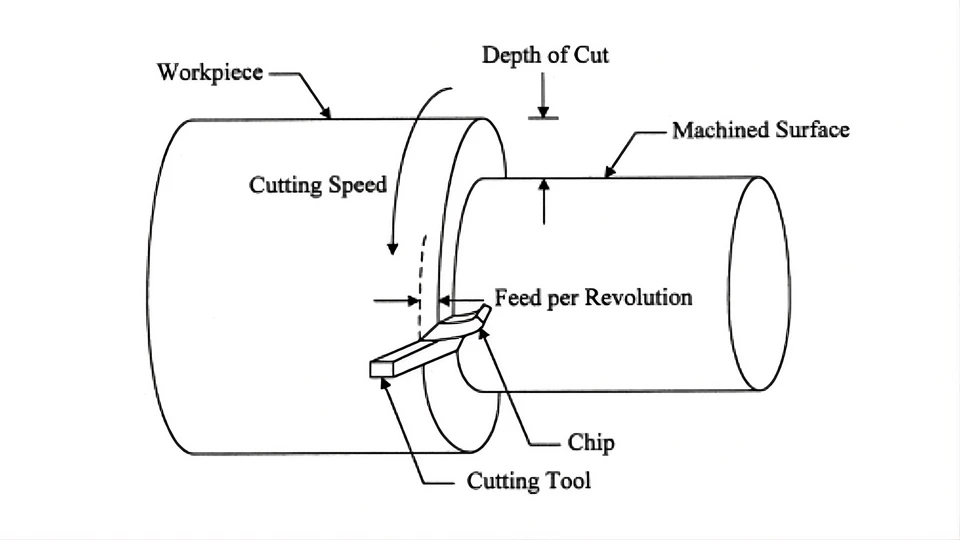
Surface Finish Control
When it comes to the final surface quality of the machined part, feed rate and cutting speed exert their influence through completely different pathways.
Feed rate is a direct, geometric factor. Assuming the tool’s nose radius remains constant, the feed rate directly dictates the physical spacing of the feed marks (scallops) left on the material. A higher feed rate fundamentally creates a wider, deeper residual texture, directly increasing the surface roughness ($Ra$ value). If you need to change the physical pattern on the part, feed rate is the primary dial to turn.
Cutting speed is an indirect, conditional factor. It does not alter the geometric layout of the tool path. However, maintaining an optimal, sufficiently high cutting speed prevents the material from tearing and eliminates the formation of Built-Up Edge (BUE)—a condition where material welds to the tool and ruins the finish. While it doesn’t dictate the geometry of the feed marks, the right cutting speed ensures those marks are cleanly sheared and visually pristine.
Practical Application: Roughing vs. Finishing Strategy
The theoretical differences discussed above dictate exactly how these parameters are manipulated across different stages of the machining process.
- During Roughing: The goal is maximum Material Removal Rate (MRR). The strategy heavily favors mechanical load over thermal load. Engineers will maximize the depth of cut and feed rate to fully utilize the machine’s structural rigidity and spindle torque. Meanwhile, cutting speed is kept relatively conservative to manage heat generation and protect the tool’s lifespan during heavy stock removal.
- During Finishing: The goal shifts entirely to dimensional accuracy and surface finish. The strategy reverses. The feed rate is drastically reduced to minimize the geometric spacing of the feed marks. Simultaneously, the cutting speed is elevated (within safe limits) to ensure a crisp, clean shearing action that prevents BUE, taking advantage of the lighter mechanical load to achieve a mirror-like finish.
Quick Comparison: Feed Rate vs. Cutting Speed
To summarize, the distinction between these two parameters lies in what they physically stress and economically control. Here is a quick reference guide:
| Feature | Cutting Speed | Feed Rate |
| Primary Effect | Tool wear rate & thermal generation | Surface finish & machining time |
| Machine Component Stressed | Spindle system (Torque & Power) | Linear axes (Ball screws & guideways) |
| Limiting Factor | Tool material & thermal stability | Tool strength & machine rigidity |
| Rule of Thumb for MRR | Increase cautiously to protect tool | Maximize first for higher efficiency |
Feed Rate and Cutting Speed in Turning, Milling, and Drilling
Although feed rate and cutting speed follow the same basic principles across CNC machining, their behavior becomes easier to understand when they are placed inside actual machining operations. In practice, turning, milling, and drilling do not apply motion in the same way, so the meaning and effect of these two parameters must always be read in the context of the specific process.
Feed Rate and Cutting Speed in Turning
Turning is the clearest operation for understanding the difference between feed rate and cutting speed because the motion relationship is highly visible. In a turning operation, the workpiece rotates, and the tool advances linearly along or across the rotating part. This makes it easy to separate the two parameters conceptually.
In turning, cutting speed is created by the surface rotation of the workpiece. The outer diameter of the part determines how fast the material surface travels past the cutting edge at a given RPM. This is why diameter matters so much in turning. At the same spindle speed, a larger diameter produces a higher cutting speed than a smaller one. As the diameter changes during the cut, the actual cutting speed changes unless the machine compensates for it.
Feed rate in turning is the linear advance of the tool relative to the rotating workpiece. It is often expressed as millimeters per revolution (mm/rev) because each spindle revolution corresponds directly to one increment of tool advance. This makes turning especially intuitive: cutting speed comes from how fast the part surface moves, while feed rate comes from how far the tool advances per revolution.
Their practical effects are also easy to separate. Increasing cutting speed in turning mainly changes thermal behavior at the tool–workpiece interface. Increasing feed rate mainly thickens the chip, raises mechanical cutting force, and changes the spacing of the feed marks left on the part. Because the geometry is so direct, turning is often the first operation where machinists truly learn how these two variables differ.
Feed Rate and Cutting Speed in Milling
Milling is more complex than turning because the tool rotates while the tool or table advances, and multiple cutting edges may enter and exit the cut during each revolution. This makes the relationship between cutting speed and feed rate more dynamic, and it is also why beginners often confuse feed rate with related values such as feed per tooth.
In milling, cutting speed is determined by the cutter diameter and spindle RPM. The outer edge of the rotating cutter generates the cutting speed, which means the same RPM will produce a different surface speed if the cutter diameter changes. This is the same physical principle seen in turning, but now it is the cutter diameter rather than the workpiece diameter that controls the surface velocity.
Feed rate in milling is the programmed linear movement of the cutter relative to the workpiece, usually expressed in mm/min or IPM. However, this total feed rate only becomes meaningful when it is connected to the number of teeth on the cutter. That is why milling engineers frequently work backward from feed per tooth (fz). The goal is not merely to move the tool quickly, but to ensure that each flute removes the proper chip thickness as it enters the cut.
This is where a major source of confusion appears: feed rate is not the same as feed per tooth. Feed rate is the total linear advance of the machine, while feed per tooth is the amount of material each cutting edge removes during engagement. A tool with more flutes can run a higher total feed rate while maintaining the same chip load per edge. If this distinction is missed, milling data becomes very easy to misread.
From a practical standpoint, raising cutting speed in milling mainly affects heat, edge temperature, and the cutter’s thermal condition. Raising feed rate mainly affects chip thickness, cutting force, tooth load, and machine axis demand. Because milling is interrupted cutting, both variables must also be judged against vibration behavior, tool engagement, and stability.
Feed Rate and Cutting Speed in Drilling
Drilling applies the same two parameters, but in a more enclosed cutting environment. The drill rotates while advancing axially into the workpiece, meaning both cutting speed and feed rate are still present, but their physical consequences are concentrated inside the hole.
In drilling, cutting speed is generated at the outer diameter of the drill. That outer edge travels the fastest and therefore experiences the highest surface speed. The center of the drill, by contrast, has almost no true cutting speed because surface velocity drops toward zero at the axis. This non-uniform speed distribution is one reason drilling behaves differently from many external cutting operations.
Feed rate in drilling is the axial advance of the drill into the material, commonly expressed as mm/rev or mm/min depending on the machine and programming style. In practical terms, feed rate controls how aggressively the drill penetrates the material and how much mechanical thrust is generated along the spindle axis.
The distinction between the two parameters remains consistent. Cutting speed controls the thermal condition of the drill margin and outer cutting edges, while feed rate controls penetration load, thrust force, and chip evacuation demand. This becomes especially important because chips are confined inside the hole. If feed is too aggressive for the drill geometry or the material, chip evacuation can fail and mechanical load rises rapidly. If speed is too high, heat builds at the drill edge and wear accelerates.
That is why drilling often feels less forgiving than turning or open-face milling. The same conceptual difference still applies, but the confined nature of the operation makes both thermal and mechanical mistakes show up more quickly.
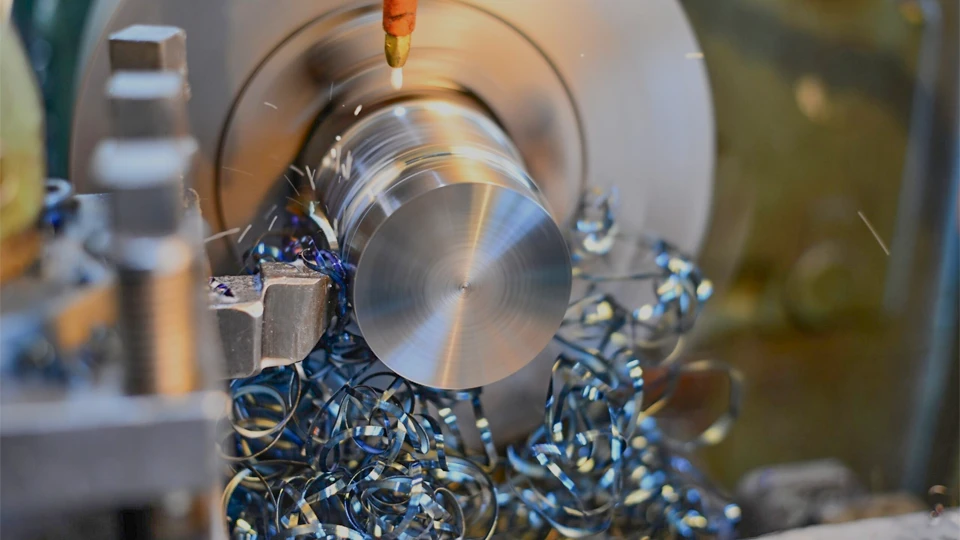
Conclusion
Feed rate and cutting speed are closely connected in CNC machining, but they do not control the same part of the process. Once that difference becomes clear, it becomes much easier to understand how machining parameters affect heat generation, mechanical load, tool life, surface finish, and overall cutting behavior. In practical terms, cutting speed mainly shapes the thermal condition of the cut, while feed rate mainly controls chip load, cutting force, and feed mark formation. Understanding both correctly is one of the most important foundations for making better machining decisions in turning, milling, and drilling.
For manufacturers that want to apply these principles in real production, machine capability matters just as much as parameter knowledge. Rosnok is a manufacturer of CNC lathes, machining centers, milling machines, vertical lathes, pipe thread lathes, Swiss type lathes, and other metalworking machine tools designed for stable cutting performance, reliable rigidity, and practical production efficiency. When the machine structure, spindle system, and feed system are properly matched to the application, feed rate and cutting speed become much easier to control with confidence.