Understanding Axis Directions on a Lathe
Axis directions are used on a lathe to describe tool movement in a clear and consistent way. Before looking at individual axes, it is important to understand why this system exists and what problem it is designed to solve.
Why a Standard Axis System Is Used on Lathes
On a lathe, simple directional words such as “left,” “right,” or “forward” can be misleading. These directions depend on the operator’s position and viewing angle, which can easily cause confusion when explaining machining processes or sharing technical information.
A standard axis system removes this ambiguity by providing fixed reference directions. Using axis-based descriptions ensures that tool movement is explained in the same way by different operators, across different machines, and in different contexts. This common reference prepares the reader to understand how individual axes are defined and used in the following sections.
The Z Axis on a Lathe
The Z axis is typically the first axis discussed when explaining lathe motion.
Direction and Orientation of the Z Axis
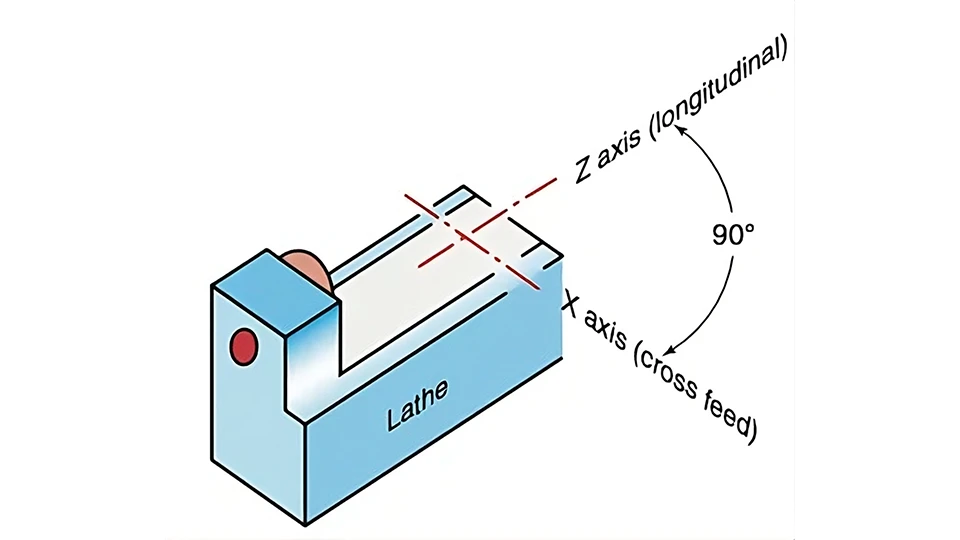
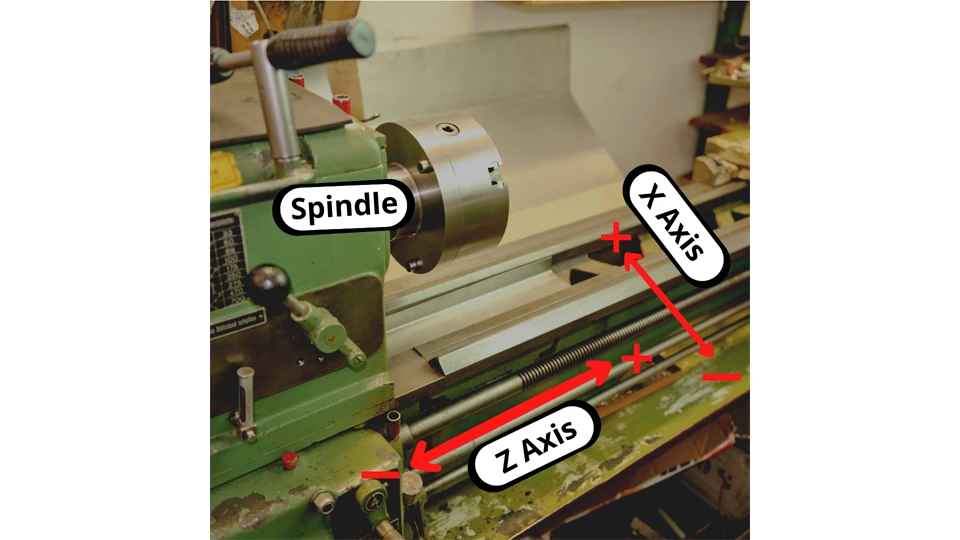
The Z axis on a lathe is oriented along the length of the machine. It runs parallel to the spindle and the centerline of the workpiece. This orientation makes the Z axis the reference for movement along the longitudinal direction of the lathe.
When the cutting tool moves left or right along the bed, it is moving along the Z axis. This definition does not change based on the operator’s position or viewing angle, which is why the Z axis provides a consistent way to describe tool movement.
What the Z Axis Controls in Turning Operations
The Z axis controls tool movement along the length of the workpiece during turning. This movement allows the tool to machine features that extend in the axial direction, such as straight shafts, shoulders, and threaded sections.
Because many turning operations involve shaping material along the workpiece length, the Z axis is used frequently. It defines where material is removed along the axis of rotation but does not describe spindle rotation or cutting speed.
Practical Examples of Z-Axis Movement
When machining a straight shaft, the tool moves along the Z axis while maintaining a fixed position in the radial direction. This produces a uniform diameter along the length of the part.
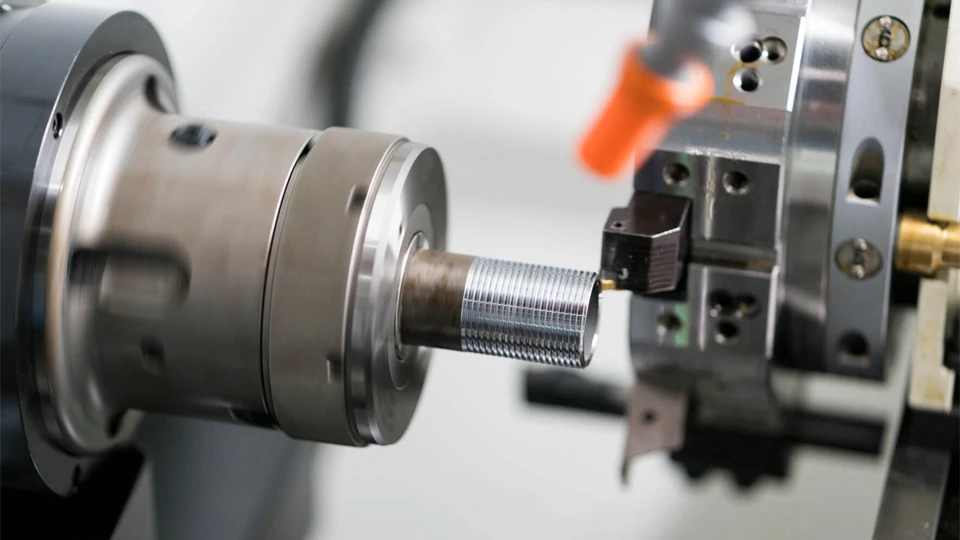
In thread cutting, controlled movement along the Z axis allows the tool to follow the thread path accurately as the workpiece rotates. These examples show how the Z axis mainly determines position along the length of the workpiece during lathe machining.

The X Axis on a Lathe
The X axis is another fundamental axis on a lathe, following the Z axis.
Direction and Orientation of the X Axis
The X axis on a lathe is oriented perpendicular to the spindle and the workpiece centerline. It represents radial movement, meaning the axis extends inward toward the center of the workpiece and outward away from it.
When movement occurs along the X axis, the position changes relative to the centerline rather than along the length of the machine. This orientation remains fixed regardless of the operator’s position, providing a consistent reference for describing radial direction.
What the X Axis Controls in Turning Operations
The X axis determines changes in the size of the workpiece diameter during turning. Movement along this axis defines how much material is removed radially, directly affecting external and internal dimensions.
Operations such as external turning, boring, and facing all rely on the X axis to establish final diameters or internal sizes. While the Z axis defines position along the length of the part, the X axis governs size across the diameter.
Practical Examples of X-Axis Movement
When turning an external cylinder, the cutting position is set by moving along the X axis to the required diameter, after which the lengthwise shaping is carried out by movement along the Z axis.
During internal machining, such as boring, movement along the X axis adjusts the internal diameter of the workpiece. These examples show how the X axis primarily controls size and diameter in lathe machining.
The Y Axis on a Lathe
The Y axis is not present on every lathe, but when it is available, it expands what the machine can do beyond the basic X–Z setup.
Why Traditional Lathes Do Not Have a Y Axis
On a conventional lathe, most work is centered on the spindle centerline, and the essential motions can be described with two linear axes. The Z axis covers movement along the length of the part, and the X axis covers movement toward or away from the centerline. For classic turning operations, these two axes are enough to generate the required geometry.
Because of that, many traditional lathes are built as X–Z machines. Adding a Y axis increases structural complexity and cost, and it is unnecessary if the machine’s main job is standard turning on centerline features.
What a Y Axis Adds on a CNC Lathe
A Y axis adds a third linear direction of travel that is independent from X and Z. With this additional axis, the tool is no longer limited to working only at the center of the part, which makes it possible to machine shapes or details that are offset from the centerline.
On many CNC lathes, the Y axis is closely associated with machines that also support additional functions (such as live tooling). The key point is simple: with Y available, the lathe is no longer restricted to “in/out” (X) and “along the length” (Z) positioning only.
Practical Examples of the Y Axis
A common use of the Y axis is machining features that are intentionally off-center, where the working position must shift sideways rather than staying aligned with the spindle centerline. This can include holes, flats, or slots located away from the centerline of the part.
Another practical benefit is reducing extra setups. Instead of moving the part to another machine or using more complicated fixtures to reach an offset feature, the Y axis lets the machine reach that location directly through axis positioning. In this way, the Y axis mainly provides flexibility for parts that include both turned features and non-centered features on the same workpiece.

How the X, Y and Z Axes Work Together on a Lathe
On a lathe, the X, Y, and Z axes are not used in isolation. Each axis describes movement in a different direction, and together they define where the tool can be positioned in relation to the workpiece. Understanding how these axes work together helps form a complete picture of lathe motion.
The Z axis establishes position along the length of the part. The X axis defines position across the diameter. When both axes are used together, the tool can reach any point on the surface of a cylindrical workpiece that lies on the centerline. This combination forms the foundation of most turning operations.
When a Y axis is available, the range of possible positions expands further. The tool is no longer restricted to positions that lie on the centerline plane. By combining X, Y, and Z movement, the machine can reach locations that are offset from the centerline, allowing more complex part features to be handled without repositioning the workpiece.
It is important to note that each axis still has a distinct role. The axes do not replace one another; instead, they complement each other. The overall tool position at any moment is simply the result of where all active axes are positioned at the same time.
Conclusion
Understanding the X, Y, and Z axes on a lathe is not about memorizing directions, but about building a clear mental model of how the machine works. Once the axis system is understood, lathe motion becomes predictable rather than abstract. The Z axis defines movement along the length of the part, the X axis controls diameter and size, and the Y axis extends machining capability beyond the centerline. Together, these axes form the foundation of accurate, repeatable, and efficient lathe machining.
In real-world machining, axis logic is not theoretical—it is built into the mechanical design of the machine itself. Rosnok designs and manufactures CNC lathes with a strong focus on structural rigidity, motion stability, and practical production requirements, ensuring reliable performance in real machining environments. From standard X–Z turning configurations to advanced CNC lathes with Y-axis capability, the focus remains the same: translating machine movement into machining accuracy, stability, and long-term performance.