Closed-loop and semi-closed-loop CNC control systems differ mainly in how they monitor axis movement and correct positioning errors. Closed-loop systems use direct feedback from the actual moving axis, while semi-closed-loop systems usually rely on feedback from the motor or ball screw side. The result is a practical difference in accuracy, stability, cost, and machine application, especially when machining demands become more precise.
Keep reading to see where closed-loop and semi-closed-loop CNC control systems really differ, and why those differences matter in actual CNC machining.
What Is a Closed-Loop CNC Control System?
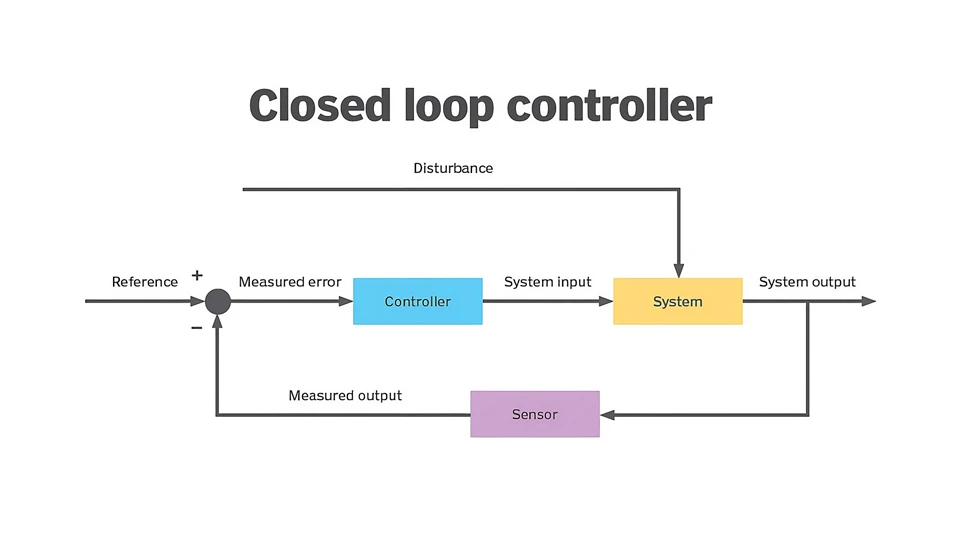
A closed-loop CNC control system is a control method that uses real-time feedback from the actual moving axis to monitor and correct machine motion during machining.
In simple terms, the CNC system does not only send a motion command and assume the axis has reached the target position. It also checks where the axis actually is. If the actual position does not match the commanded position, the system makes a correction.
This is why it is called closed-loop control. The command, movement, feedback, and correction form a complete control loop.
In a typical closed-loop CNC machine, the feedback signal comes from a device that measures the real position of the axis, such as a linear scale or other direct position feedback component mounted close to the machine axis. That matters because the controller is reading the position of the axis itself, not just the rotation of the motor. This bypasses the mechanical transmission chain, including components such as the ball screw and couplings.
Once the controller receives that real position signal, it compares the commanded position with the actual position. If there is any deviation, even a small one, the system dynamically corrects the deviation in real-time so the axis can move closer to the target value. This correction process happens continuously during operation.
Because of this control logic, closed-loop CNC systems are often associated with higher positioning accuracy and stronger error correction ability. They are better suited to situations where direct axis feedback matters, especially when the machine must reduce the effect of motion deviation during precision machining.
Another important point is that closed-loop control is not simply about “adding a sensor.” Its value comes from the fact that the control system can respond to real axis position instead of relying only on theoretical motion. That makes the control process more direct and, in many cases, more precise.
The main advantages of a closed-loop CNC control system usually include stronger position monitoring, more direct correction of axis error, and better support for high-precision machining tasks. At the same time, it also has limits. The system is usually more complex, requires more careful integration, and places higher demands on control tuning, machine matching, and operating conditions.
At its core, a closed-loop CNC control system is designed to answer one question more accurately during machining: Has the axis actually reached the position the CNC system commanded?
What Is a Semi-Closed-Loop CNC Control System?
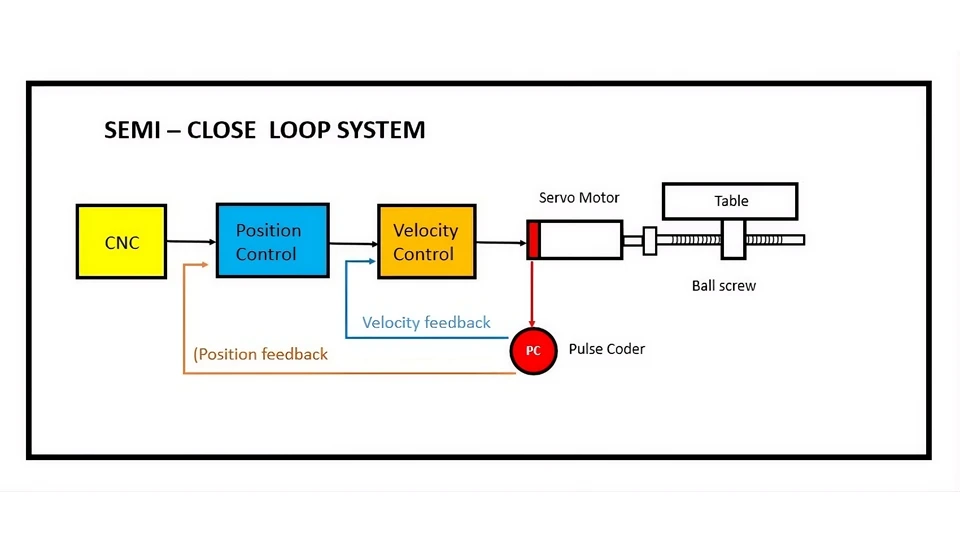
A semi-closed-loop CNC control system is a control method that uses indirect position feedback from the drive side of the motion system, rather than from the actual final axis position.
In most cases, that feedback comes from the servo motor encoder. The CNC controller reads the motor’s rotation and uses that signal to estimate how far the axis should have moved.
This is why it is called semi-closed-loop control. The system still has feedback, so it is not open-loop. But the feedback does not come directly from the actual machine axis position.
In practical terms, the controller monitors motor movement, compares it with the commanded value, and corrects the motion through the servo system. This allows the machine to maintain controlled and accurate movement under normal machining conditions.
Because the feedback is taken from the motor or drive side, the system does not directly measure the final position after the full mechanical transmission chain, including components such as the ball screw and couplings. That means it works through the mechanical system rather than bypassing it.
Even so, semi-closed-loop CNC control is widely used in modern machine tools. The reason is simple. It offers a mature and practical balance between control performance, system stability, and machine cost.
Another reason it remains common is that many machining tasks do not require direct axis feedback to achieve acceptable results. For a large range of standard metal cutting applications, a well-designed semi-closed-loop system can still deliver reliable positioning performance and stable production output.
Its main advantages usually include a simpler control structure, easier system integration, and lower overall complexity compared with more advanced direct-feedback arrangements. In many CNC machines, this makes the system easier to apply and maintain in real production environments.
At the same time, semi-closed-loop control has its limits. Since the controller is not reading the final axis position directly, some motion deviation introduced along the transmission path cannot be observed as directly at the feedback source.
At its core, a semi-closed-loop CNC control system is designed to answer a different question during machining: Has the drive system moved as the CNC controller commanded?
Why Feedback Matters in CNC Machining
Feedback is one of the core ideas behind CNC control, but its importance is often underestimated. Before comparing closed-loop and semi-closed-loop systems directly, it is important to understand why feedback matters in the first place and how it affects real machine behavior.
Feedback Tells the Controller What the Machine Is Actually Doing
In CNC machining, sending a motion command is not enough. The control system also needs to know what the machine is actually doing after that command is sent.
Feedback provides that information. It returns motion data to the controller, so the system does not rely only on programmed instructions. Without feedback, the controller would only assume the commanded movement happened as expected.
This makes feedback a basic requirement for controlled motion. It gives the CNC system a real reference instead of a theoretical one.
Feedback Helps the Machine Reach the Correct Position
Feedback also matters because it affects whether the machine can reach the target position more accurately.
In real machining, commanded motion and actual motion are not always perfectly the same. Small deviations can appear during axis movement. When the control system receives useful feedback, it can respond more effectively and keep the axis closer to the intended position.
That is why feedback is closely connected to positioning accuracy. The clearer the system can observe motion, the better it can control position.
Feedback Supports Consistent Motion Over Time
CNC machining is not only about reaching one correct position once. It is also about repeating motion consistently across many cycles and over long operating periods.
This is where feedback supports repeatability and running stability. Machine axes do not move under static conditions. They accelerate, decelerate, reverse direction, and follow continuous tool paths. Feedback helps the controller manage these changing conditions more consistently.
As a result, the machine is better able to maintain predictable motion during repeated operations, not just isolated movements.
Feedback Gives the Control System a Basis for Correction
Another reason feedback matters is that correction depends on detection. A control system cannot respond to motion deviation unless it can first observe that deviation.
Feedback provides the basis for that response. When the controller receives motion information and detects a difference between the commanded value and the actual response, it can take corrective action within the control loop.
This does not mean every kind of error is corrected in the same way, but it does mean feedback is the starting point for any meaningful correction process in CNC control.
In simple terms, feedback gives the CNC system something essential during machining: confirmation, position awareness, motion consistency, and a basis for correction.
Closed-Loop vs Semi-Closed-Loop CNC Control Systems: Key Differences
Both systems use feedback, but they do not use it in the same way. That difference affects how motion is monitored, how errors are handled, and how the machine behaves in real machining conditions. To compare them clearly, it is better to look at each difference one by one.
Feedback Location
The most fundamental difference is where the feedback signal comes from.
In a closed-loop CNC control system, feedback comes from the actual moving axis position. The controller reads the real axis movement directly through a position feedback device mounted close to the axis.
In a semi-closed-loop CNC control system, feedback usually comes from the servo motor encoder or drive side. The controller monitors motor rotation and uses that signal to estimate axis movement.
This difference matters because the feedback source determines what the controller can see directly during motion. Closed-loop feedback is closer to the final axis position, while semi-closed-loop feedback is taken earlier in the motion chain.
Positioning Accuracy
Because the feedback location is different, positioning accuracy is also affected differently.
Closed-loop systems usually have an advantage when very accurate final axis positioning is required. Since the controller reads the actual axis position, it can respond more directly to position deviation at the output side of motion.
Semi-closed-loop systems can still deliver good positioning accuracy, especially in well-built machines. However, because the controller is not reading the final axis position directly, its position control depends more on how accurately the mechanical drive system transfers motion.
This does not mean semi-closed-loop systems are inaccurate. It means their control accuracy is less direct at the final axis level.
Repeatability and Stability
The next difference is how the system behaves over repeated motion and long operating periods.
Closed-loop systems can maintain strong motion consistency when the application demands tight control over repeated positioning. Direct axis feedback gives the controller a clearer view of actual movement during repeated cycles.
Semi-closed-loop systems can also provide stable repeatability in many production environments, especially when the machine structure is solid and the drive system is well matched. That is why they remain widely used in practical manufacturing.
The key difference is not that one repeats and the other does not. The difference is that closed-loop systems monitor repeated motion more directly at the axis level, while semi-closed-loop systems rely more on the stability of the transmission system behind the feedback signal.
Mechanical Error Compensation
Another major difference is how each system responds to mechanical deviation inside the motion chain.
In a closed-loop system, the controller can observe the final axis position more directly. This gives it a stronger basis for dealing with motion deviation that appears after the motor side, including errors introduced through the transmission system. Closed-loop systems are especially valuable when the machine must deal with dynamic position errors, including thermal expansion in the ball screw during long machining cycles.
In a semi-closed-loop system, the controller does not directly measure the final axis position after the full mechanical chain. That means some deviation introduced between the motor and the final axis cannot be seen as directly at the feedback source.
This is one of the main reasons closed-loop systems are often preferred when compensation ability is especially important. The controller has more direct position information to work with.
System Complexity
Closed-loop systems are usually more complex at the control and integration level.
They require additional feedback hardware, more precise installation, and more careful coordination between the control system and the machine structure. Tuning and calibration also tend to demand more attention. A more direct feedback structure can also make the control loop more sensitive to mechanical resonance or instability if the machine is not well matched.
Semi-closed-loop systems are generally simpler in architecture. Because the feedback is taken from the motor or drive side, the control structure is easier to integrate in many machine designs.
This difference does not automatically decide performance, but it does affect engineering difficulty and implementation requirements.
Cost and Maintenance
The two systems also differ in cost and maintenance demands.
Closed-loop systems usually require more components, more careful setup, and more demanding system matching. As a result, they often involve higher initial cost and greater technical requirements during service and adjustment. In some machine configurations, direct feedback hardware may also require better protection and cleaner operating conditions, which can add to maintenance attention over time.
Semi-closed-loop systems are often more economical to apply. Their structure is simpler, and in many cases they are easier to install, maintain, and troubleshoot in day-to-day factory use.
This is one reason semi-closed-loop control remains common in many CNC machines. The balance between performance and practical maintenance can be very attractive.
Suitable Applications
Because of all these differences, the two systems do not fit every application in the same way.
Closed-loop systems are generally more suitable for machining tasks that place stronger demands on final axis accuracy, direct position correction, and tighter motion control.
Semi-closed-loop systems are often well suited to general metal machining, standard production work, and many applications where stable performance and practical cost control matter more than maximum correction capability.
In other words, the difference is not only technical. It also affects where each system makes the most sense in real manufacturing.
Does Closed-Loop Always Mean Better Performance?
Not always.
Closed-loop control is often associated with higher precision, but that does not mean it is automatically the better choice in every CNC machine or every machining task.
The first reason is simple: control performance does not exist alone. A CNC machine is still a mechanical system. If the machine structure lacks rigidity, alignment quality, thermal stability, or transmission consistency, a more advanced feedback method will not solve every problem by itself.
The second reason is that machining performance is not defined by one indicator only. In real production, shops often care about a combination of factors, including accuracy, stability, maintenance workload, setup difficulty, and total operating cost. A system that offers stronger correction ability may still be unnecessary if the machining task does not require that level of control.
Another important point is that higher control capability usually comes with higher integration demands. A closed-loop system can be very effective, but it also depends more on proper tuning, machine matching, and overall system quality. If those conditions are not well handled, the theoretical advantage of the control system may not be fully reflected in actual machining results. In some cases, a more responsive control loop can also make vibration or instability more noticeable if the machine structure and tuning are not well matched.
This is why semi-closed-loop systems are still widely accepted in many practical applications. In a well-designed machine, they can already provide stable and reliable performance for a large range of standard machining work.
So the better question is not whether closed-loop is more advanced in theory. The better question is whether its advantages are necessary and meaningful for the job you actually need the machine to do.
How to Choose Between Closed-Loop and Semi-Closed-Loop CNC Control Systems
Choosing between closed-loop and semi-closed-loop CNC control systems is not just about which one sounds more advanced. The better choice depends on what your machining work actually needs, how your machine is built, and what kind of long-term value you expect from the investment.
Consider Your Accuracy Requirements
The first question is how much positioning accuracy your application really requires.
If your parts demand tighter final axis control, more direct correction, or better control over deviation during long and demanding machining cycles, a closed-loop system may be the more suitable option.
If your production tasks are more standard and do not require that level of direct axis feedback, a semi-closed-loop system may already provide enough control performance for stable machining.
Evaluate the Machine Structure as a Whole
The control system should never be judged alone. A CNC machine is still a complete mechanical and control system.
Even a stronger feedback method cannot fully replace machine rigidity, transmission quality, assembly accuracy, or thermal stability. The better approach is to ask whether the control method matches the machine structure behind it.
Compare Budget and Total Cost
The decision should not be based only on the initial machine price.
You also need to consider setup demands, service difficulty, maintenance attention, and long-term operating value. A more advanced control system only creates better value when its performance advantages can actually be used in daily production.
Think About Part Type and Production Style
Different machining tasks place different demands on the control system.
If you run high-precision work, demanding contours, or long-cycle machining with tighter control targets, a closed-loop system may offer meaningful benefits. If you focus on standard metal cutting, repeat production, and practical cost control, semi-closed-loop control is often the more balanced solution.
Consider Long-Term Manufacturing Goals
The final decision should support where your production is going, not just what you are machining today.
If your future work is moving toward tighter tolerances, more demanding parts, or higher-value precision applications, a closed-loop system may be worth the extra complexity. If your priority is stable output, manageable cost, and reliable operation across common machining tasks, a semi-closed-loop system may be the smarter long-term fit.
In the end, the best choice is not the one with the more advanced label. It is the one that fits your accuracy target, machine design, production conditions, and long-term manufacturing goals.
Conclusion
In the end, the real difference between closed-loop and semi-closed-loop CNC control systems comes down to how feedback is collected, how motion is corrected, and how that affects actual machining results. Closed-loop systems offer more direct position feedback and stronger correction potential, while semi-closed-loop systems remain a highly practical solution for many standard machining tasks. What matters most is not choosing the system that sounds more advanced, but choosing the one that truly matches your accuracy targets, machine structure, production style, and long-term manufacturing goals.
Seen from a practical manufacturing perspective, the value of any CNC control system depends on how well it fits the machine, the application, and the production target as a whole. That is also the principle behind Rosnok as a CNC machine manufacturer. Rather than focusing only on technical labels, Rosnok pays attention to the full machine solution, including control performance, mechanical structure, machining stability, and long-term production value, so customers can choose equipment that truly fits their machining needs.