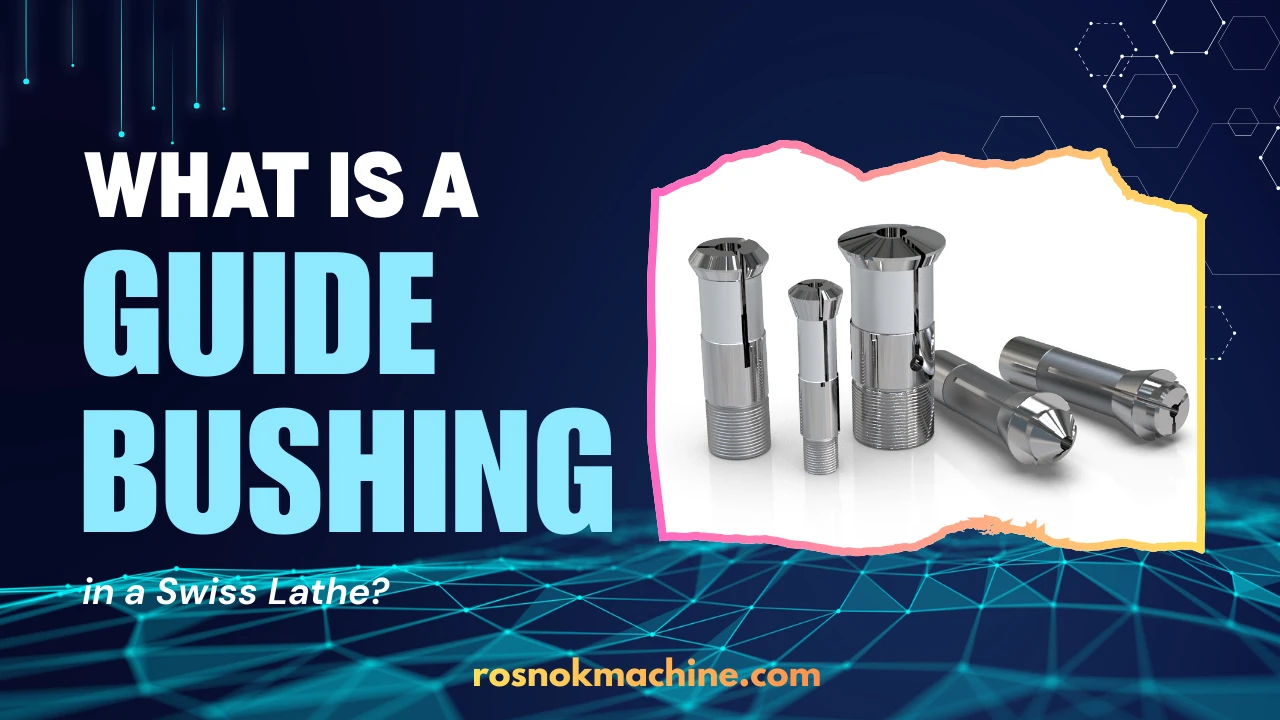
Where Is the Guide Bushing Located?
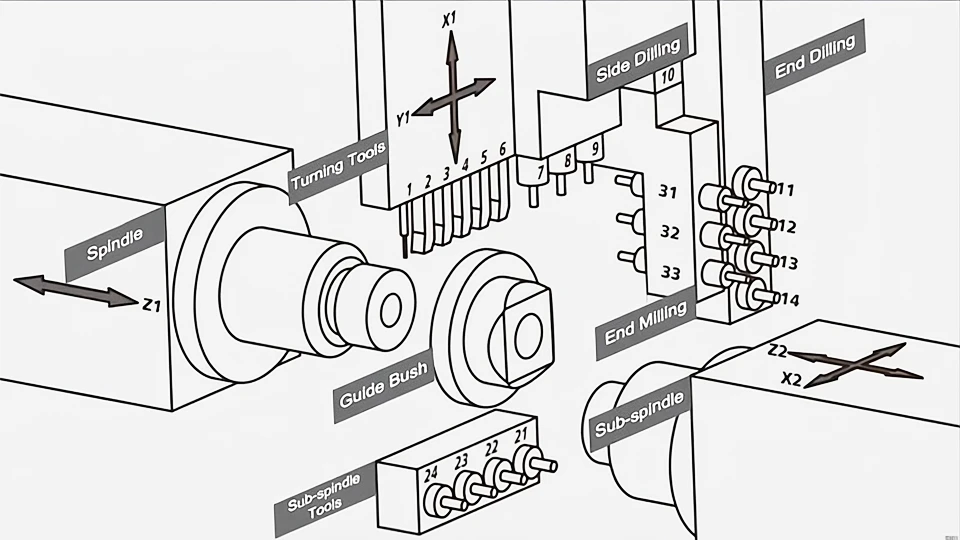
In a Swiss lathe, the guide bushing is located at the front of the bar-feeding path, between the spindle outlet and the cutting zone. The bar stock passes through the spindle and then through the guide bushing before it reaches the tools. In practical terms, the guide bushing sits immediately ahead of the cutting area rather than deeper inside the machine, making it part of the machine’s core front-end layout. This matches the standard Swiss-type structure in which bar material is fed through the spindle hole and only the section being machined enters the cutting zone.
Because of this placement, the guide bushing is directly aligned with the travel path of the bar stock. It is not a separate accessory mounted away from the cutting process, but a support component positioned along the material’s movement path near the point of cut. In standard Swiss-type layouts, the remaining bar stays supported while only the immediate machining section is exposed to the cutting area, which is why the guide bushing is positioned so close to the cutting zone in the first place.
How Does a Guide Bushing Work in a Swiss Lathe?
A guide bushing in a Swiss lathe works by guiding and supporting the bar stock as it passes through the machine toward the cutting tool. In a typical Swiss-type setup, the bar is fed through the spindle hole, and the spindle drives it to rotate during machining. At the same time, the workpiece also moves axially in the Z-axis, so the material is not held in one fixed axial position during machining.
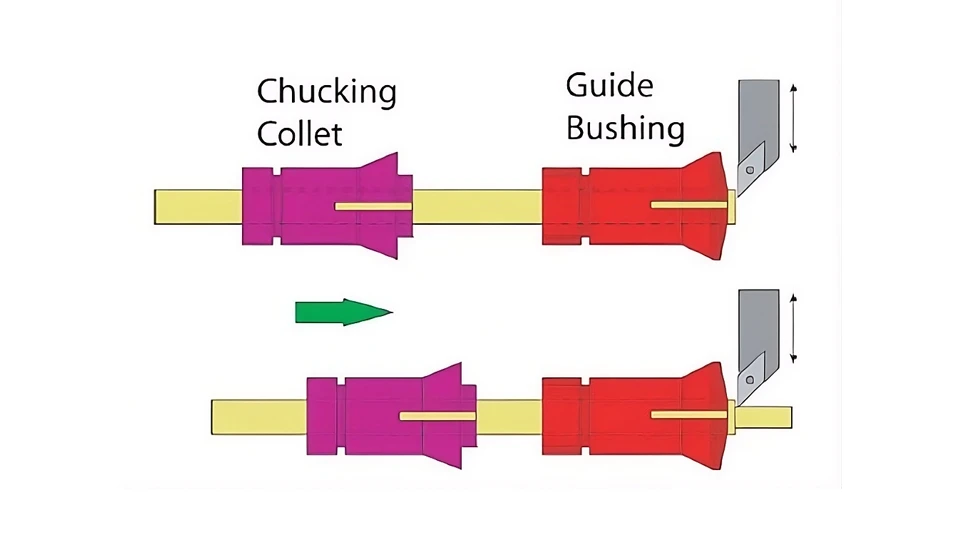
As the bar stock advances, it passes through the guide bushing before reaching the active cutting area. The guide bushing keeps the material supported during this movement, which means the section being machined stays close to the support point instead of projecting too far outward. In standard Swiss-type machine design, only the section to be machined enters the cutting zone, while the remaining bar stays supported as feeding continues.
This is also why the structure differs from a conventional lathe. In a traditional lathe, the workpiece mainly rotates in a more fixed position while the tool feeds along it. In a Swiss-type lathe, the bar material continuously feeds forward during machining, and the guide bushing works as part of that support-and-feeding system rather than as a separate holding device.
Because the support point stays close to the cutting action, this layout naturally relates to terms such as cantilever effect, deflection, and vibration. In simple terms, the guide bushing helps control how the bar behaves while it is rotating and advancing through the machine. That close support is the core of how the guide bushing works in Swiss machining, especially in applications involving long, slender parts and high length-to-diameter ratios.
Why Is a Guide Bushing Important in Swiss Machining?
A guide bushing is important because it helps keep the bar stock stable where machining actually happens. In a Swiss-type lathe, the workpiece often has a high length-to-diameter ratio and is continuously fed during cutting.
Its first value is reduced deflection. When a long, small-diameter bar is being machined, even a small amount of bending can affect size, straightness, and overall consistency. The guide bushing helps limit that tendency by keeping support close to the cutting area rather than leaving too much of the material unsupported.
It is also important for vibration control. In precision turning, vibration is not just a surface-finish issue. It can also affect dimensional stability, repeatability, and even tool life. By helping the bar remain more stable during cutting, the guide bushing supports a more controlled machining condition.
Most importantly, this stability is one of the reasons Swiss machining is so effective for long, slender parts. When the material stays better supported, the machine is better able to maintain accuracy and consistency across small, high-precision components. That is why the guide bushing is not just a structural detail in a Swiss lathe, but a core element in the process’s ability to machine long, slender parts accurately and consistently.
Can a Swiss Lathe Run Without a Guide Bushing?
Yes, a Swiss lathe can run without a guide bushing in certain applications. However, that does not mean the guide bushing is unimportant. In traditional Swiss-type machining, the guide bushing remains one of the defining features of the process because it supports the bar close to the cutting area during machining.
Whether a guide bushing is needed depends largely on the part being produced. If the workpiece has a high length-to-diameter ratio, close support becomes much more important. That is why guide bushings are especially associated with the machining of long, slender, high-precision parts, where bar stability has a direct effect on machining performance. In some cases, this guide-bushing-less setup is referred to as chucker mode.
So the practical answer is simple: some Swiss lathes can run without a guide bushing, but many classic Swiss applications still rely on one. Running without a guide bushing may also be chosen in some applications to reduce material waste by shortening the remnant length. When the part is slender and the machining requirement is demanding, the guide bushing remains a central part of the process.
Conclusion
A guide bushing may appear to be a small part in a Swiss lathe, but its role is far more important than many beginners first assume. Once readers understand where it is located, how it works, and why it matters, the logic of Swiss-type machining becomes much easier to follow. At its core, a guide bushing supports bar stock close to the cutting area, helping the machine process long, slender workpieces with greater control, stability, and accuracy. That is why it remains one of the defining features of traditional Swiss-type lathe design.
For manufacturers evaluating Swiss-type machining for real production needs, understanding the guide bushing is also an important step in choosing the right machine structure for the right parts. Rosnok is a CNC machine tool manufacturer focused on metal machining solutions, with products including Swiss-type lathes built for precision, reliability, and demanding production applications, as well as other types of lathes and machining centers. For buyers who want to understand not only what a machine does, but also why its structure matters, that distinction is well worth attention.