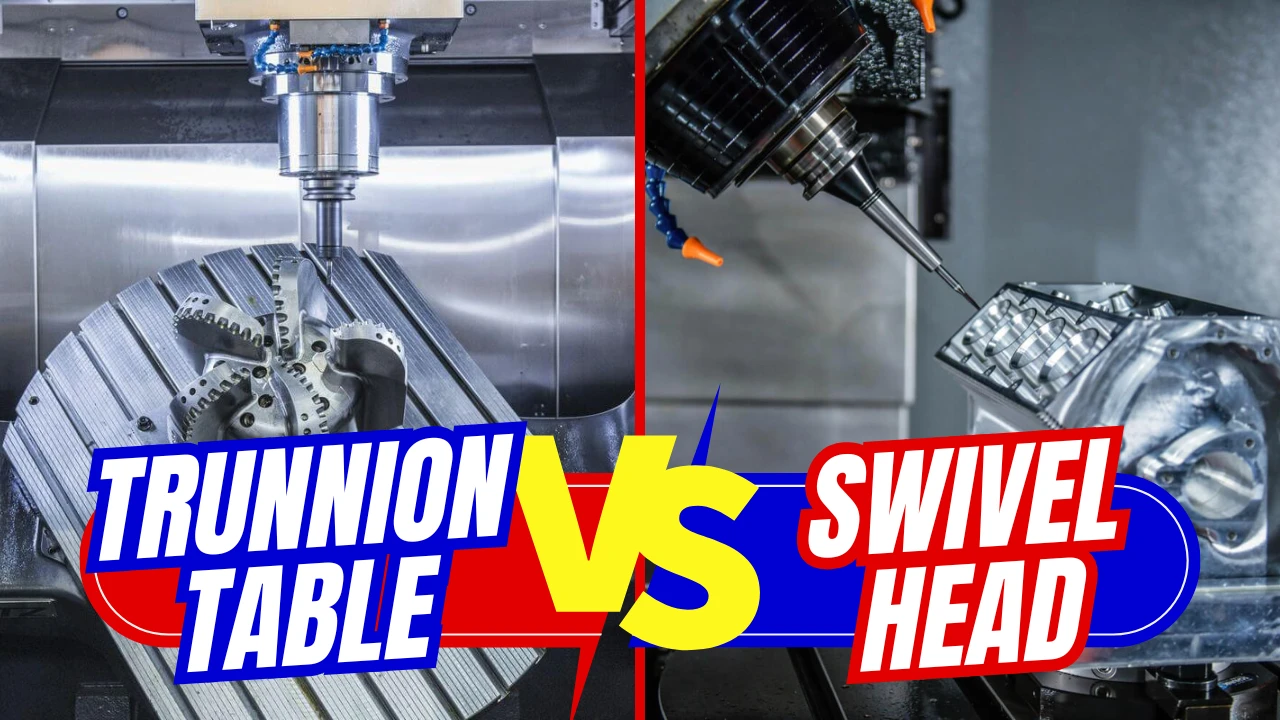
The main difference is where the rotary axes are located: a trunnion machine rotates the workpiece on the table, while a swivel head machine tilts the spindle head to approach the part from different angles. This structural difference affects rigidity, usable work envelope, tool length, part size capacity, and the kinds of applications each machine handles best.
Keep reading to see how trunnion and swivel head machines differ in rigidity, work envelope, tooling flexibility, and real machining applications.
What Is a Trunnion 5-Axis Machine?
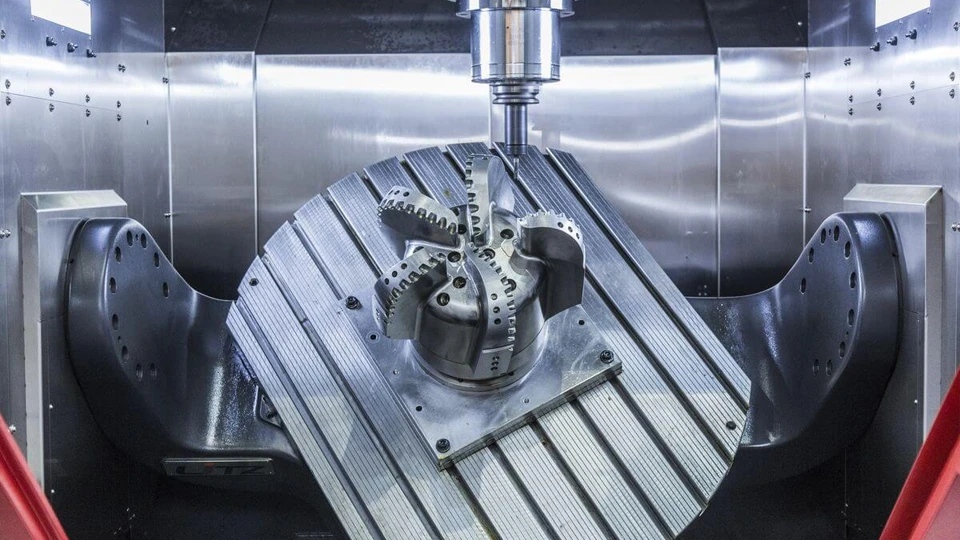
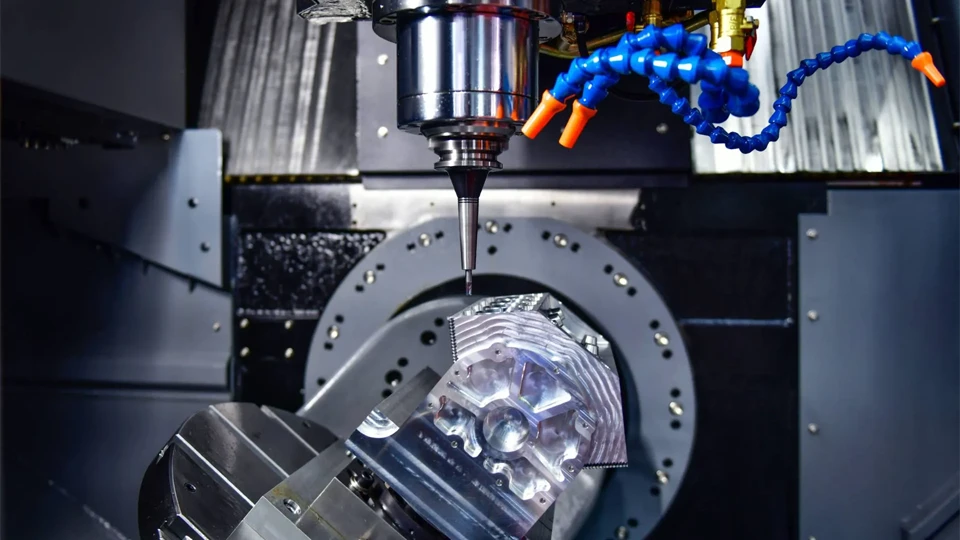
A trunnion 5-axis machine is a type of 5-axis CNC machine where the workpiece is mounted on a tilting rotary table. Unlike designs that rely on a moving spindle head to achieve machining angles, this configuration adjusts the orientation of the part itself.
In a typical trunnion setup, the rotary axes—specifically the A-axis (tilting) and C-axis (rotation)—are integrated into the table. This allows the workpiece to be positioned precisely to expose multiple surfaces to the cutting tool in a single setup. This capability makes trunnion machines a widely used solution for high-precision, multi-sided machining of complex components.
In essence, the defining characteristic of a trunnion machine is that the part moves with the table, while the spindle maintains a consistent orientation.
What Is a Swivel Head 5-Axis Machine?
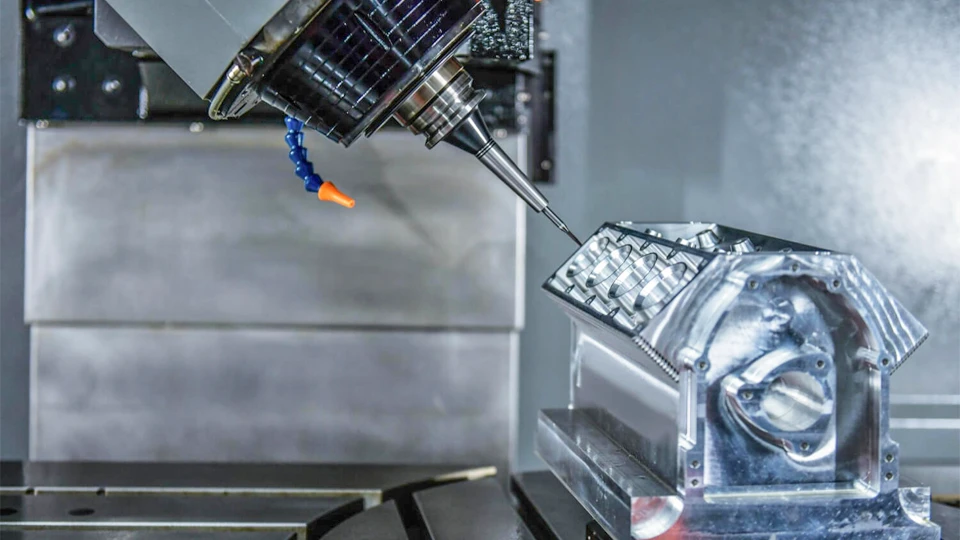
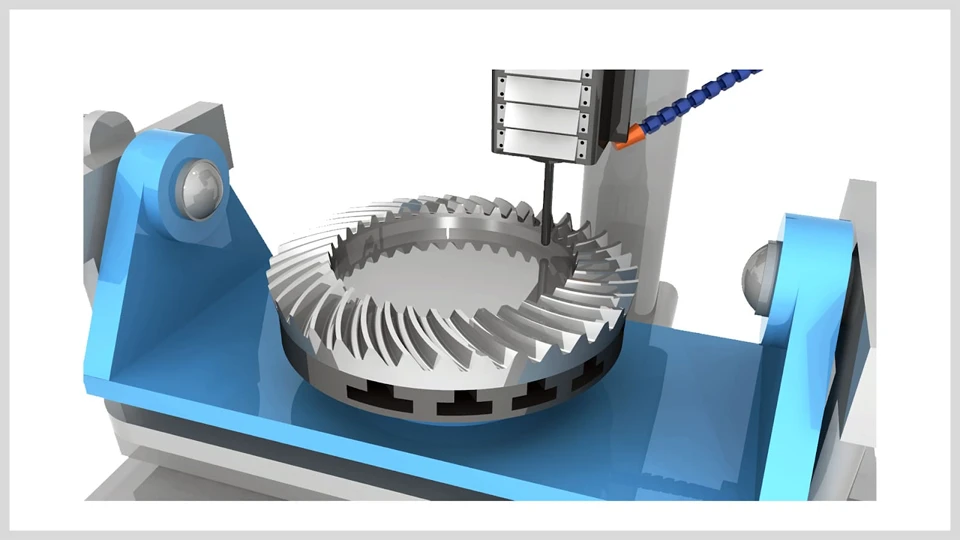
A swivel head 5-axis machine is a type of 5-axis CNC machine in which the spindle head tilts or rotates to reach different machining angles. Unlike a trunnion design, where the workpiece changes orientation on the table, this configuration creates angular access mainly through movement of the spindle head itself.
In a typical swivel head setup, the rotary axes are integrated into the head assembly, allowing the cutting tool to approach the workpiece from multiple directions without relying entirely on table motion. This makes swivel head machines a widely used solution for machining parts that require flexible tool access, especially when the workpiece is larger or less suitable for frequent table tilting.
In essence, the defining characteristic of a swivel head machine is that the spindle head moves to create the cutting angle, while the workpiece remains more stable on the table.
Trunnion vs Swivel Head: What Is the Main Difference?
Although both machine types belong to the 5-axis CNC category, they are built around fundamentally different structural concepts. The most important distinctions begin with how rotary motion is generated and how the machine creates the required cutting angle. Understanding this structural foundation is essential to comparing the two designs clearly.
Rotary Axis Location
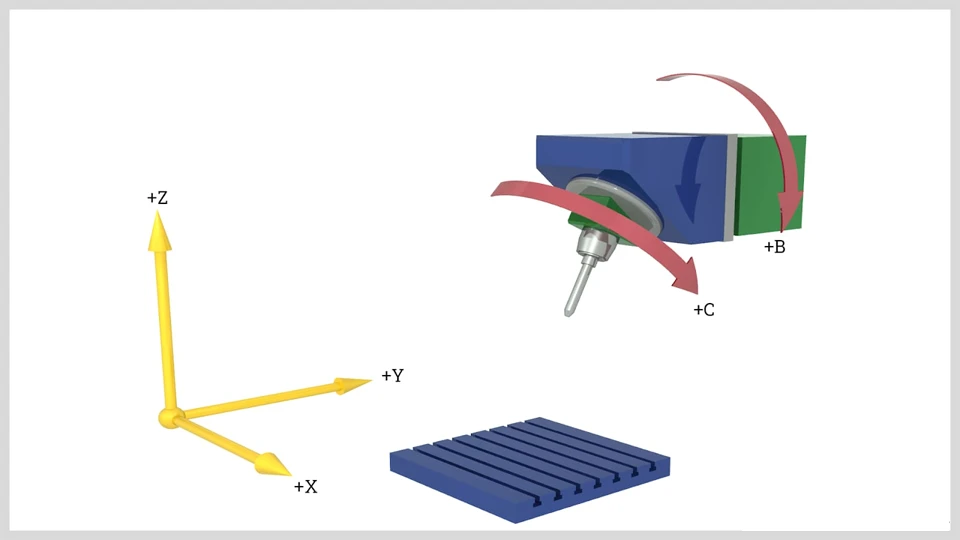
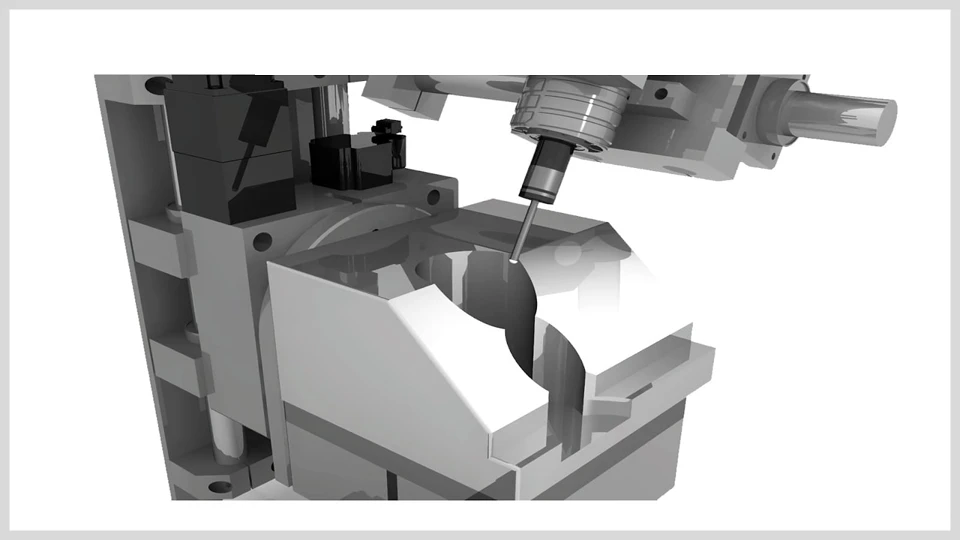
The primary difference between a trunnion machine and a swivel head machine lies in the location of the rotary axes. In a trunnion configuration, the rotary axes are integrated into the trunnion table, meaning the workpiece itself tilts and rotates during machining. In a swivel head configuration, the rotary axes are built into the spindle assembly, allowing the cutting tool to change angle while the workpiece remains more stable on the table.
This structural difference defines how each machine achieves angular access. In practical terms, a trunnion machine generates rotary motion through the table and the workpiece, while a swivel head machine generates it through the spindle head and tool side. Because the rotary axes are placed in different parts of the machine, axis location becomes the starting point for understanding every other difference between the two designs.
Workpiece Movement vs Tool Movement
Another core difference between trunnion and swivel head machines is how each one creates the required cutting position during machining. In a trunnion machine, the workpiece moves with the table, so the part itself is tilted and rotated into the required angle. In a swivel head machine, the spindle head moves to create that angle, while the workpiece stays in a more fixed position on the table.
This means the two designs handle motion in fundamentally different ways. A trunnion machine changes the orientation of the part, while a swivel head machine changes the orientation of the tool. This distinction is important because it shapes how each machine behaves once more demanding machining conditions are involved.
Rigidity, Structural Stability, and Gravity Load
Rigidity and structural stability are influenced not only by machine mass or casting design, but also by how the machine manages motion and load during 5-axis machining. In a trunnion machine, the workpiece tilts and rotates with the table, which means the center of gravity shifts as the machining angle changes. This makes gravity load a dynamic variable in the machine’s behavior, especially when the part is heavy or mounted with a significant offset, since the changing position of the load can also increase torque demand on the rotary system.
In a swivel head machine, the workpiece remains in a more stable orientation on the table while the spindle head handles the angular movement. Because the part is not continuously tilted through the same type of rotary motion, the gravity load on the workpiece side tends to remain more consistent. This is one reason swivel head designs are often considered better suited to larger or heavier workpieces.
However, overall rigidity is never determined by configuration alone. Axis support, spindle design, casting quality, and actual cutting conditions all play an important role, so these differences should be understood as structural tendencies rather than fixed rules.
Work Envelope, Part Size Capacity, and Interference
Work envelope is defined not only by linear travel, but also by how much usable space remains once rotary motion is involved. In a trunnion machine, the workpiece tilts and rotates with the table, so the setup envelope can expand significantly as the angle changes. This can reduce practical workspace, especially when the part is large, the fixture is tall, or the setup already occupies much of the table area.
As the table moves toward more extreme angles, part of the setup envelope may rise further into the machine space, reducing usable vertical clearance and increasing the risk of interference. In these situations, clearance issues can develop between the part, fixture, spindle, or enclosure, even if the machine’s nominal axis travel appears sufficient.
In a swivel head machine, the workpiece generally remains in a more stable position on the table, which often makes the available workspace more predictable for larger or heavier parts. For this reason, part size capacity should not be judged only by table dimensions or axis travel, but by the real usable space that remains after tilt, fixture height, and interference risk are taken into account.
Tool Reach and Accessibility
Tool reach and accessibility depend on how each machine configuration positions the tool relative to the part. In a trunnion machine, the table rotates the workpiece into position, which can make it easier to approach multiple surfaces while keeping the tool in a more favorable orientation. In some cases, this also helps reduce effective overhang, allowing shorter and more rigid tools to be used on complex but compact parts.
In a swivel head machine, the spindle head creates the angular movement directly. This can provide greater flexibility when the workpiece is too large or too heavy to reorient through table motion alone. However, because the head assembly itself has physical size, accessibility is not determined by tool length alone. In deep cavities or tight-clearance areas, the spindle head may approach an interference limit before the tool reaches the feature, which can require more careful path planning or longer tooling.
For this reason, accessibility should be judged not only by nominal reach, but by the real geometric relationship between the tool, the spindle structure, and the part.
Application Suitability
Application suitability depends on how well each machine configuration matches the geometry, size, and machining demands of the part. Trunnion machines are often well suited to small or medium-sized components that require multi-face machining, complex angles, and efficient repositioning within a compact setup. This makes them a common fit for applications such as medical components, precision molds, and other complex parts where access to multiple surfaces is important.
Swivel head machines are generally better suited to larger or heavier workpieces that are less practical to tilt through table motion alone. Because the workpiece remains in a more stable position while the head creates the cutting angle, this configuration is often a better fit for large structural parts, larger mold applications, and other setups where part mass and workspace stability are more significant concerns.
For this reason, neither design is universally better. The more practical question is which machine structure fits the part, the setup, and the machining task more naturally.
Advantages of Trunnion 5-Axis Machines
Trunnion machines are widely used because their structure offers practical advantages in many precision machining tasks. When the part is rotated by the table rather than relying mainly on spindle-head articulation, the machine can deliver efficient multi-face access in a compact setup. This makes trunnion designs especially valuable in applications that require flexibility, repeatability, and precise angular positioning.
Better for Small to Medium Complex Parts
One of the main advantages of a trunnion 5-axis machine is its suitability for small to medium-sized complex parts. Because the workpiece is mounted on a tilting rotary table, the machine can expose multiple faces of the part in a controlled and efficient way without requiring repeated manual repositioning. This is especially useful for components with angled features, compound surfaces, or multi-side machining requirements.
This configuration is often a strong fit for precision parts where complexity matters more than raw size. In these cases, the trunnion structure helps combine compact machine layout with high positional flexibility, which is why it is commonly used for demanding multi-sided work in industries such as medical manufacturing, precision tooling, and advanced metalworking.
Efficient Multi-Side Machining
Another major advantage of trunnion machines is their efficiency in multi-side machining. Since the table can tilt and rotate the part into different cutting positions, several faces can often be machined in a single setup. This reduces the need for repeated re-clamping, which helps improve inter-feature positional accuracy and lowers the risk of cumulative setup error.
Single-setup machining is one of the most practical strengths of a trunnion design. It can shorten setup time, improve consistency between features, and better preserve the geometric relationship of the part across multiple machined surfaces.
Strong Access to Complex Angles and Surfaces
Trunnion machines also offer strong access to complex angles and surfaces because the part itself can be reoriented through table motion. By tilting the workpiece into a more favorable position, the machine can often approach difficult features more directly, which is particularly useful for parts with angled surfaces, deep contours, or multiple intersecting geometries.
In some cases, this part reorientation also makes it possible to use shorter and more rigid cutting tools instead of relying on excessive tool extension to reach angled features. That can improve cutting stability and make the machine especially effective for high-precision contouring and multi-angle machining within its most efficient working range.
Advantages of Swivel Head 5-Axis Machines
Swivel head machines offer a different set of strengths from trunnion designs, especially when the workpiece is larger, heavier, or less practical to reorient through table motion. Because the spindle head creates the cutting angle directly, this configuration can provide a more stable workpiece position and a more predictable working space in many demanding machining situations. These structural traits make swivel head machines especially valuable where part size, setup stability, and flexible tool approach matter most.
Better for Large or Heavy Workpieces
One of the biggest advantages of a swivel head 5-axis machine is its suitability for large or heavy workpieces. Since the part remains in a more stable position on the table while the spindle head handles the angular movement, the machine does not rely on tilting the full workpiece mass through the same type of rotary motion used in a trunnion setup. This makes the configuration more practical when the part is physically difficult to rotate or when setup mass becomes a significant factor.
In many of these cases, clamping is also easier to manage because the workpiece can remain in a more natural resting position on the table rather than being prepared for repeated tilting. For larger structural components, heavier fixtures, or bulky setups, this can make the overall machining process more stable and easier to control.
More Stable Workpiece Positioning in Certain Applications
Another advantage of a swivel head machine is that it can maintain a more stable workpiece position during machining. Because the cutting angle is generated from the head side, the part does not need to be continuously tilted through the same type of rotary movement. This can help keep gravity load on the workpiece side more consistent, which is particularly valuable when the setup is large, tall, or heavy.
This stability can also benefit applications where fixture security and spatial predictability are important. When the workpiece stays in a more fixed position, it becomes easier to manage clearance around larger setups and to maintain a more consistent relationship between the part and the table throughout the process.
Greater Flexibility for Specific Machining Tasks
Swivel head machines also provide strong flexibility for machining tasks where direct spindle articulation is an advantage. By changing the angle of the spindle head itself, the machine can approach certain features without depending entirely on table motion to create access. This can be especially useful when the part is too large to tilt efficiently or when the setup would otherwise create practical limits for rotary table movement.
In many cases, this head-based motion also works with a more open and predictable work zone around the part, which can be helpful when machining larger setups or managing heavy-duty clamping arrangements. That is one reason swivel head machines are often selected for machining environments where part size, setup scale, and head-side approach flexibility are more important than compact table-driven repositioning.
Trunnion vs Swivel Head: Which One Should You Choose?
There is no single best answer between trunnion and swivel head machine designs. The right choice depends on what kind of parts you machine, how those parts are fixtured, and which machining conditions matter most in your real production environment. The most practical way to choose is to match the machine structure to the physical and process demands of the work.
Choose Based on Part Size and Weight
Part size and weight are often the first deciding factors. If the workpieces are relatively small to medium in size but geometrically complex, a trunnion machine is often a strong fit because the table can reorient the part efficiently within a compact machining space. If the parts are larger, heavier, or more difficult to tilt safely, a swivel head machine is usually the more practical option because the workpiece can remain in a more stable position on the table.
This distinction becomes more important as setup mass increases. Once the part, fixture, and clamping system become too large or heavy for efficient table-driven repositioning, the advantages of a swivel head structure become more apparent.
Choose Based on Rigidity and Machining Stability
If machining stability is strongly affected by part mass, gravity load variation, or setup height, a swivel head machine often offers a more stable starting point because the workpiece is not continuously tilted through the same type of rotary motion. This can be helpful in larger or heavier setups where consistent load behavior matters.
A trunnion machine, however, can still be highly effective when the part is smaller and the setup remains within the machine’s most efficient working range. In those cases, the structure can support precise and stable machining while also providing strong angular flexibility. The key is not to treat rigidity as a simple machine-category label, but as a result of the actual part, setup, and cutting conditions together.
Choose Based on Work Envelope and Interference Risk
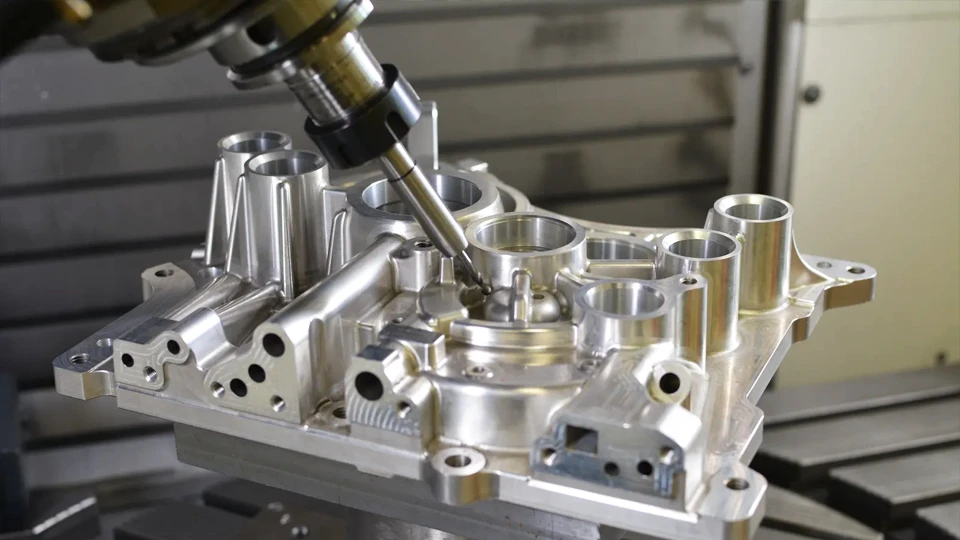
If the setup is tall, bulky, or likely to approach the machine’s spatial limits during tilt, interference risk becomes a major part of the decision. In a trunnion machine, rotary table motion can consume usable space more quickly as the angle changes, especially when the fixture or part already occupies a large portion of the working area. For those situations, a swivel head machine often provides a more predictable usable envelope around the part.
On the other hand, if the workpiece is compact and the setup remains well within the rotary range of the table, a trunnion machine can use its workspace very efficiently. The right decision depends less on nominal travel numbers and more on the real clearance that remains once tilt, fixture height, and setup geometry are taken into account.
Choose Based on Real Application Requirements
The final decision should always come back to the actual machining task. If the priority is compact multi-face machining, efficient single-setup processing, and access to complex surfaces on smaller parts, a trunnion machine is often the better fit. If the priority is handling larger workpieces, keeping the setup more stable, and working within a more predictable space around the part, a swivel head machine is often the stronger choice.
In other words, the best machine is usually the one whose structure matches the real application most naturally. That is a more useful standard than asking which design is better in the abstract.
| Factor | Trunnion Machine | Swivel Head Machine |
|---|---|---|
| Best For | Small to medium, high-complexity parts | Large, heavy, or long workpieces |
| Rotary Motion | Table-driven / workpiece-driven | Head-driven / tool-side driven |
| Workpiece Position | Tilts and rotates with the table | Remains more stable on the table |
| Gravity Load | More dynamic as tilt angle changes | More consistent on the workpiece side |
| Interference Risk | Can increase at extreme tilt angles | Often more predictable around large setups |
Conclusion
Trunnion and swivel head machines represent two different approaches to 5-axis machining, and neither one is universally better in every situation. The real value of this comparison is understanding how structure affects performance in practice. Trunnion machines are often a strong fit for compact, complex parts that benefit from efficient multi-face machining, while swivel head machines are often better suited to larger or heavier workpieces that require a more stable setup and a more predictable working space. Once these structural differences are understood clearly, it becomes much easier to match the machine to the real machining task rather than relying on broad assumptions.
For manufacturers evaluating 5-axis solutions, the best decision usually comes from combining machine structure, part requirements, and production priorities into one practical judgment. That is also how we approach machine design and customer support at Rosnok. As a CNC machine manufacturer focused on real metalworking applications, Rosnok pays close attention to machining stability, structural logic, and long-term usability, so customers can choose solutions that fit their parts, processes, and production goals more naturally.