Why Thermal Compensation Matters in Real CNC Machining
Thermal Compensation matters because thermal error is not a minor detail in CNC machining. In machine tools, thermal error is widely reported as one of the main contributors to machining inaccuracy, and several technical studies place it at roughly 40% to 70% of total machining error. When heat changes the machine’s geometry, axis position and cutting stability can shift enough to affect the final result. That is why Thermal Compensation is closely tied to real machining accuracy, not just to machine specifications on paper.
In real production, the value of Thermal Compensation is consistency. A CNC machine is not judged only by whether it can cut one good part. It is judged by whether it can keep dimensions stable across repeated cycles, longer runs, and changing operating conditions. Siemens notes that thermal expansion changes actual axis positions and has a negative impact on workpiece precision. In practical terms, this means Thermal Compensation helps the machine hold dimensional stability more reliably as production continues.
Thermal Compensation also matters because it improves process repeatability and reduces process uncertainty. When machining accuracy drifts during production, operators often need more offset adjustment, more checking, and more correction between parts or batches. A more thermally stable machine process supports better repeatability, more predictable inspection results, and fewer interruptions caused by dimension movement. This is especially important where the customer expects stable quality, not just acceptable quality on a single test piece.
Another reason Thermal Compensation matters is that modern manufacturing increasingly values “accuracy of the first part” as well as stability over the full run. HEIDENHAIN specifically notes that first-part accuracy is becoming more important and that thermal error is attracting growing attention, especially in feed axes. For real CNC machining, this means Thermal Compensation supports faster process stabilization, lower scrap risk, and more confidence in production performance from startup to steady operation.
Why Thermal Error Happens in CNC Machines
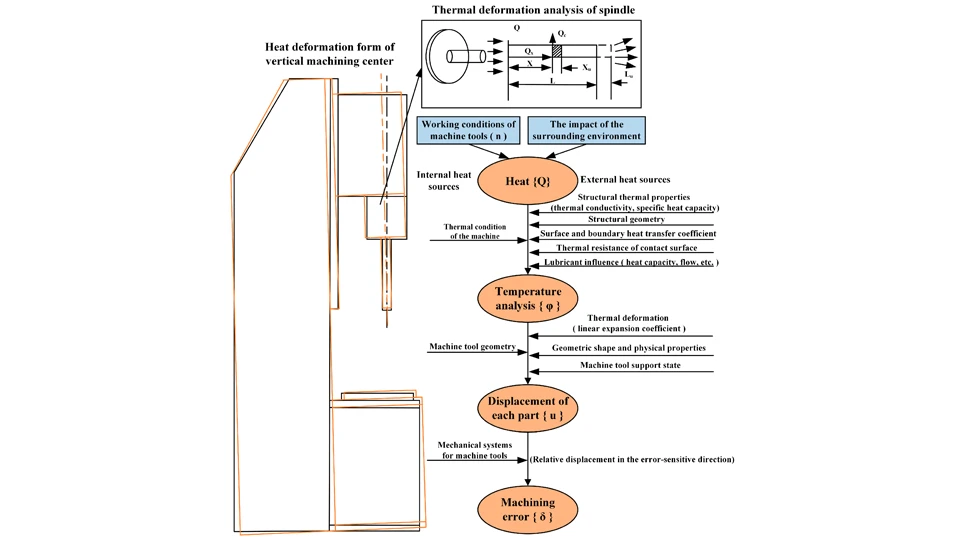
Thermal error happens because a CNC machine does not stay at one stable temperature during operation. As the machine runs, different components heat up at different rates, and that uneven temperature change causes small expansions, shifts, and distortions in the machine structure. In machine tools, thermal error is widely linked to both internal heat sources and external environmental changes, which is why it remains one of the most important causes of accuracy loss in practice.
Heat from the Spindle
One common source is the spindle. During rotation, the spindle system generates heat through bearings, motor operation, and friction. As spindle speed increases, heat generation usually increases as well, which can lead to thermal growth in the spindle and nearby structure. This is one reason spindle-related thermal behavior is so often discussed in machine tool accuracy research.
Heat from the Feed Drive System
Another major source is the feed drive system, especially ballscrews, servo motors, and related moving parts. As these components run, friction and drive load create heat, leading to thermal expansion of the ballscrews and related transmission components. That heat can change the effective position of the axis by causing thermal expansion in the transmission system. This is why feed-drive heat is a major factor in CNC positioning performance.
Heat-Related Changes in the Machine Structure
Thermal error is also affected by the machine structure itself. Even when the amount of heat is not extreme, non-uniform temperature distribution across the column, bed, headstock, or other structural parts can create small geometric changes. Uneven heat across the column, bed, or headstock can cause slight bending, tilting, or other geometric changes in the machine structure. These changes do not need to be large to affect machining accuracy. In precision machining, even slight structural movement can influence the relative position between tool and workpiece.
Ambient Temperature Changes
Thermal error is not caused only by the machine’s internal systems. Ambient temperature changes in the workshop also matter. If the surrounding environment changes during the day, or if the machine is exposed to unstable airflow or nearby heat sources, the machine’s thermal state can shift again. Day-to-day ambient variation, seasonal temperature changes, or unstable airflow around the machine can all influence the machine’s thermal state. That is why thermal error in CNC machining is best understood as the result of both machine-generated heat and environmental temperature variation.
Methods of Implementing Thermal Compensation
Thermal Compensation is usually implemented through a combination of machine design, temperature data, and CNC control logic. In practice, the goal is not only to detect heat, but to limit its effect and then correct the resulting position error as accurately as possible. That is why thermal compensation in CNC machining is often built in layers rather than through one single function.
Structural and Design-Based Thermal Control
The first layer is structural and design-based thermal control. This is the passive side of thermal compensation. A machine with better thermal symmetry, better heat isolation, and better cooling layout is naturally less sensitive to temperature change. Research and technical references on machine tool thermal stability consistently treat structural symmetry, thermal insulation, and temperature control as core methods for reducing thermal deformation before software compensation is even applied.
Sensor- and Model-Based Thermal Compensation
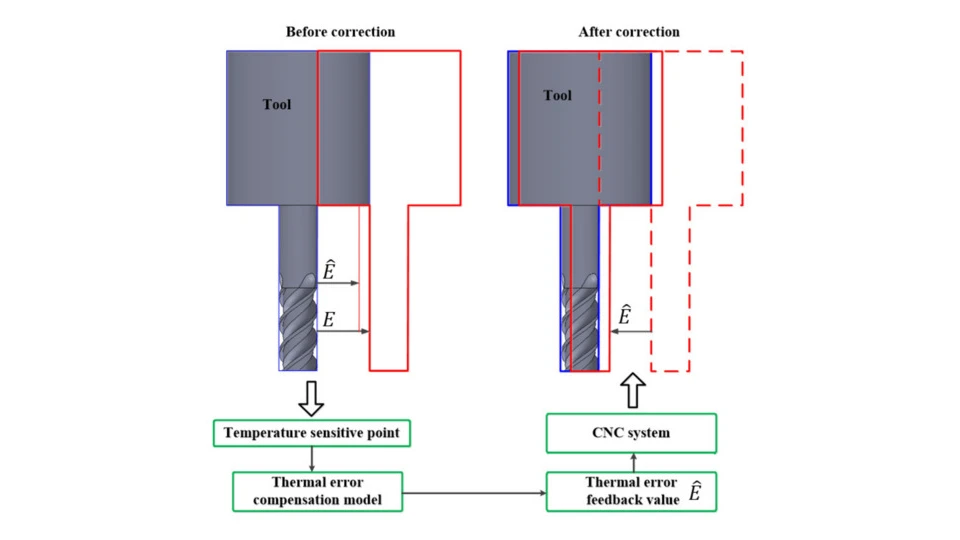
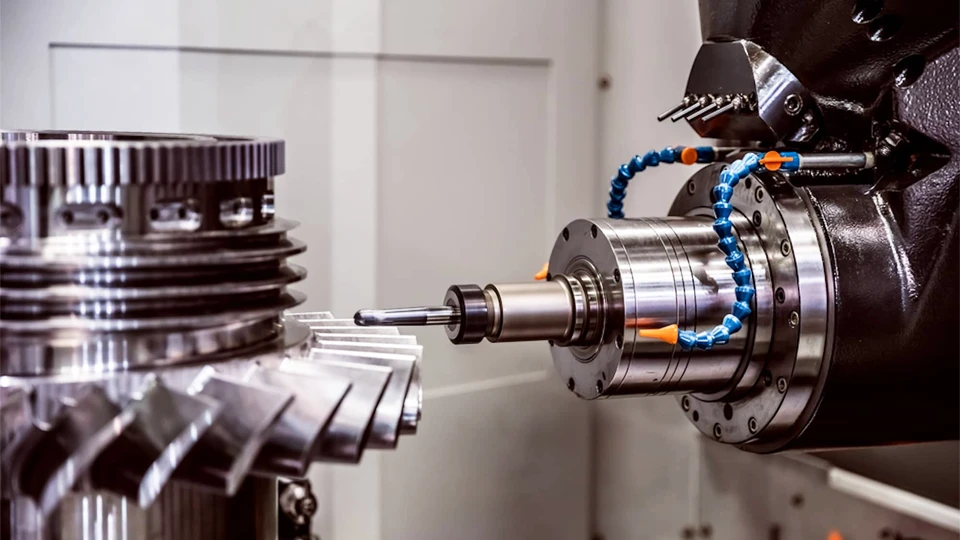
The second layer is sensor- and model-based compensation. Here, temperature sensors are placed at key locations such as the spindle area, feed system, or machine structure to capture thermal changes during operation. The control system then uses a compensation model to relate those temperature inputs to likely thermal displacement or position error. Siemens documentation describes temperature compensation as relying on temperature sensors and axis-based compensation logic, while thermal error modeling research treats temperature-sensitive points as the key inputs for predictive compensation models.
Real-Time Compensation Through CNC Control
The third layer is real-time compensation through the CNC control. After thermal behavior is measured and modeled, the control applies correction values to the relevant axis or tool position during operation. In higher-accuracy setups, feedback systems such as linear encoders can further reduce the influence of drive-side thermal effects. HEIDENHAIN notes that when a linear encoder is used for position measurement, thermal expansion of the ball screw has no influence on measured position and position drift becomes negligible. This does not replace Thermal Compensation as a whole, but it strengthens the machine’s ability to maintain actual axis accuracy under changing thermal conditions.
Limitations of Thermal Compensation
Thermal Compensation can reduce thermal error, but it cannot remove every source of machining inaccuracy. Thermal behavior in a CNC machine is influenced by many variables at the same time, including heat generation, machine structure, load condition, and ambient temperature. Because of that, compensation accuracy depends heavily on how well the machine’s thermal behavior is modeled and how stable those operating conditions remain. Recent reviews describe the difficulty of modeling non-linear thermal behavior as a core limit in thermal error compensation, especially when working conditions change.
Another limitation is that Thermal Compensation cannot fully replace good machine design. If a machine has weak thermal symmetry, poor cooling layout, or unstable structural behavior, software compensation can only do part of the job. In practice, thermal stability still starts with the machine itself, which is why machine builders treat structural control and compensation as complementary rather than interchangeable.
Thermal Compensation also depends on environment and maintenance. Siemens documentation notes that permissible ambient conditions must be followed for the control system and compensation functions to operate properly. This means unstable workshop temperature, poor airflow control, or weak maintenance discipline can reduce the effectiveness of compensation even when the function itself is available. Large machine tools are especially sensitive to ambient temperature fluctuation, which can directly affect machining performance.
There is also a practical limit in what the control system can directly correct. Some errors can be compensated effectively at the axis or position level, but thermal behavior in real machining is not always simple or uniform. Different machine structures, duty cycles, and axis configurations respond differently to heat. Heavy roughing and fine finishing, for example, do not create the same thermal load or thermal response. In other words, Thermal Compensation is an important accuracy tool, but it should be understood as part of a broader precision system rather than as a complete solution by itself.
Conclusion
Thermal Compensation matters because CNC machining accuracy is not only about static machine specifications, but about how well a machine can stay stable as thermal conditions change. Throughout this article, I have shown that thermal error comes from the real operating behavior of the machine, that effective compensation depends on practical implementation, and that even advanced compensation still has its limits. In real machining, Thermal Compensation is valuable because it helps improve dimensional stability, supports repeatability, and makes production performance more reliable under changing thermal conditions.
This is also why thermal stability should be considered as part of overall machine performance rather than as an isolated control function. In practical manufacturing, achieving stable accuracy depends on the combined effect of machine structure, control capability, and application-focused design. With this understanding, Rosnok continues to develop CNC machine solutions for real production needs, including CNC lathes, machining centers, milling machines, vertical lathes, pipe thread lathes, and Swiss-type CNC lathes, helping manufacturers pursue more stable and consistent machining results in demanding working environments.