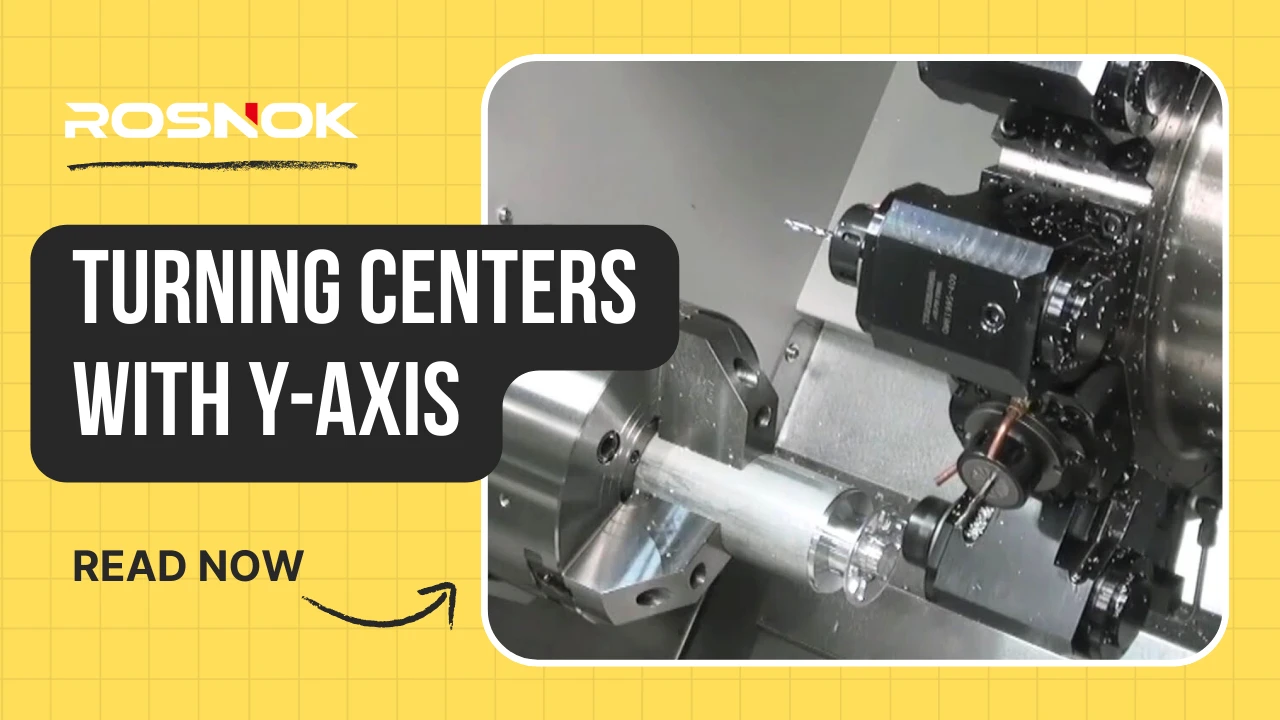
Understanding the Y-Axis in CNC Turning Centers
To understand what a Y-axis turning center can do, it is first necessary to clarify what the Y-axis represents within the machine structure. The Y-axis changes how the cutting tool can move relative to the spindle centerline, extending the capability limits of traditional XZ-only turning centers.
What Is the Y-Axis in a Turning Center?
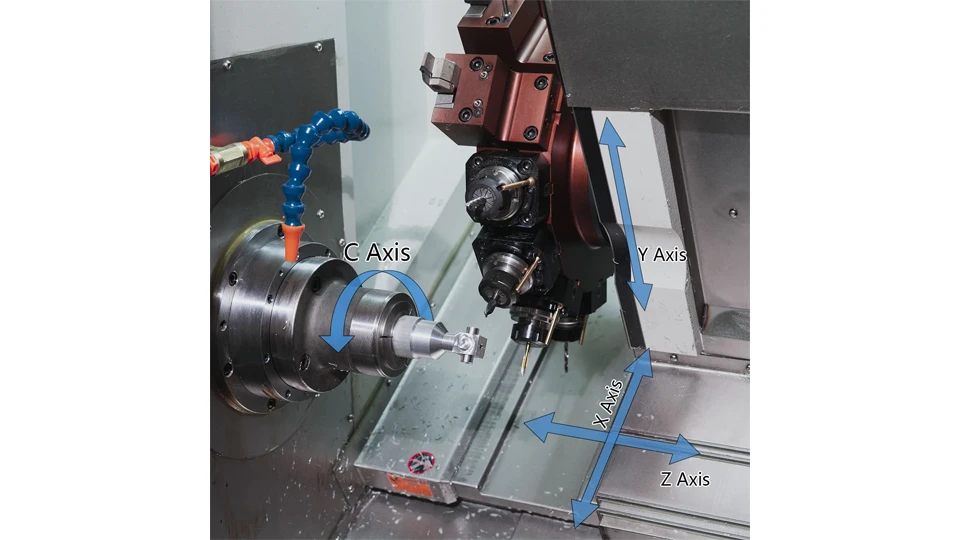
In a CNC turning center, the Y-axis is a linear feed axis that is perpendicular to the spindle centerline, working together with the X and Z axes to form a three-axis linear motion system.
- X-axis: controls the radial position of the tool relative to the workpiece center
- Z-axis: controls the axial movement of the tool along the spindle direction
- Y-axis: allows linear tool movement perpendicular to the XZ plane
In addition to these linear axes, many turning centers also provide C-axis control, which means the spindle can be positioned and controlled as a programmable rotational axis rather than simply spinning at a set speed. This enables the machine to coordinate spindle angle with tool motion when required.
In traditional turning centers without a Y-axis, tool motion is strictly confined to the XZ plane. As a result, all machining features are inherently constrained to be symmetric about the spindle centerline.
The introduction of the Y-axis removes this geometric limitation.
The cutting tool is no longer forced to remain on the spindle centerline plane and can instead move laterally in a controlled manner, providing the necessary motion freedom for off-center machining and contoured milling operations.
Y-Axis vs Traditional XZ Turning
To understand the role of the Y-axis, it is essential to first recognize the capability limits of traditional XZ turning.
In a standard XZ turning center:
- The spindle functions only as a rotational axis
- Tool movement is limited to the X and Z directions
- All machining features must be symmetric about the spindle centerline
Even when live tooling is present, the absence of a Y-axis significantly restricts milling operations. Certain off-center features can only be achieved through multiple setups, complex fixturing, or compromises in process planning.
The Y-axis does not replace the X or Z axes; it adds a missing degree of spatial freedom. It allows the cutting tool to access regions that are unreachable in an XZ-only configuration while maintaining the same rotational reference of the workpiece, fundamentally expanding the range of machinable features.
In practice, some turning centers without a Y-axis rely on polar coordinate interpolation, using coordinated motion between the X-axis and C-axis to approximate milling paths. This approach can produce certain contoured features, but the effective cutting radius changes continuously during machining. As a result, maintaining consistent cutting conditions becomes more difficult, which can affect surface finish and process stability, especially on more complex profiles.
A true Y-axis provides independent linear motion, allowing the tool path to be controlled directly in Cartesian space. This makes it easier to maintain stable cutting conditions and predictable tool engagement when performing milling operations on a turning center.
Relationship Between Y-Axis, C-Axis, and Live Tooling
One important point must be clearly stated: the Y-axis does not function as a standalone capability.
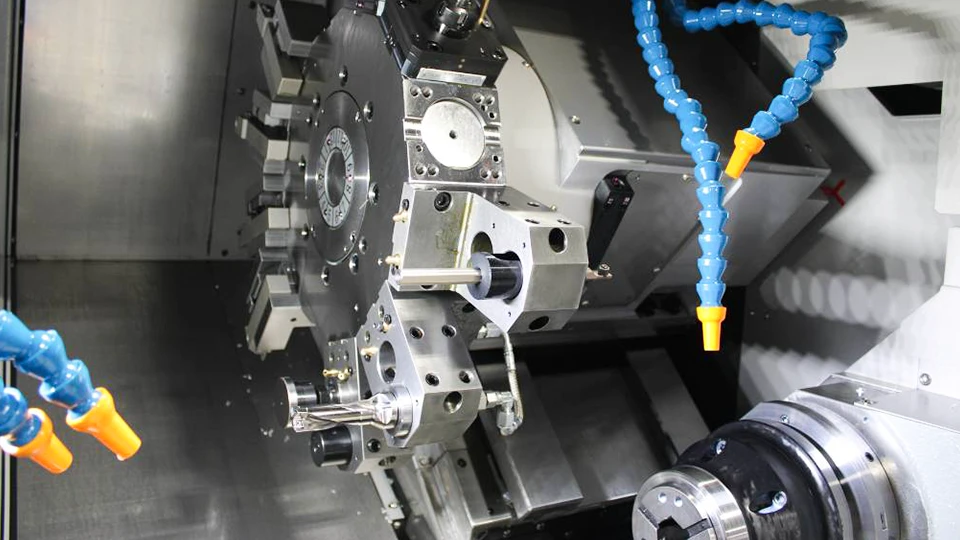
In practical CNC turning centers, the Y-axis operates in coordination with the C-axis, which provides precise angular positioning and interpolation of the spindle, and live tooling, which supplies cutting power for milling and drilling operations.
Without C-axis control and live tooling, the Y-axis alone has little practical machining value.
For this reason, the term “Y-axis turning center” in an engineering context typically implies a machine that includes X, Z, and Y linear axes, C-axis spindle control, and support for live tooling.
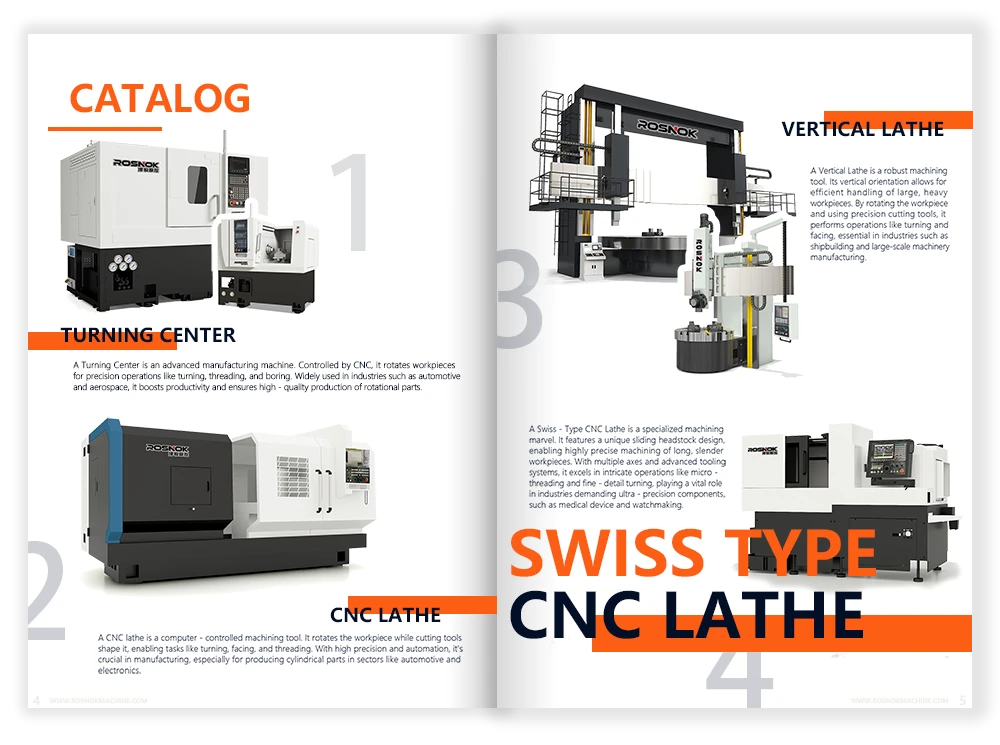
This combination also explains one of the key distinctions between a CNC turning center and a conventional CNC lathe. The former is designed as an integrated platform for multi-process machining, while the latter is primarily intended for pure turning operations.
Machining Capabilities Enabled by the Y-Axis
The addition of a Y-axis fundamentally expands what a turning center can physically machine. Rather than changing how efficiently parts are produced, the Y-axis changes what types of features and operations are possible on a turning platform.
Off-Center Machining Capabilities
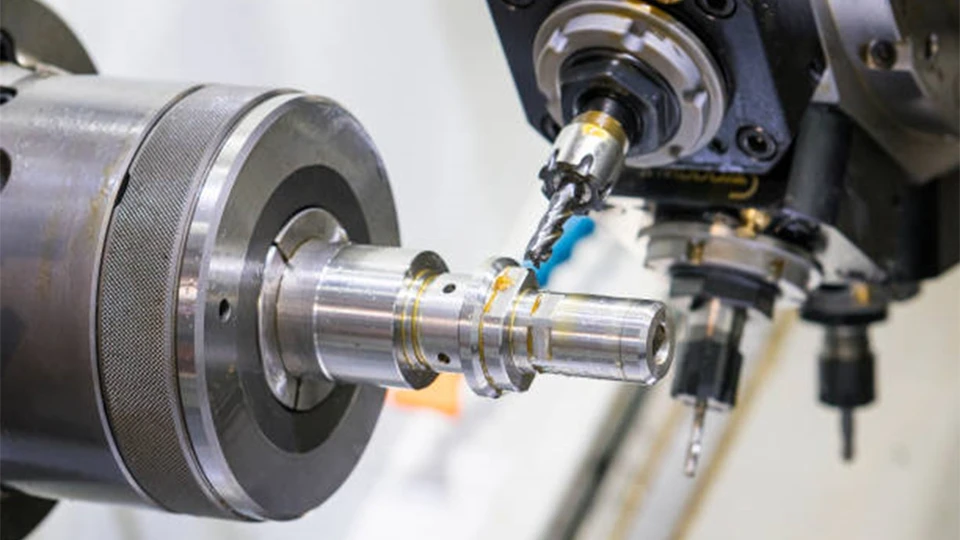
The most direct capability enabled by the Y-axis is off-center machining. By allowing linear tool movement perpendicular to the spindle centerline, the Y-axis makes it possible to machine features that are not symmetric about the rotational axis of the workpiece.
Typical off-center features include:
- off-center holes
- off-center slots
- asymmetrical milled flats
Without a Y-axis, these features are either impossible to machine directly on a turning center or require complex workarounds using multiple setups or specialized fixturing. The Y-axis provides a straightforward geometric solution by allowing the tool to be positioned independently of the spindle centerline.
Contoured Milling Features on a Turning Center
In addition to simple off-center features, the Y-axis enables contoured milling features to be machined directly on a turning center. These features are typically produced through coordinated motion of the X, Y, and Z linear axes, often in combination with controlled spindle orientation.
Common examples include:
- milled pockets
- profile slots
- contoured outlines on cylindrical or end faces
It is important to clarify the capability boundary here. Y-axis turning centers are well suited for 2.5D and limited 3-axis milling operations, but they are not intended to replace machining centers for large freeform surfaces or complex sculptured geometries. The Y-axis expands milling capability within the context of turning-based machine architecture.
Multi-Face Operations in a Single Setup
The presence of a Y-axis also enables multi-face operations to be performed without repositioning the workpiece. By combining linear Y-axis motion with controlled spindle indexing, tools can access different machining faces around the circumference or on the end face of the part.
This capability allows a turning center to machine:
- features on the end face
- features on the cylindrical surface
- features located at specific angular positions
All of these operations are achieved while the workpiece remains clamped in the same orientation. The Y-axis provides the necessary spatial offset to reach these faces directly.
Key Advantages of CNC Turning Centers with Y-Axis
The advantages of a Y-axis turning center do not come from adding more machining functions, but from how those functions are combined and executed within a single machine setup. Based on the machining capabilities discussed earlier, this section focuses on the practical advantages that Y-axis turning centers deliver in real production environments.
Single-Setup Machining and Datum Consistency
One of the most significant advantages of a Y-axis turning center is the ability to complete multiple operations in a single setup. By eliminating the need to reclamp or reposition the workpiece, the machining datum remains consistent throughout the process.
This consistency directly reduces positional deviation between features that would otherwise be produced on different machines or in separate setups. The result is not higher theoretical accuracy, but more reliable and repeatable positional relationships between machined features.
Improved Positional Accuracy for Complex Features
When off-center and multi-face features are machined without changing the workpiece orientation, positional accuracy is easier to maintain. Errors introduced by secondary setups, fixture tolerances, or manual alignment are largely avoided.
For parts with multiple functional features, the Y-axis enables these relationships to be controlled within a single coordinate system, improving overall feature alignment without relying on downstream correction processes.
Reduced Re-Clamping and Shorter Cycle Times
By consolidating turning and milling operations on one platform, Y-axis turning centers significantly reduce the need for intermediate handling steps. Each eliminated setup reduces not only handling time, but also the indirect delays associated with inspection, re-alignment, and part transfer.
Cycle time reduction in this context comes primarily from process integration, not from faster cutting speeds or aggressive parameters. This makes the improvement more predictable and easier to standardize across different production runs.
Higher Process Stability and Repeatability
Fewer setups and fewer manual interventions lead to a more stable machining process. Once a process is proven on a Y-axis turning center, it can be repeated with minimal variation between parts and between batches.
This stability is especially valuable in continuous or unattended machining scenarios, where consistent execution matters more than peak performance under ideal conditions.
Overall Production Efficiency and Floor Space Utilization
A Y-axis turning center can often replace multiple standalone machines by combining operations into a single workflow. This consolidation simplifies material flow, reduces in-process inventory, and lowers the complexity of shop-floor scheduling.
From a layout perspective, fewer machines performing more complete processes can improve floor space utilization and make production lines easier to manage, especially in high-mix manufacturing environments.
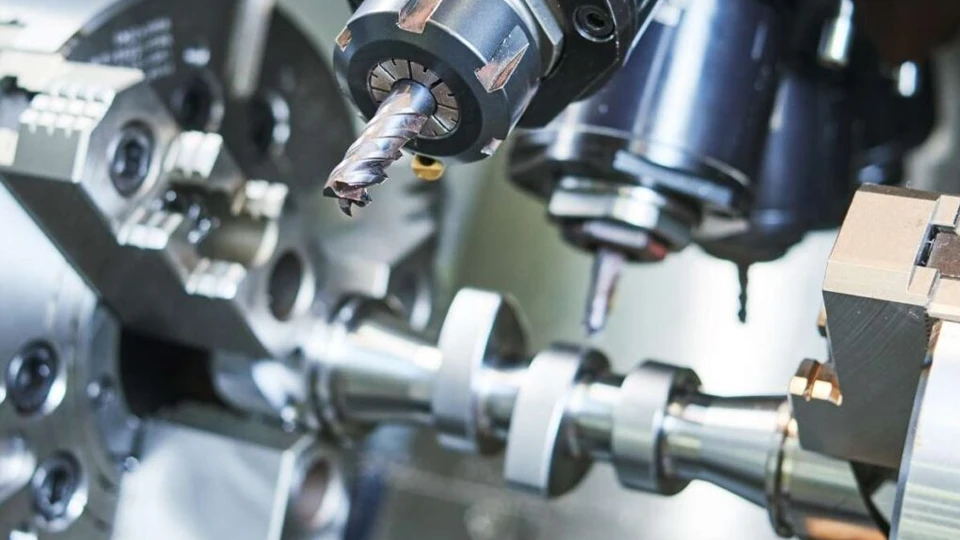
Typical Applications of CNC Turning Centers with Y-Axis
Y-axis turning centers are most commonly applied in production scenarios where turning-based parts also require milled features, off-center geometry, or multiple machining faces. The following applications reflect where the Y-axis provides clear practical value without overextending the role of the machine.
Automotive Components
In automotive manufacturing, Y-axis turning centers are widely used for shaft-type and rotational components that include secondary milled features. Typical examples include flanged shafts, transmission sleeves, couplings, and steering-related components with side holes or milled flats.
These parts often combine high production volumes with tight positional requirements between turned and milled features. The Y-axis allows these features to be produced within a single machining workflow, making it suitable for stable, repeatable automotive production environments.
Aerospace and High-Precision Parts
Aerospace and high-precision industries often deal with lower volumes but higher demands on feature alignment and process consistency. Y-axis turning centers are commonly applied to rotational parts that include functional milled features, such as ports, slots, or mounting interfaces.
In these applications, the emphasis is not on cycle time alone, but on maintaining accurate positional relationships between features while minimizing process variation across small batches.
Precision Machinery and Industrial Components
In general machinery and industrial equipment manufacturing, many components fall between pure turning and pure milling. Valve bodies, connectors, couplings, and similar parts often require both cylindrical features and precisely located milled surfaces.
Y-axis turning centers are well suited to these mixed-geometry components, allowing manufacturers to consolidate operations without resorting to complex part transfers between different machine types.
When a Y-Axis Turning Center Is the Right Choice
A Y-axis turning center is typically the right choice when a part is fundamentally rotational, but includes features that cannot be efficiently produced using XZ turning alone. This includes parts that require off-center features, multiple machining faces, or milled geometry integrated with turned surfaces.
For parts dominated by large planar surfaces or complex freeform geometries, machining centers or multi-axis milling platforms may remain the more appropriate solution.
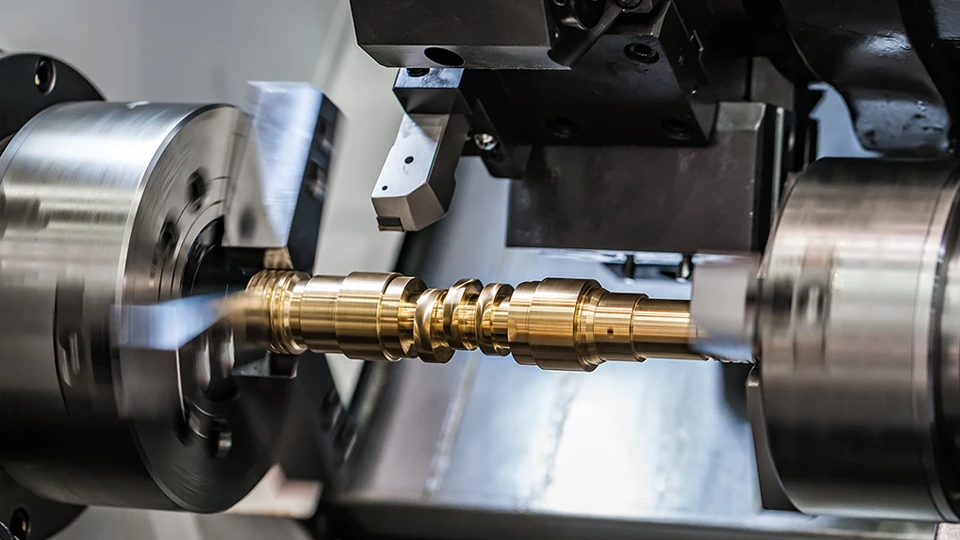
CNC Turning Center with Y-Axis vs Other Machine Tools
When evaluating a Y-axis turning center, it is often compared with other common machine tool types. These comparisons are not about which machine is universally better, but about which machine is more appropriate for a given part geometry and process requirement.
Y-Axis Turning Center vs Conventional CNC Lathe
A conventional CNC lathe is primarily designed for XZ-axis turning operations. It excels at producing rotationally symmetric parts with high efficiency and stable turning performance.
A Y-axis turning center extends this capability by enabling off-center and milled features to be produced without secondary setups. The difference is not in basic turning performance, but in the range of features that can be completed on the same machine platform. For parts that require only pure turning, a conventional CNC lathe remains a straightforward and cost-effective solution.
Y-Axis Turning Center vs Machining Center
Machining centers are optimized for parts dominated by milling operations rather than turning. They offer large working envelopes and strong capability for planar and multi-sided machining.
A Y-axis turning center, by contrast, is optimized for rotational parts that include secondary milled features. It does not replace a machining center, nor is it intended to handle large flat surfaces or extensive freeform geometry. The distinction lies primarily in whether the part is fundamentally rotational or milling-dominated in nature.
Y-Axis Turning Center vs Multi-Tasking and 5-Axis Machines
Multi-tasking and 5-axis machines provide a broader range of motion and greater geometric freedom. They are well suited for complex parts with demanding multi-axis machining requirements.
A Y-axis turning center occupies a more focused position. It offers a balance between capability and complexity, targeting parts that benefit from integrated turning and milling without requiring full multi-axis interpolation. In many cases, this balance results in simpler process planning and easier production control.
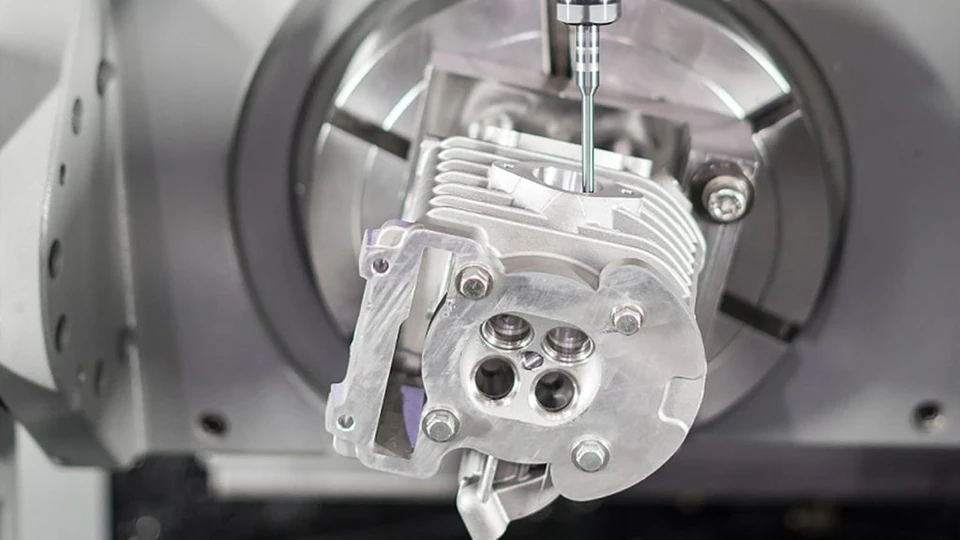
Key Considerations When Choosing a Y-Axis Turning Center
Choosing a Y-axis turning center is not simply about adding more axes, but about determining whether the machine configuration aligns with the actual part and production requirements. The following considerations help clarify when a Y-axis turning center is the appropriate choice.
Part Geometry and Feature Requirements
The first and most important consideration is part geometry. A Y-axis turning center is best suited for parts that are fundamentally rotational, but include off-center features, milled flats, slots, or features distributed across multiple faces.
If the part geometry is dominated by large planar surfaces or complex freeform shapes, a machining center or multi-axis milling platform may be more appropriate. The Y-axis adds flexibility to turning-based parts, but it does not change the core nature of the machine.
It is also important to consider Y-axis travel limits, as the available stroke defines how far off-center features can be reached on a turning center.
Production Volume and Part Mix
Production volume and part variety strongly influence whether a Y-axis turning center makes sense. For medium to high volumes of parts with integrated turning and milling features, consolidating operations on one machine can simplify production flow.
In high-mix, low-volume environments, the ability to complete multiple features in a single setup can reduce process complexity and setup variation. However, for very simple, high-volume turning parts, a conventional CNC lathe may remain the more efficient option.
Initial investment should be considered in relation to production volume and process consolidation, rather than evaluated in isolation.
Accuracy, Repeatability, and Tolerance Needs
When parts require tight positional relationships between turned and milled features, a Y-axis turning center can offer advantages by maintaining all features within a single coordinate system.
This is particularly relevant for functional features that must align precisely, such as mating surfaces, ports, or mounting interfaces. The decision should be driven by tolerance requirements rather than theoretical machine accuracy alone.
Tooling, Automation, and Future Flexibility
A Y-axis turning center should be evaluated as part of a broader production system. Tooling availability, automation options, and the potential for future process expansion all affect long-term suitability.
If future parts are expected to include more integrated features or require greater process consolidation, investing in a Y-axis configuration may provide additional flexibility without moving to more complex machine architectures.
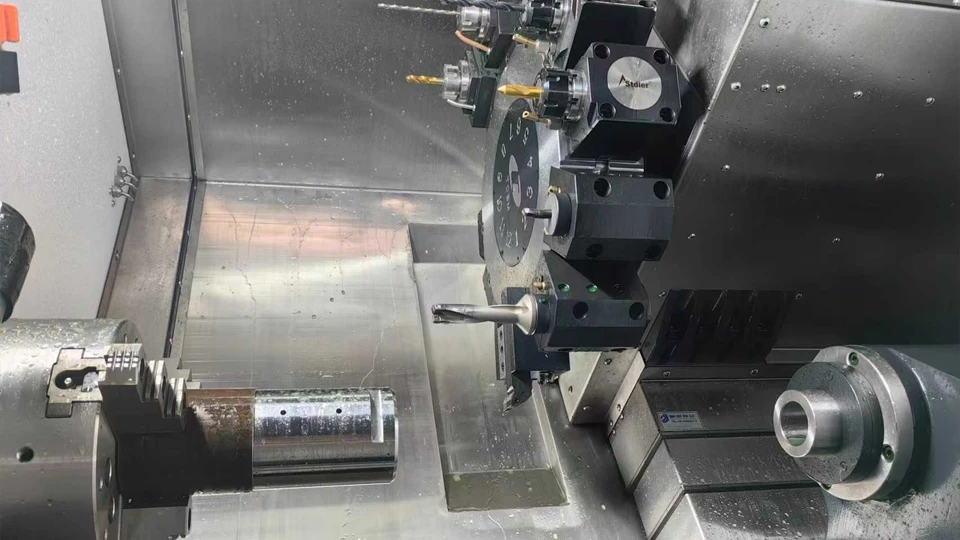
Conclusion
CNC turning centers with Y-axis represent a practical evolution of turning-based machining, not by changing the fundamentals of turning, but by extending what can be achieved within a single, controlled setup. By enabling off-center features, integrated milling operations, and multi-face machining on rotational parts, the Y-axis bridges the gap between traditional lathes and more complex machining systems. When applied in the right scenarios, it simplifies process planning, improves feature consistency, and supports stable, repeatable production without unnecessary complexity.
In real-world manufacturing, choosing and applying this type of machine is rarely about adding more axes, but about matching machine capability to actual shop-floor requirements. This is where experience in machine design and application becomes critical. Rosnok focuses on developing CNC turning centers and machining solutions that align with real production needs, supporting manufacturers in integrating turning and milling in a balanced, reliable way while remaining adaptable to future process demands.