CNC machining keeps evolving, and understanding the difference between 3-axis, 4-axis, and 5-axis systems has become essential for anyone working in modern manufacturing. Many professionals still find the boundary between these setups unclear—when each should be used, and what real advantages they bring. Based on proven industry experience and widely accepted machining principles, this guide will help you grasp the core distinctions and make confident, informed decisions when selecting the right machine configuration for your production goals.
Coordinate System
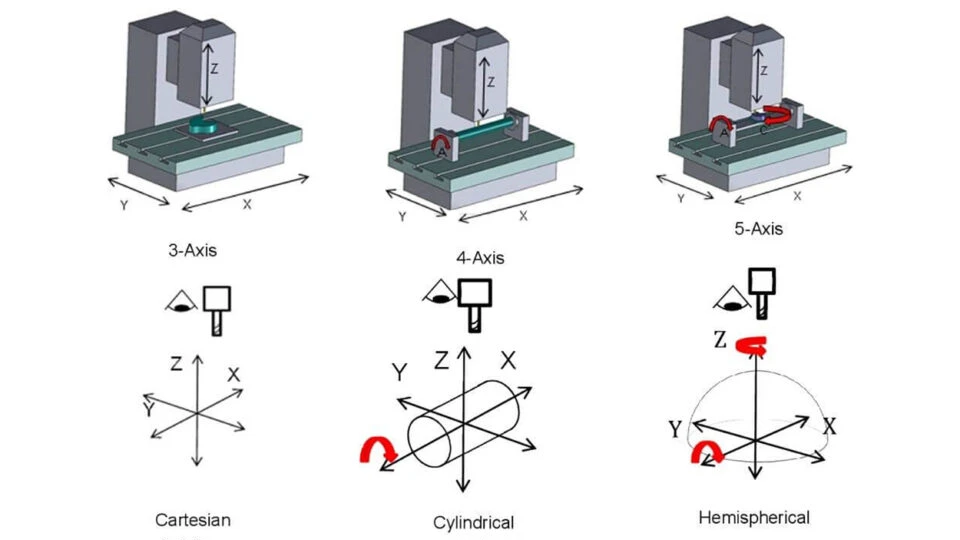
In CNC machining, the coordinate system defines how the machine interprets position and movement in three-dimensional space.
It provides a common language between the tool, the workpiece, and the control software.
Every axis — whether linear or rotational — represents a specific direction or orientation of motion.
By understanding this system, engineers and operators can accurately define paths, maintain precision, and synchronize tool motion across multiple axes.
Linear Axes
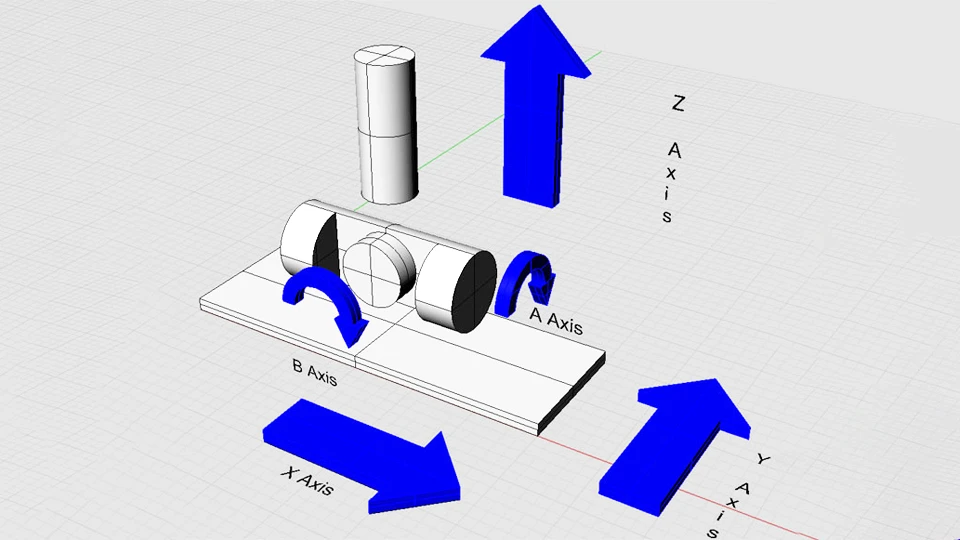
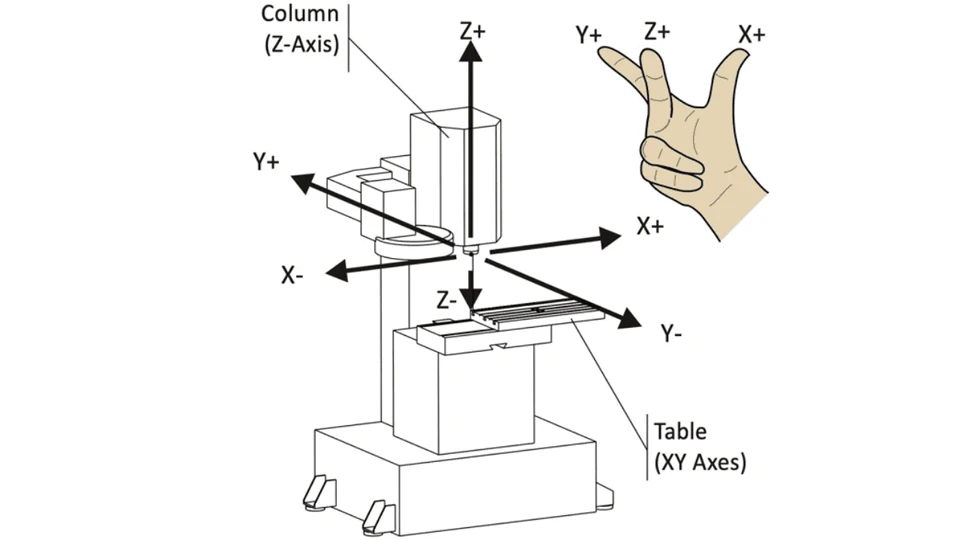
The linear coordinate system consists of three perpendicular directions — X, Y, and Z — which form the foundation of all CNC machine movements.
Each represents translation along a single geometric axis.
- X-Axis:
The X-axis defines horizontal motion from left to right when viewed from the operator’s position.
Positive values move to the right, and negative values move to the left across the horizontal plane. - Y-Axis:
The Y-axis defines motion along the front-to-back direction within the horizontal plane.
Positive values move away from the operator (toward the back), and negative values move toward the operator (to the front). - Z-Axis:
The Z-axis defines motion perpendicular to the horizontal plane, controlling vertical movement.
Positive values move upward (away from the workpiece plane), and negative values move downward (toward the workpiece plane).
These three axes together create a Cartesian coordinate grid.
Their positive and negative directions are defined according to the right-hand rule, where the thumb, index, and middle fingers represent the X, Y, and Z directions respectively.
This standardized system ensures every CNC machine interprets motion consistently, regardless of type or manufacturer.
Rotational Axes
Beyond linear translation, CNC machines also incorporate rotational axes, allowing angular motion around each of the three linear axes.
These are labeled A, B, and C, corresponding respectively to rotation about the X, Y, and Z axes.
All rotational directions follow the right-hand rule—when the thumb points in the positive axis direction, the curled fingers indicate positive rotation.
- C-Axis:
Defines rotation around the Z-axis, producing angular motion in the XY plane.
Positive values rotate counterclockwise when viewed from the positive Z direction.
This axis enables full contouring and synchronized milling-turning functions in complex machining systems. - A-Axis:
Defines rotation around the X-axis, generating angular motion in the YZ plane.
Positive values represent rotation counterclockwise when viewed from the positive X direction.
This axis is typically introduced in 4-axis machining for cylindrical or curved surface operations. - B-Axis:
Defines rotation around the Y-axis, creating angular motion in the XZ plane.
Positive values rotate counterclockwise when viewed from the positive Y direction.
It provides tool tilt capability and is a core feature in many 5-axis machining centers.
By combining angular and linear motion, the system achieves precise multi-directional control—allowing tools to maintain optimal orientation while minimizing setup changes.
Understanding how these axes interact forms the foundation for distinguishing between 3-axis, 4-axis, and 5-axis machining configurations, which we’ll explore next.
What Is 3-Axis CNC Machining?
Definition
3-axis CNC machining refers to a machining process that moves the cutting tool or workpiece along three linear axes — X, Y, and Z.
These three directions define how the tool travels left-to-right, front-to-back, and up-and-down across the workpiece.
It is the simplest and most common form of CNC machining, forming the technological foundation for all advanced multi-axis systems.
In a 3-axis setup, the spindle and tool move precisely along these three directions to remove material, while the workpiece remains stationary on a fixed table or vise.
Every machining operation is executed based on coordinate data from the part program, allowing the system to reproduce complex shapes with high accuracy and consistency.
Capabilities
3-axis CNC machines are ideal for components that can be accessed from a single direction or machining plane.
They are widely used for:
- Face milling and end milling
- Drilling, tapping, and boring
- Pocket cutting, slotting, and contour shaping
- Engraving and flat surface machining
These machines can produce complex 2D and moderately 3D parts efficiently, provided that tool access is not obstructed by part geometry.

Advantages
- High Stability and Reliability: Fewer moving parts reduce the chance of mechanical errors.
- Cost-Effective Operation: Lower machine price and programming costs make it ideal for small and medium-sized manufacturers.
- Ease of Programming: Simple G-code generation and CAM setup reduce operator workload.
- Strong Repeatability: Excellent for high-volume production of standardized metal parts.
- Widespread Compatibility: Most cutting tools, fixtures, and CAM packages are optimized for 3-axis setups.
Limitations
Despite its broad applicability, 3-axis machining has inherent constraints:
- The tool can only approach from one direction, limiting its ability to machine undercuts or complex 3D contours.
- Requires multiple setups for multi-sided parts, increasing both cycle time and potential alignment errors.
- Less efficient for deep cavities or curved shapes that require simultaneous multi-angle cutting.
- Cannot perform true 5-sided machining without repositioning or custom fixturing.
Because of these limitations, manufacturers often adopt 4-axis or 5-axis machines when part complexity or precision requirements exceed the reach of 3-axis capabilities.
What Is 4-Axis CNC Machining?
Definition
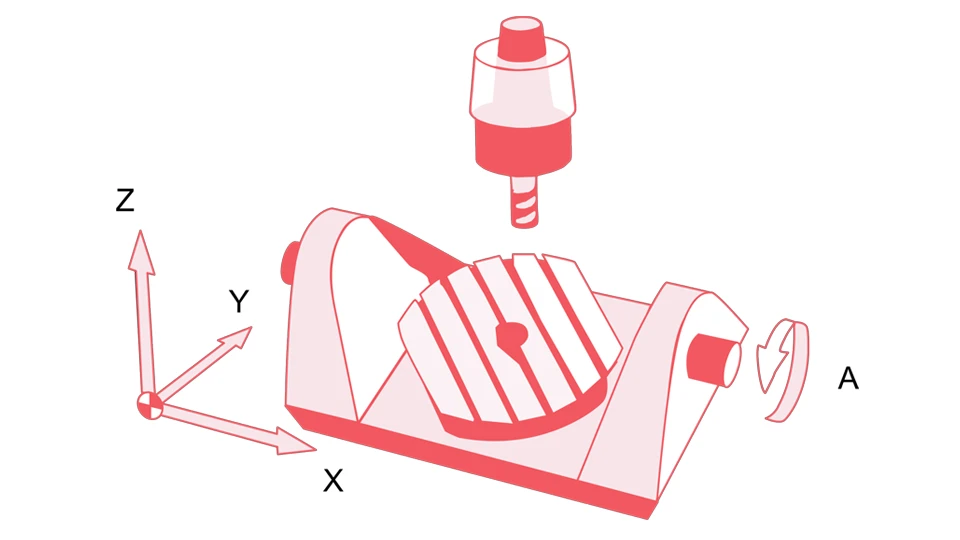
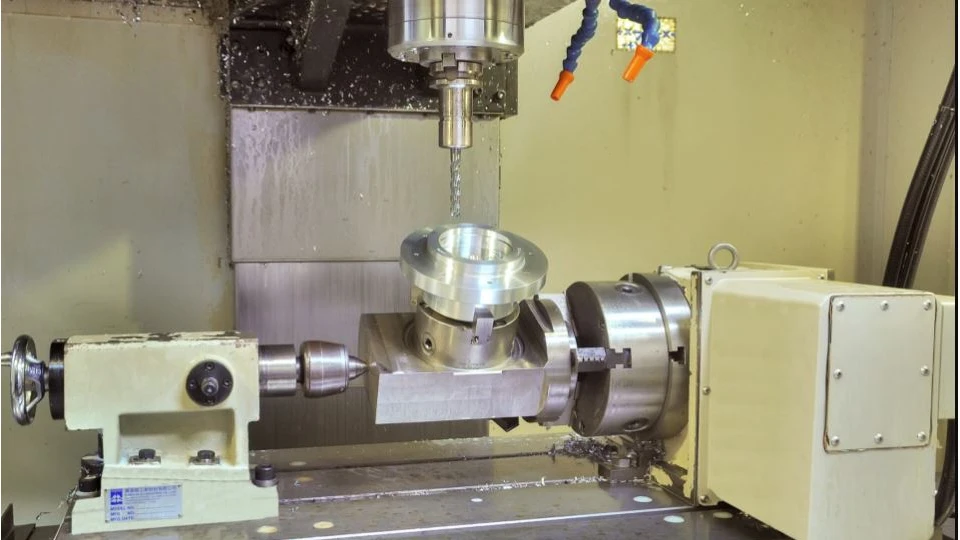
4-axis CNC machining expands the functionality of a traditional 3-axis system by adding one rotational axis — either the A-axis (rotation around X) or B-axis (rotation around Y).
This additional motion allows the workpiece to rotate or index automatically, enabling machining from multiple sides without manual repositioning.
In essence, a 4-axis machine introduces angular flexibility that bridges the gap between standard 3-axis setups and full 5-axis systems.
This configuration is particularly beneficial for parts with features located on different sides or around a central axis, such as gears, camshafts, or turbine discs.
Capabilities
4-axis machining provides enhanced flexibility for components that require work on multiple sides.
Common applications include:
- Machining cylindrical and curved surfaces
- Cutting features on spiral or helical geometries
- Drilling holes or slots on angled planes
- Performing rotary engraving or contour milling
- Producing complex automotive and aerospace parts requiring accurate radial symmetry
These capabilities make 4-axis systems ideal for medium-complexity parts that are too intricate for simple 3-axis setups but don’t require full 5-axis motion.
Advantages
- Reduced Repositioning: The rotary axis allows machining on multiple sides in a single setup, minimizing human error.
- Higher Precision: Fewer clamping and repositioning steps improve accuracy and repeatability.
- Increased Productivity: Simultaneous motion shortens machining cycles and improves surface smoothness.
- Enhanced Surface Quality: Continuous 4-axis toolpaths reduce visible tool marks on curved profiles.
- Better Tool Access: Enables cutting of features that are otherwise difficult to reach with fixed tool orientations.
Limitations
While 4-axis machining provides notable improvements, it also introduces new challenges:
- Programming Complexity: Multi-axis toolpaths require advanced CAM software and skilled operators.
- Higher Machine Cost: The additional rotary axis increases initial investment and maintenance requirements.
- Limited Angular Range: With only one rotational axis, tool orientation is still constrained compared to 5-axis systems.
- Setup Sensitivity: Proper fixture alignment and rotary calibration are essential to maintain tolerance integrity.
For many workshops, 4-axis CNC machining strikes an effective balance between flexibility and cost, offering substantial productivity gains without the full complexity of 5-axis systems.
What Is 5-Axis CNC Machining?
Definition
5-axis CNC machining represents the most advanced form of computer numerical control technology.
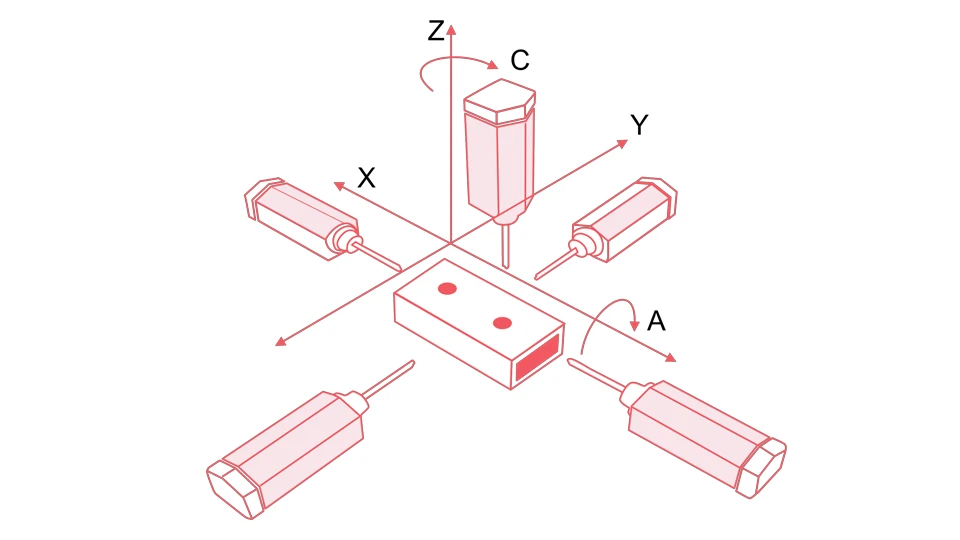
It builds upon the three linear movements (X, Y, and Z) by adding two rotational axes, which differ by configuration — commonly the A-axis (rotation about X) and B-axis (rotation about Y), or A-axis and C-axis (rotation about Z), depending on machine design.
This allows both the tool and workpiece to move in five different directions simultaneously, providing full orientation control during machining.
With 5-axis capability, the tool can approach the workpiece from virtually any angle, eliminating the need for manual repositioning.
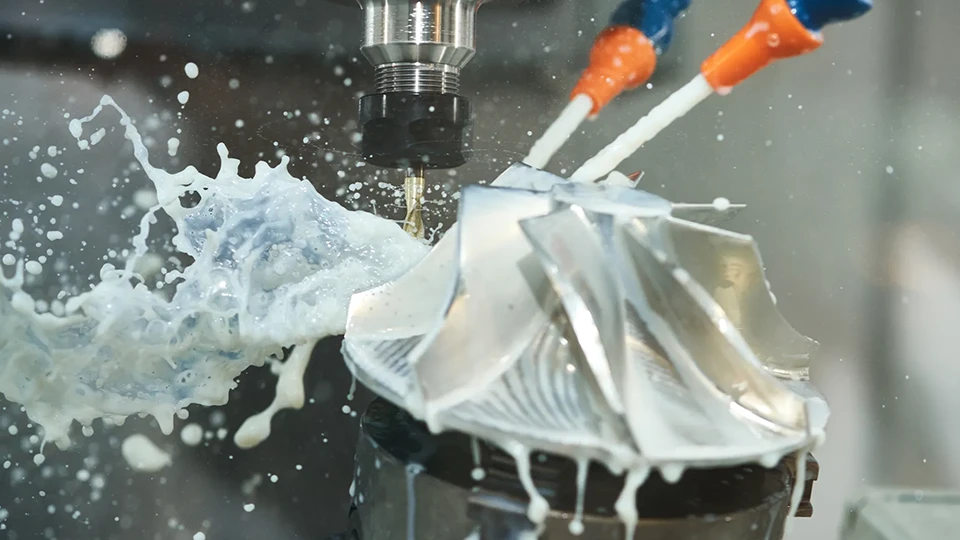
This enables continuous, smooth machining of complex geometries such as impellers, molds, and aerospace components — parts that demand precise multi-surface contouring and exceptional surface quality.
Capabilities
5-axis machining provides unparalleled flexibility and process control for complex parts.
Common applications include:
- Aerospace turbine blades, impellers, and structural housings
- Medical implants and surgical components with organic shapes
- Precision molds with undercuts or multi-angle surfaces
- Automotive engine parts with intricate geometry and deep cavities
- Energy components such as turbines, pumps, and valves
These machines can execute simultaneous 5-axis movement, where all axes operate at once, or 3+2 positioning, where the two rotary axes set the tool orientation before cutting.
Both approaches enable smoother surfaces and more efficient toolpaths for intricate 3D parts.
Advantages (Revised)
- Single-Setup Manufacturing: Machine multi-surface parts in one clamping, minimizing datum transfers and stack-up error.
- Tolerance Retention on Complex Geometry: Fewer re-clamps and stable tool orientation help maintain tight tolerances across multi-face surfaces.
- Superior Surface Continuity: Continuous 5-axis or 3+2 machining keeps the tool normal optimal to curved faces, reducing cusps and visible marks.
- Shorter Tools, Less Deflection: Tilting toward the work area allows shorter tools, lowering deflection and vibration for dimensional consistency.
- Shorter Cycle Time: Fewer setups and more efficient toolpaths improve productivity and reduce downtime.
- Greater Geometric Freedom: Enables machining of shapes and angles impossible or inefficient on 3- or 4-axis systems.
Limitations
Despite its clear superiority, 5-axis CNC machining also brings several challenges:
- High Initial Investment: Machines, tooling, and calibration systems cost significantly more.
- Complex Programming: Advanced CAM software and highly skilled operators are required.
- Potential Overuse: For simple parts, 5-axis may add unnecessary complexity and cost.
- Calibration Sensitivity: Rotary axis alignment errors can affect part quality and require regular compensation.
For shops producing low-volume or simple geometry parts, the cost-to-benefit ratio of 5-axis machines may not justify the investment.
However, for high-value industries — aerospace, medical, and energy — the payoff in productivity and part quality is substantial.
Key Differences Between 3-Axis, 4-Axis, and 5-Axis Machining
The differences between 3-axis, 4-axis, and 5-axis machining lie in how each system balances accessibility, efficiency, and complexity.
The following table provides a clear comparison of their capabilities, requirements, and ideal use cases.
| Feature | 3-Axis Machining | 4-Axis Machining | 5-Axis Machining |
|---|---|---|---|
| Motion Axes | X, Y, Z | X, Y, Z + A (or B) | X, Y, Z + A, B (or A, C / B, C) |
| Workpiece Orientation | Fixed on one plane | Rotates around one axis | Rotates and tilts for full orientation |
| Setup Frequency | Multiple setups required | Reduced setups | One setup for multi-surface machining |
| Machinable Geometry | Simple flat or prismatic | Cylindrical and angled features | Complex freeform and contoured surfaces |
| Cycle Time | Longer due to repositioning | Moderate | Shortest due to continuous motion |
| Programming Complexity | Basic G-code | Intermediate CAM setup | Advanced CAM and postprocessing |
| Operator Skill Level | Standard machinist | Skilled programmer | Highly experienced multi-axis operator |
| Tool Access | Limited approach directions | Improved access on one rotation axis | Full tool orientation flexibility |
| Investment Cost | Low | Medium | High |
| Typical Use | General metal parts, molds, plates | Shafts, gears, curved housings | Aerospace, medical, high-value molds |
3-axis machining remains reliable for simple geometries, 4-axis improves throughput and accessibility, and 5-axis delivers full control for intricate, high-value parts.
Choosing the right system depends on part complexity, production scale, and investment priorities — not merely on having more axes.
Is There 6-Axis and/or 7-Axis Machining?
As CNC technology continues to evolve, many manufacturers and engineers wonder whether systems beyond 5-axis — such as 6-axis or 7-axis machining — actually exist and how they differ from conventional setups.
While the idea sounds advanced, the reality is more nuanced: these machines do exist, but their application is highly specialized.
6-Axis Machining
A 6-axis CNC machine extends traditional 5-axis configurations by incorporating three linear axes (X, Y, Z) and three rotational axes (A, B, C) — with the sixth motion often represented by a secondary rotary or sliding axis, such as table translation or spindle head tilt, to enhance tool approach flexibility and contouring accuracy.
This allows simultaneous rotation and tilt along multiple axes, improving tool approach angles and minimizing repositioning even further.
In practice, 6-axis systems are primarily used in aerospace, robotics, and high-precision component manufacturing, where continuous contouring and complex surface finishing are required.
They provide smoother tool paths, shorter cycle times, and improved surface consistency, but their cost and programming complexity limit adoption for general manufacturing.
In short, 6-axis machines offer greater freedom of motion, yet their benefits are most noticeable in ultra-complex or high-volume automated operations, rather than everyday metal part machining.
7-Axis Machining
A 7-axis CNC system represents an advanced hybrid configuration that combines three linear axes (X, Y, Z), three rotational axes (A, B, C), and one additional axis — typically a worktable translation or tool arm articulation — enabling near-unlimited movement and orientation control.
This design is commonly found in robotic milling and hybrid machining centers, enabling almost unrestricted tool positioning around the workpiece.
7-axis systems are capable of machining from almost any direction without re-clamping, offering exceptional flexibility for sculpted or organic surfaces.
They are primarily used in robotic milling, advanced aerospace components, and custom medical implants, where continuous orientation control and automation efficiency are critical.
However, their complexity comes with trade-offs: programming requires advanced post-processors, simulation, and highly trained operators.
For most industrial applications, the performance gains do not justify the significantly higher investment.
Why 5-Axis Remains the Industry Standard
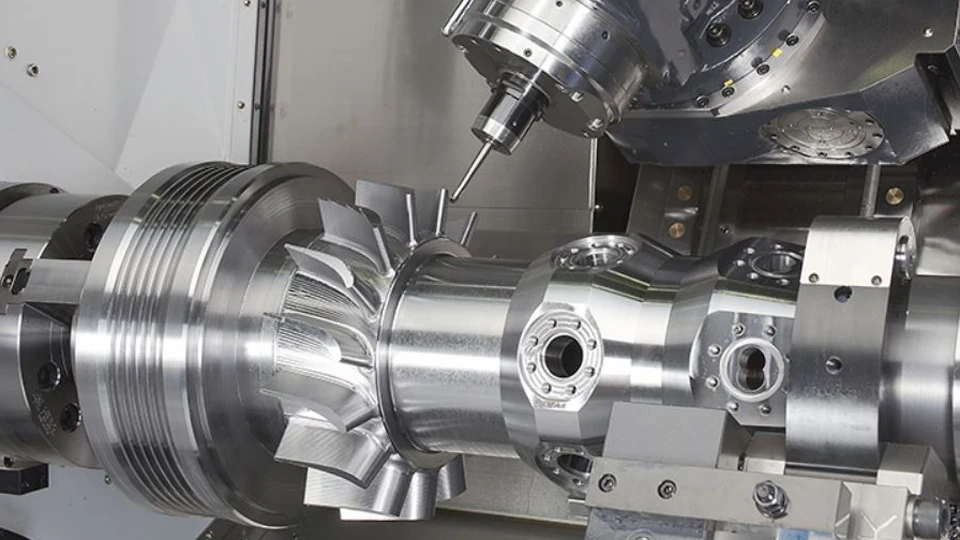
While 6-axis and 7-axis systems represent the cutting edge of CNC technology, 5-axis machining remains the global industry benchmark.
It provides an ideal balance between capability, cost, and reliability — allowing complex contouring, efficient setups, and high-quality finishes without the exponential jump in maintenance or programming demands.
For 99% of precision machining applications — from aerospace impellers to medical components — a well-calibrated 5-axis CNC offers all the flexibility and precision needed.
How to Choose the Right Axis System for Your Shop
Selecting the right CNC axis configuration is not just a technical decision — it’s a business strategy.
Every shop’s success depends on balancing part complexity, production goals, operator skill, and return on investment.
The following five steps provide a practical framework for choosing the right system for your operation.
Step 1: Assess Part Geometry and Material
Start by analyzing your typical part geometry.
If your components are flat, prismatic, or single-sided, a 3-axis CNC machine will handle them efficiently.
If parts require features on multiple sides or around a cylindrical form, 4-axis machining provides a major productivity boost.
For complex surfaces, undercuts, or compound angles, a 5-axis machine is the right tool.
Material hardness also plays a role — tougher metals benefit from shorter tools and better approach angles, both strengths of multi-axis setups.
Step 2: Consider Production Volume and Setup Time
Production volume determines how much setup time you can afford per batch.
In low-volume or custom jobs, multiple setups on a 3-axis machine may be acceptable.
But when you scale to medium or high-volume production, the time lost in manual repositioning quickly adds up.
4-axis and 5-axis machines reduce or eliminate these extra setups, providing consistent alignment and faster throughput — crucial for high-mix, high-precision manufacturing.
Step 3: Match Complexity to Capability
One of the most common mistakes is overinvesting in unused capability.
A 5-axis machine isn’t automatically better if your parts don’t need multi-angle machining.
Match your system to the highest complexity level you regularly produce.
A balanced shop often operates multiple systems — for example, 3-axis for standard milling and 5-axis for high-end contouring — achieving optimal utilization and cost control.
Step 4: Evaluate Operator Skills and CAM Software Readiness
Even the most advanced machine is only as good as the team operating it.
3-axis systems are straightforward to program and run, suitable for most machinists.
4-axis requires intermediate CAM knowledge, while 5-axis demands specialized software, post-processors, and experience in collision avoidance and toolpath optimization.
Before upgrading, ensure your team has the right training and your CAM environment can handle complex multi-axis data flow.
Step 5: Calculate ROI (Return on Investment)
A CNC machine purchase should always be viewed as an investment, not an expense.
Calculate ROI by comparing machine cost, cycle time savings, and reduced labor hours.
Sometimes a more expensive machine delivers a faster payback because of shorter setups and improved quality consistency.
Use your production data — cycle times, rejection rates, tool wear — to build a clear financial projection before committing to a new axis system.
Common Misunderstandings About Axis Count and Precision
In CNC machining, one of the most widespread misconceptions is that a higher axis count automatically means higher precision.
While additional axes increase flexibility and efficiency, they do not directly improve a machine’s inherent accuracy.
Precision is determined by far more fundamental engineering factors.
1. Axis Count ≠ Machine Accuracy
The number of axes defines how a machine moves, not how precisely it moves.
A 5-axis system can reach more angles than a 3-axis machine, but both rely on the same core elements for precision — servo resolution, mechanical rigidity, spindle quality, and control feedback loops.
A poorly tuned 5-axis machine may produce less accurate parts than a well-maintained 3-axis system.
2. True Accuracy Comes from Structure and Control
Machine accuracy depends primarily on:
- Rigidity: Stable castings and well-balanced drives resist vibration and deflection.
- Thermal stability: Proper cooling and compensation prevent drift during long runs.
- Servo and encoder resolution: Determines how finely motion can be controlled.
- Calibration and alignment: Regular verification ensures each axis remains in sync.
- Tooling and fixturing: High-quality fixtures and sharp tools minimize micro-movement and surface deviation.
These structural and control factors define repeatable, predictable accuracy — not the number of controlled axes.
3. What Extra Axes Actually Provide
So, if they don’t make a machine “more precise,” what do extra axes add?
The answer: accessibility and efficiency.
- Multi-axis motion reduces re-clamping and cumulative setup error.
- The tool maintains better cutting orientation, improving surface finish.
- Cycle times shorten as more features can be machined in a single setup.
In other words, extra axes improve process capability, not dimensional precision.
They allow your precision to be maintained across complex geometries — not created by the axis count itself.
Conclusion
Understanding the difference between 3-axis, 4-axis, and 5-axis CNC machining isn’t just about knowing how many directions a tool can move — it’s about understanding how technology, process, and purpose come together to achieve precision efficiently. 3-axis systems remain the foundation for reliable, cost-effective production; 4-axis systems bring flexibility for multi-sided and cylindrical work; and 5-axis systems deliver complete geometric control for complex surfaces in one setup. The number of axes doesn’t define quality — the right configuration, calibration, and operator skill do. In the end, mastering CNC machining means matching the machine’s capability with the exact needs of your parts, your workflow, and your business goals.
At Rosnok, this is exactly how we build machines — not to impress on paper, but to perform on the shop floor. Every spindle, slideway, and controller is designed with the same goal: stable accuracy, practical operation, and easy maintenance. Some customers start with a 3-axis mill and later move to 5-axis production; others need both running side by side. We make sure each step feels natural, reliable, and worth the investment. Because when a machine fits the work perfectly, it stops being a product — it becomes part of your production rhythm. That’s what we aim for at Rosnok.